I accidentally wrote a poem.
‘Would you like to contribute something to an art exhibition on ancient grassland fungi that I’m organizing?’, asked Katie.
I demurred. ‘I’m no artist, I just write. No one wants to stand in an exhibition and read an essay.’
‘Have a think’, she encouraged.
So I did. I knew what I wanted to write about. I knew that, having spent years researching local agricultural history and its complex but often positive relationship to the biodiversity in this landscape, I wanted to acknowledge the role that generations of local farmers had had in the survival of these fungi. But how could I do it in a way that was going to fit in alongside ceramics and sculpture, weaving and drawings and paintings?
It would need to be creative, and also succinct. I should have spotted where this was going, but I somehow failed to see it coming. I spent about a year or so, around the age of 16, writing dreadful poems about hills and hillwalking. But since then I hadn’t dared try again. I had no intention of trying now, and besides, there were proper poets who would be contributing to the exhibition.
But then, after I had researched the themes I wanted in the piece and had mulled ideas for the images I wanted to convey, when I came to write, out it tumbled, and when I was finished and squinted at the page, I was nonplussed to find it appeared to be a poem, of sorts.
It fitted into the exhibition much better than an essay would have, and in that sense I was pleased with it. But there is a recovering academic in me that rebels at condensing information into a line so that it looks good on the page, that grudges obscuring material behind an expression that sounds well in the ear, that values clarity of meaning and effectiveness of communication over a pleasing turn of phrase. This part of me is a philistine, and I apologise on its behalf to Clare and Ian and Simon and Emily and Zaffar and other local poets I know and admire. But I am going to indulge its wish to do a most ridiculous thing: to explain the poem.
This part of me that wants footnotes and references and wants sentences that start, ‘Consequently…’, doesn’t care that poems are like jokes: if you find yourself having to explain one, then either your poem is not very good, or you’ve misunderstood the nature of poetry. But besides admitting to guilt on both counts, I think I can defend this perverse need to elucidate the unintentional verses, on the grounds that not only did I not mean to write them in the first place, but also that doing so is a way of continuing with my ongoing project of exploring the history of local farming.
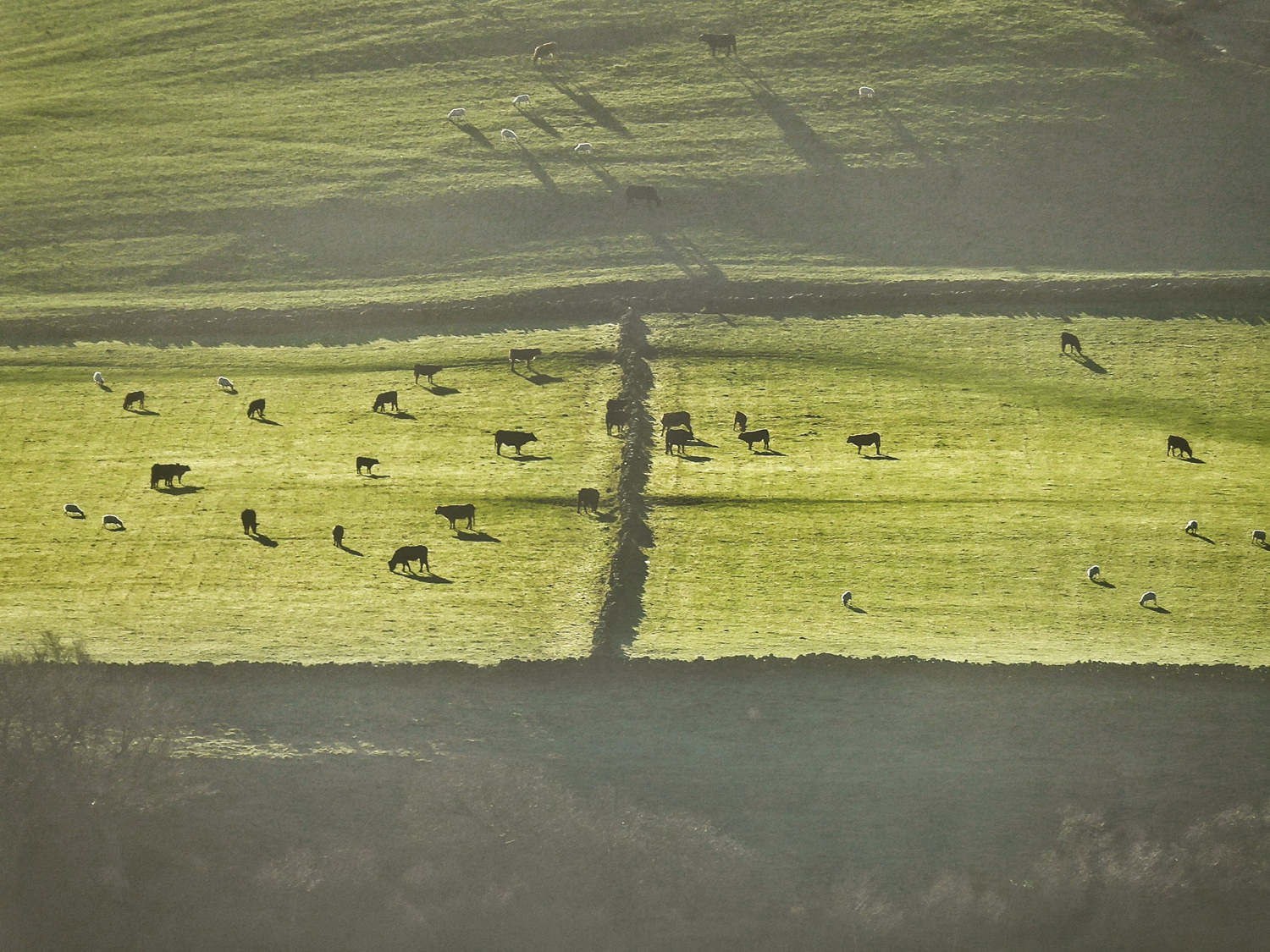
So here is my accidental poem, my nod of respect to the generations of farmers in whose fields these fungi thrive. The image below—with the verses overlaying a faded photo of mine—was displayed in a frame at Gibson Mill, Luddenden Foot Community Centre and now Hebden Bridge Town Hall (11th February to 8th March), and below I will spoil it by explaining, line by line, what it all means.

The ancient grasslands of this valley are jigsawed / Into 10,000 fields
It can be difficult to think of the Pennines as containing ancient grasslands. For one, the myth of the unbroken primeval wildwood is a stubborn one. Defying decades of ecological reassessment, its persistence means that many still think that, almost by definition, a grassy field cannot be ancient, since it must have been relatively recently deforested by our destructive ancestors.
While there was no way I could enter into the contested terrain of how our ecology has evolved over the millennia, I did want to see if I could address another barrier to thinking of our local fields as ancient grasslands—that barrier being that the very term ‘ancient grasslands’ is apt to conjure unbroken green plains, like the savannah or the Pampas or the steppe. I wanted to suggest an image of our rolling green ‘tops’ as a great tract of open country, but one that happens to be made up of thousands of smaller pieces, like a jigsaw. Of course, the dry stone walls that do the dividing—one of the defining features of the Pennine landscape—are difficult to visually discount, but it is an imaginative leap which I wanted to encourage.
As for that jigsaw being a 10,000-piece edition, I will show my workings. We are lucky that the 19th-century editions of the 25-inch Ordnance Survey maps give the acreage of each and every field down to three decimal places. By ranging across these maps, one can eyeball that the average field size in the upper valley is probably a shade under three acres. Fields under one acre are uncommon, those of four and over are plentiful, but they are much less frequent than those between one and three acres, which are by far the most widespread. So, let’s call the average three acres.
Now at an average of three acres, 10,000 fields cover 30,000 acres. So how much of ‘this valley‘ am I referring to in my poem? In ‘A History of Farming in the Upper Calder Valley‘, I specified that my study area is constituted by the five ancient townships of Langfield, Erringden, Heptonstall, Wadsworth and Stansfield (roughly, between Mytholmroyd and Cornholme), and that within this area there are approximately 12,000 acres enclosed within fields, so I am clearly referring to a wider area. Indeed, I actually had in mind for my poem the whole watershed of the upper Calder Valley down to Sowerby Bridge. That would incorporate the additional townships of Todmorden and Walsden, Midgley, Warley, Sowerby and Soyland. Or, to put it in the more topographically natural terms of the catchments of the various watercourses within the area, I mean the Calder from Portsmouth down to Todmorden, the Walsden Water, Colden Water and Hebden Water, as well as Luddenden Brook, Cragg Brook and the River Ryburne. Within their catchments, there is around 30,000 acres of enclosed land, or, very roughly, 10,000 fields.

…tended by a 20-generation lineage.
At 25 years per generation, 20 generations spans 500 years. The oldest fields in the district may be upwards of 700 years old, while the youngest, dating from the last days of enclosure in the 1860s, are a mere 160 years old. So, while it took a line of 20 or more generations of farmers to look after the older fields, the younger have only been around for six generations.
This brings us back again to that question of how ancient these grasslands really are. You might wonder whether those younger fields truly qualify as ancient grasslands. Unlike ancient woodland—defined in England as woodland with ecological or documentary evidence of continuous cover since at least 1600—there is no universally agreed definition for ancient grassland. Ecologists are still debating the criteria, but even the strictest proposals only set the threshold at 1840. Other definitions suggest a minimum age of a century, or even as recent as World War II. So all the fields of the valley that have not been ploughed and resown count as ancient grassland according to this definition.
But remember, I have only been discussing how old the field is—how long ago it was formally enclosed within a dry stone wall, and thus appears on maps or in valuation surveys or deeds. This does not tell us how old the grassland itself is. If, prior to the creation of the field, there was already a grassland habitat there, and its botanical and fungal assemblage was preserved by agricultural practices, then the grassland may be counted as much older than the field that now happens to contain it. Whether extensive areas of current grasslands are so is the contested ecological question.
In seasonal cycles that suited farmer-clothier and fungi alike.
With the reference to ‘seasonal cycles‘ I wanted to set up the subtle references in the rest of the poem to certain points—turning out the cattle from the barn, liming, haymaking, muck spreading, winter walling—in the farming calendar. And ‘farmer-clothier‘ is intended to set the scene for some of the allusions to the dual existence that local farmers led, deriving as they did a livelihood not only from subsistence agriculture, but also from handloom weaving.
I say that these seasonal cycles ‘suited farmer-clothier and fungi alike‘ because, although farmers did not tailor the cycle and balance of grazing, mowing and fertilising for the benefit of the fungi, their management for productive agricultural ends was clearly apt to sustain the fungi we find in their fields today. Farming of the kind practiced over the past five centuries evidently did not deviate too much from the conditions of the natural ecosystems in which these fungi evolved. However, since we have little understanding of the local abundance and distribution of ancient grassland fungi prior to the advent of farming, we should be equally open to two possibilities: either that there are fewer fungi, or less diversity, than there would have been otherwise, or else that some areas may sport more fungi, of greater diversity, than pre-human ecosystems. The latter is a tantalising deviation from the assumption that human activities, particularly farming, always and only harms the natural world: perhaps the current array of fungi for which Calderdale is increasingly being noted is here not despite of farming practices, but because of them.

Each had a name, the farming families and their fields, / Almost lost now, in Baptist cemetery, on archived map.
These farming predecessors are, I wanted to remind readers, still here in a sense, scattered within the landscape in the hilltop cemeteries of nonconformist chapels—Baptist and Methodist—at Slack and Blackshaw Head, Blake Dean and Wainsgate, Lumbutts and Shore and others.
I wanted to bring the little scenes from the history of the landscape that would make up the rest of the poem to life, to bring home that the abstract past was once a real and concrete present. Naming was the way I chose to do that—naming the farmers, and naming the very fields that we find the fungi in today.
However, I did not want to name either particular historical people, or particular, real fields. This was partly for reasons of sensitivity, for some of the farming families that remain can trace their lineage back for many generations, and many of the fields are still worked by them. It was also so that the scenes would be representative rather than tied to particular places or people. I wanted, instead, to find a balance between fact and fiction for both the farmers’ names and the field names.
For the farmers’ names, I combed the censuses of the five townships between Todmorden and Mytholmroyd from 1841–1911, making a list of about 25 for each of the top recurring surnames, male names and female names. I then experimented with combining them to name my characters. In doing so, I took note of names that were popular in different periods, choosing older names for scenes I had in mind as taking place earlier in the half-millennium period my poem spans, and more recent names for scenes I conceived as being closer to the present.
It may be a surprise to some that every individual field has a name, but it stands to reason that farmers would want to refer to each parcel of their holding. Farmers still do so, although no doubt some of the names have changed over time; it would be interesting to study the extent to which historical field names survive into modern times. These names are not to be found on the normal Ordnance Survey maps, but rather historical deeds, conveyances, wills and valuations. I was lucky enough that local historian Nigel Smith granted me access to his painstaking transcription of the 1805 valuation for the township of Stansfield, which covered the present-day parish of Blackshaw and part of the parish of Todmorden. This extraordinary resource lists the names of the nearly 3,000 enclosures within the township, together with their owners and occupiers. Again, as with the census, I noted down common names, grouping them into the various names for fields—croft, close, ing, hey, royd, lee, fold, meadow, and so on—and then the adjectives that were attached to them, such as colour (brown, white, green, black), location (far/near, upper/lower, top/bottom), age (new/old), or some other feature concerning their terrain or topography (hanging, holes, slack, stony, hollow, rake, end, brink, law, delph, rough, and so on). And again I experimented with combining them in various ways, constrained by the etymology—some combinations would not make topographical or historical sense. I won’t explain what each of the landscape feature terms mean, as I intend to write a separate essay about the lexicon of the local landscape at a future date. But the result of the exercise was six field names (some of which do make an appearance in the Stansfield Valuation, and some that do not) that bore a relation to the scene and the event in the farming calendar I was describing. I will explain each one as we come to it.

The reason I wanted to refer to concrete (albeit fictionalised) individual farmers and fields was that I think our landscape’s past can feel abstract to many. In an urbanised society—even in a relatively rural area like the Calder Valley—only a small percentage of people work in land-based occupations that would connect them to the farming traditions that shaped the countryside. Moreover, most do not have a tangible ancestral connection to the generations of farmers who once shaped the landscape to draw upon for that connection. The more immediate forebears of today’s residents of the towns of the Calder Valley were likely engaged in its industrial rather than agricultural past. And, due to gentrification meaning that former farmhouses now often sell for £500,000–£800,000, making them homes primarily for people from outside the area, these newer residents of the rural areas of the Calder Valley do not have a familial attachment to the local landscape to make its past less abstract.
This distillation of the language of the landscape and its people into the names of six farmers and six fields was my attempt to preserve a little of the heritage of generations of farming families and their connection to the land.
But let us remember a few, and imagine their encounters / With the hidden harvest of fungi we yet reap from their efforts:
And here I am cueing up the following six verses, these little scenes in which I am imagining the farmers going about their business among the ancient grassland fungi. For a while I toyed with the idea of including in the scenes the characters actually noticing, perhaps sometimes stooping to pick up, the fungi, but in the end I reined back on that idea. I found it too difficult to be certain how much our predecessors in the field would have been aware of them. It’s certainly the case that most people today are barely aware of them, although the average walker does not look closely at the sward the way a farmer does—at how it is growing, at the spreading of the molehills which will compromise the quality of the hay harvest and bend the mower’s blades, at whether that work on the field drain in the winter has had the desired effect. But even so, many species of ancient grassland fungi are extremely inconspicuous, so I contented myself with each of the six farmer’s ‘encounters‘ being more minimal, and not depending on them having much or even any awareness of the fungi.
This is what I am getting at with the phrase ‘hidden harvest‘, which I also chose as the poem’s title; the fungi are hidden in the sward, and they were, I suspect, mostly at the edge of the awareness of past farmers, and beyond the edge for most current non-farming residents. But thanks to the efforts of ecologists, especially Steve Hindle, the Ancient Grasslands Officer of the National Trust, we are increasingly aware of and therefore able to appreciate these little gems. This enjoyment is, I am suggesting, a different kind of harvest than that gathered by farmers, but it is one that we can reap if we attend closely.

Abraham Sutcliffe’s graving spade slices sod, roots out rock,
In the first of the six, three-line stanzas, I conceived of the scene as being at the beginning of the 500-year span of local agricultural history I had in mind. I therefore chose an older-sounding name in ‘Abraham’, and Sutcliffe has always been a classic Calder Valley surname.
I also chose for it the originating act of creating a field; that of digging it over. As I explained in ‘A History of Farming in the Upper Calder Valley‘, ‘carving these fields out of the moor required unimaginable labour. Rocks and the roots of tough moorland vegetation were painstakingly excavated using the locally distinctive graving spade, a wrought-iron-bladed tool used by one labourer, who would slice into the turf and push it forward, while a second, using a tool called a hack, would turn the turf over…The cleared land was initially used for crops like oats or potatoes, which could be grown for a few years before the soil was exhausted. Afterward, the land was turned into permanent grassland.’
This labour of creating a field, which also of course would involve constructing a dry stone wall to enclose it and underground field drains to keep the soil from waterlogging, was the one agricultural action in my selection of six which cannot have been good for the fungi. As I say, it involved ‘slicing sod‘ and rooting out rock, which must have damaged and disrupted the subterranean networks of mycelia. But since every field originated with this treatment, and given many still harbour ancient grassland fungi, we know that they must recover. The interesting question is how long they take to do so.
His umber acre of waste greened ever after…
Answering the question of how long ancient grassland fungi take to recover from the disruption of the field having been ‘graved’ at its creation is complicated not only by the fact that dating fields is not always straightforward, but also by the fact that we do not know how each field has been used over the centuries. For while I said above, and suggested with ‘greened ever after‘, that after an initial crop of oats or potatoes, these fields were put down permanently to grass, this was not strictly true for a certain proportion of them.

To quote again from my history article, ‘Today, there is no arable farming in the Upper Calder Valley, but historically, this was a significant part of the agricultural landscape. The primary crop grown was oats, with small amounts of wheat and rye…It seems likely that a form of convertible husbandry was practiced in the valley, where fields would alternate between oats and grassland in a rotation, lasting anywhere between three and twelve years. This rotation helped mitigate the rapid depletion of the soil’s fertility caused by arable farming.’
Oats were grown in the Calder Valley from at least the 12th century, although it declined somewhat from the 1300s as the climate cooled, and died out altogether by 1880s, with a brief revival during the war years when the government required farmers to turn a few of each of their fields over to oats, or in some cases, root crops. Apart from this last episode during the 1940s (for which we have the National Farm Survey, which details which fields were put to oats), we do not know exactly which fields were part of the historic rotation. This is a shame, as in his extensive surveying for ancient grassland fungi, Steve Hindle finds some fields contain an abundance and some hardly any, and if we had records, we might be able to test the theory that the impoverished fields were more recently used for oats. It seems reasonable to assume, though, that this difference might be accounted for by whether a field was repeatedly turned over to crops across centuries, or was, as will have been the case for many, ‘greened ever after‘ subsequent to their initial graving.
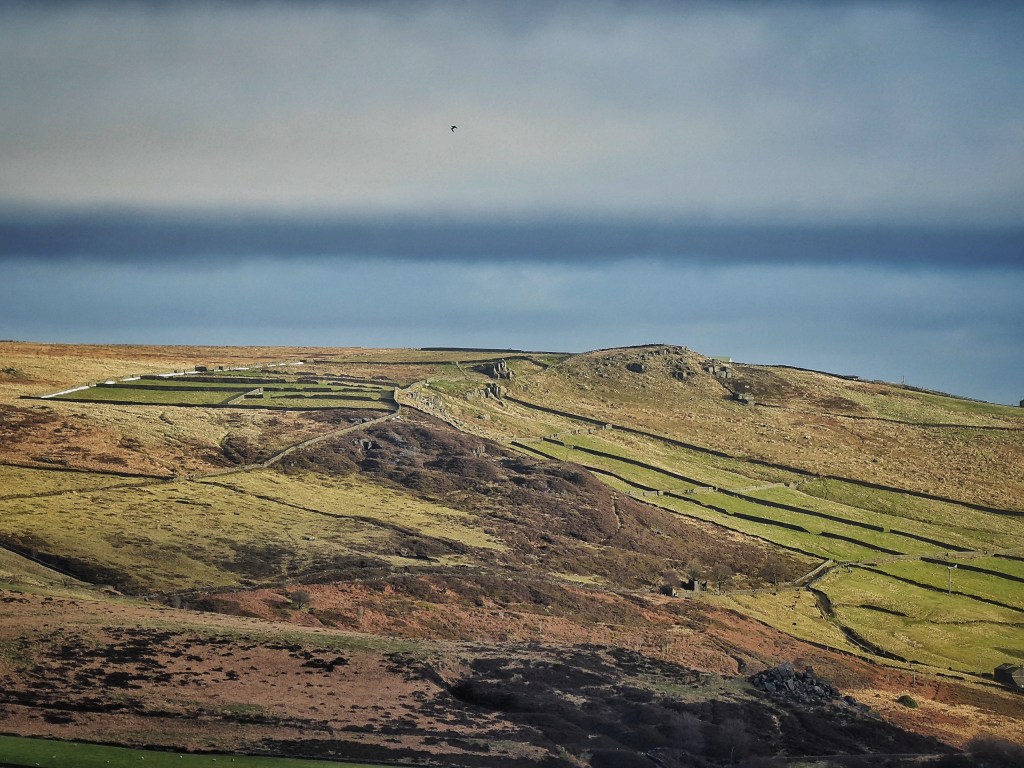
New enclosures—often called ‘intakes’—were ‘taken in’ from what was called the ‘waste‘, which was the rather derogatory term for the unimproved soils and vegetation of the moor. For much of the year, these areas have an overall brown, or ‘umber‘, hue. During the final throes of the enclosure movement in the mid-19th century, green fields were muscled up onto the moors to the limits of cultivation at 1,400 feet, but prior to this the ‘waste’ stretched much further down the hillsides than they do today; the few lower-altitude areas that escaped enclosure exhibit very moor-like vegetation, and can be found down to just a little above 700 feet.
…into Far Greave Meadow
For this first of the field names, I imagined Abraham Sutcliffe creating what would become a meadow. A meadow is a field from which stock is excluded in spring to allow the grass to grow, which is then mown in summer to preserve for winter fodder. They would typically be close to the farmhouse and its barn, so that the hay did not have to be carried too far for storing, so the element ‘Far’ did not necessarily mean it was very far away, just that it was the furthest away of the meadows. The others might have been called ‘Near’ and ‘Middle’, for instance.
The ‘Greave’ element in the name is from the Old English ‘grǣfe’, meaning ‘copse’. It does not necessarily suggest that there was woodland present at the time of the naming; the name might have been attached to that part of the landscape long before Abraham Sutcliffe’s labour and the naming of his field.
There is only one instance of the ‘greave’ element in a field name in the 1805 Stansfield Valuation, but it occurs in the names of several farms in the district, such as Good Greave, Mare Greave and Raistrick Greave. However, since I have always found the word evocative, I think because these farmhouses are derelict and so I cannot help hearing it as ‘grieve’, I decided I’d like to use it.
For five centuries of successors to steward its soil…
Here I am reiterating the span of the agricultural history covered by the poem, a span in which farmers at either end would recognise each other’s cycles and methods, if not their tools. But what I am also doing is mitigating the damage that Abraham has done to the mycelia in Far Greave Meadow, absolving him a little. Yes, he has uprooted and churned its threads, and set its network back a few centuries, but he and his successors, with their stewardship, will allow the unwitting injury to heal, and redress the unintentional harm.

…and pinkgill mycelia;
And finally we come to the fungi itself. Ancient grassland fungi are prosaically known to mycologists as CHEG-D fungi. Each letter represents a different group of fungi. I picked one from each of the groups (plus an extra C) for each of my six verses. Pinkgills are the E group, Entomola.
This is a good time to make clear that I am no mycologist. Indeed, fungi have always and continue to be a significant blind spot in my natural history knowledge. But my son and I have had the privilege of joining Steve Hindle on two surveys at High Hirst Woodmeadow. Steve and I are members of the scything team for this community-run project, so we are there each summer replicating the traditional management which has kept it such a valuable site for fungi and for wild flowers. And then in the autumn, my son and I join a team of volunteers who comb the site in a line like police at a crime scene, planting little yellow flags beside any and all mushrooms that we see, which Steve then visits one by one to identify. At the first survey in 2022, we found 35 different species, two of which are classified as ‘near threatened’ on the UK Red Data List, and four of which are globally threatened species, classed as vulnerable on the International Union for Conservation of Nature (IUCN) classification scale. On the basis of these, High Hirst Woodmeadow was designated a Local Wildlife Site. At the second survey, in 2023, we (well, Steve) found a specimen that, after DNA analysis, was declared new to science, and the criteria for having High Hirst designated a SSSI were met (not that it will be, but it could). On both surveys, we found three species of pinkgills—lilac, star and square spored—and it was these I had in mind for Abraham’s encounter.

After carding and spinning the long day, young Alice Hartley
This is the first reference to the textile side of the economy in which the little hill farms of the Calder Valley were engaged. The whole family was involved, and so here I imagine a young girl, perhaps 11 or 12 years old, having spent the day using hand carders with iron pins to separate and straighten wool fibres, and spinning on a great wheel or using a drop spindle. She would also have other jobs in the process, picking the raw wool clean and greasing it before carding and spinning, and then washing and drying it, all before her father wove it on their handloom.
Herds her dairy shorthorns into Back o’th Laithe, roan backs rippling,
But she would also have had jobs on the farm, so having been inside all day at her textile tasks, she is then tasked with turning the cattle out of the barn. Barns were locally called the ‘laithe’, and I have named the field here ‘Back o’th Laithe‘, which occurs quite a few times at different farms within the Stansfield Valuation. ‘Back o’th’ is a term that is used quite frequently, sometimes descriptively, as in ‘Croft at back o’th House’ or ‘Field at back o’th Chapel’, but sometimes as a name, as I have used it.
I had the field immediately adjacent to the laithe as I am imagining here a springtime scene, and young Alice being given the pleasure of letting the cattle out of their winter quarters for the first time. They are dairy shorthorns, which was a popular breed in the 19th century. Their colouring was often roan, a mix of white and red hair.

Hoof and clog treading beside…
I grappled throughout in squaring my aim of portraying the positive role (besides the initial graving of each field) that farming has had in the sustaining of the ecological conditions in which the fungi survive, with how my farmers were encountering them in the little scenes I was painting. If they didn’t much notice or admire them (though I’m sure some did), then how was I to show them together, as inhabiting and intertwined within the same landscape? Well, here I have Alice, and her herd of cattle, ‘treading beside‘ the fungi, although of course if they were treading beside some they would have been treading on others. However, since that part of the fungi which is visible is merely the ‘flowering’ part, we can largely discount this damage.
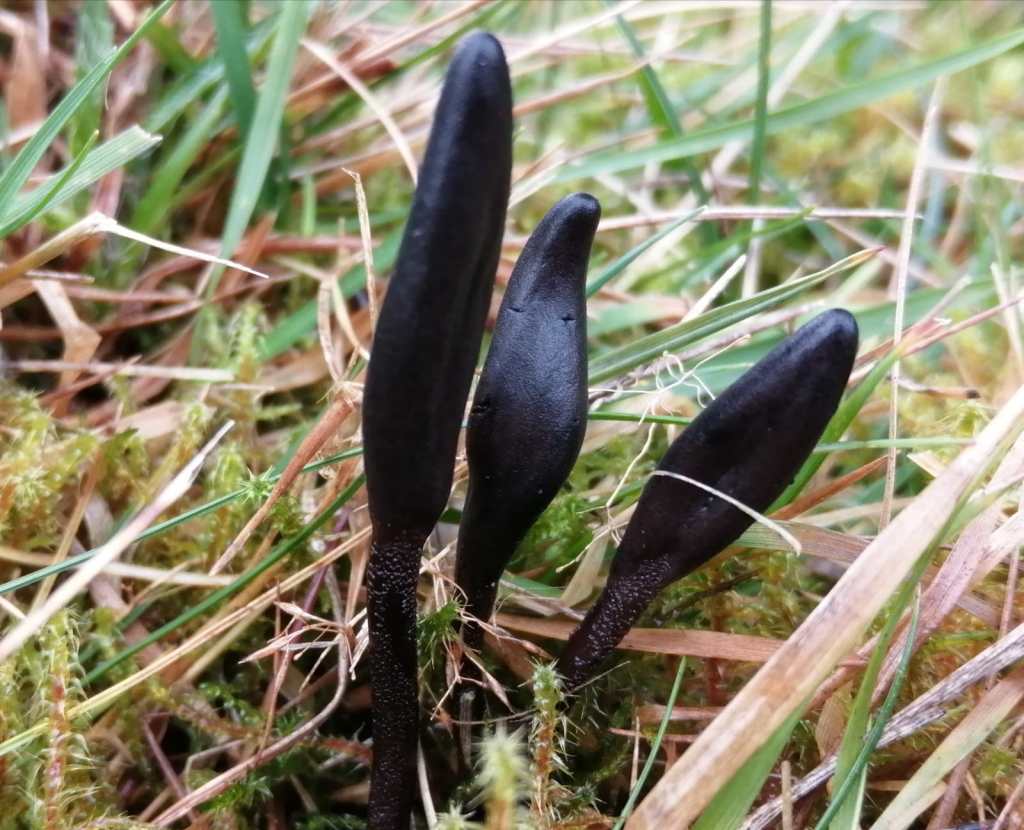
…black blades of earthtongue;
Earthtongues are the G of CHEG-D, the Geoglossaceae. They are extremely small, and until my son, who had quickly got his eye in on the first survey at High Hirst, pointed the first one out before even having it described to him by Steve, I cannot say that I had ever been aware of seeing anything like it before, and I certainly would not have considered the tiny scrap of black as a mushroom at all.
In Tenter Croft, under woollen pieces stretched on wooden frames,
I could not count on every reader knowing what a tenter was, so I have described them and their purpose in this line. After the woven wool, which were created in standard 30-yard lengths called ‘pieces‘, was washed, it had to be stretched out on these wooden frames to prevent shrinkage. Rows of these frames would have lined hillsides all over the district. They are sometimes marked on maps, and appear incidentally in some old Victorian photographs and paintings of the area. In places, the terraces that were created on hillsides to accommodate them can still be found, but only a single extant example of an intact tenter frame, a once widespread landscape feature, survives today.
There are a few fields named ‘Tenter Croft‘ in the Stansfield Valuation. Fields named ‘croft’ would typically be adjoining, or very close to, the farmhouse, and so would be ideal for housing tenters, so the wet wool did not have to be carried far.
Grace Butterworth glimpses apricot clubs:
I imagined Grace Butterworth, having wrestled the heavy textiles onto the frames, just noticing for a moment, in the shade cast by the spread cloth, the little flames of apricot clubs. The C of CHEG-D are the clubs and corals, the Clavariaceae.

Nebulae among constellations of crushed lime.
I fancifully liken them here to nebulae, for their shape reminds me of the Pillars of Creation, the towers of cosmic gas and dust that make up part of the Eagle Nebula, subject of one of the most famous images taken by the Hubble Space Telescope. And that thought gave me an opening to make a reference to lime. Crushed limestone—in the form of tiny white rocks, almost dust—from the Craven district to the north, or from Wycoller or Thursden over the moors to the north-west, was brought over on trains of Galloway ponies, to be spread on the fields to reduce their acidity—the higher the soil’s pH, the more productive the grass growth. I am not quite sure what time of year it would have been spread, but I was imagining another springtime scene here, in April, just after the stock has been excluded from the meadows, when the lime might have been spread to spur on the grass growth ready for mowing, which is the next scene.
Jonas Shackleton’s scythe arcs through the steep sward / In Hanging Brink,…
From mid-June to mid-July, haymaking would have taken place across the Calder Valley. There would have been an influx of Irish labourers, many of whom were farmers themselves from County Mayo, who came every year, often to the same farm, to assist with the harvest. This market developed because the local farmers were often too busy with their handloom weaving to bring in the hay crop all by themselves. But my character here, Jonas Shackleton, is a local who has found the time to join his Irish helpers out in the field.
Ideally, meadows were close to the house, and reasonably flat, both in their overall angle, and the surface of the ground itself. A tremendous amount of effort went into smoothing out the surface, with any protruding rocks, however small, removed to avoid damaging the scythe blade, and molehills spread out if any appeared. But the angle of the slope could not be altered, and some farms were left with little choice but to designate a steeper-than-ideal field as a meadow. That is Jonas Shackleton’s fate on his farm; both the ‘Hanging‘ and ‘Brink‘ elements of the name refer to its steepness.
…early spires of smoky spindles
I knew I wanted haymaking to be one of the events in the farming calendar in the poem, but given fungi are an autumn phenomenon, how was my farmer to have an encounter with them? But it was OK, as Steve told me that in some years, in certain conditions, they might start appearing in July. So I imagined the very first smoky spindles appearing just as the final fields, like Hanging Brink, were being mown. The spindles, like the clubs, are part of the C group, the Clavariaceae.

Smothered, safe, under combs of windrows.
As I have said, given that I wanted my message to be that, overall, the agricultural practices of Calder Valley farmers have been benign or positive for the CHEG-D fungi, I wanted to avoid the incongruity of the individual encounters that my farmer characters were having with them being destructive. I therefore didn’t want Jonas Shackleton’s scythe to be slicing through the delicate smoky spindles spires. But given that they would only just be sending their first ‘shoots’ up through the soil, it seems unlikely that scythe blades would have damaged them. Indeed, scythe blades are carefully angled so that they do not slice too close to the ground. The blade is subtly shaped with a ‘lift’ that raises the ‘toe’ (the point) of the blade away from the ground so that it does not bury itself in every slight wrinkle in the soil, and when we are setting the scythe up at the beginning of every season we insert a small wooden wedge between blade and ‘snath’ (shaft) to set the ‘lay’ of the blade edge with a slight upward angle, so that the grass is being cut at a more efficient slicing angle.
All of this means that I was content that Jonas Shackleton’s scything would not be decapitating the fungi. As he moved through the sward, he would have left a swath of mown grass behind him, and a windrow of cut grass to his left. This windrow would have fallen onto the swath of the mower to his left, who would be slightly ahead of him, for the teams staggered themselves across the meadow so that no mower’s windrows fell onto uncut sward.
When a whole meadow has been mown, the stripes of light green swath and darker green windrows make it look like it has had a comb run through it. I don’t quite know what I’ve done here, turning these dark green stripes into ‘combs of windrows‘—I don’t think ‘comb’ is a noun in this sense—but I take it that it is the poet’s prerogative to be playful with language where it suits them.

Any fungi that had started appearing at this time would have been ‘smothered, safe‘ under the windrows. As necessary, according to the prevailing weather, the windrows would have been fluffed out, or ‘tedded’, with forks and rakes to speed up the drying of the hay, or raked up into piles, which were locally called ricklings or hoblins, to keep the majority of the grass within them dry if rain arrived. When it was absolutely dry, which was essential so that it neither spoiled nor combusted in storage, it would have been ‘led’ to the barn, or ‘laithe’, either carried as a ‘burden’ using a hay rope, or dragged on a horse-drawn or person-drawn sled.
Between the mowing, tedding, rickling-making, re-tedding and leading, there was a lot of activity in the meadows for a few days, and no doubt there would have been some trampling of some of the fungi that was emerging, but haymaking was not only an essential part of the agricultural cycle, providing fodder for the livestock through the winter when the grass stopped growing; it also maintained the balanced ecology of the grassland by removing nutrients from the fields—if the soil becomes too nutrient-rich then the more vigorous grasses thrive, and botanical and fungal diversity declines.
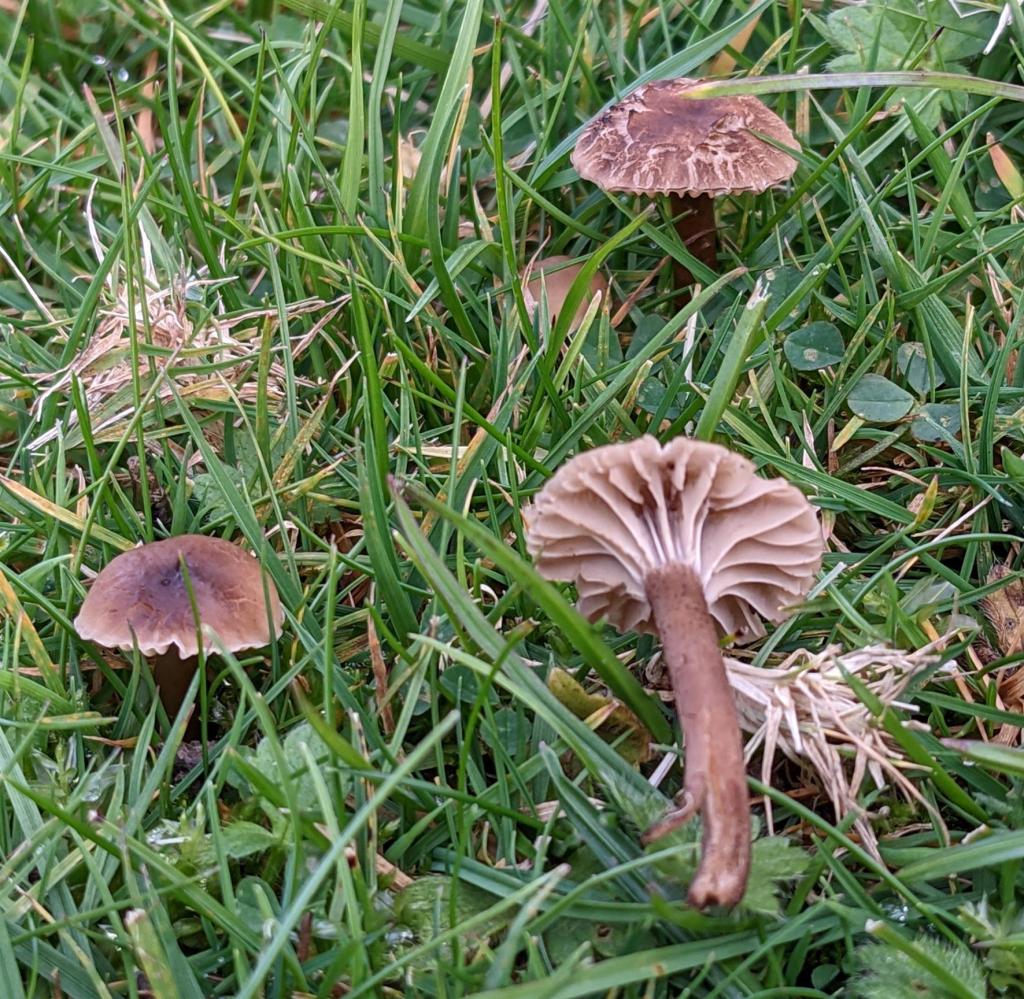
Stinking fanvaults in Old Black Reaps are fed by fork / With clods of muck,
In the 2023 High Hirst survey, we found a stinking fanvault, which is one of the D group, the Dermoloma, the crazed caps and allies. It is a globally rare species, and is the only specimen ever recorded in England. However, as Steve always modestly points out, he finds previously unrecorded species in many places that he looks not necessarily because he is better at finding rarities than anyone else, but because no ecologist with the relevant mycological expertise has ever looked in this area before. I am therefore assuming that stinking fanvaults were present in Margret Ackroyd’s time, which I am imagining is early in the 20th century, which was when I found the name Margaret to be popular in the district.
Muck spreading is another part of the agricultural cycle that I wanted to include. While I said above that removal of nutrients in the form of the ‘arisings’, the cut grass, was important so that the soil did not become too nutrient-rich (as well so that wildflower seeds have light to germinate), it is also important that some nutrients are returned. To this end, muck from the barn, where the cattle spend the winter inside eating the hay, was taken back out to the fields.
I have seen muck spreading carried out at various points through the year, including straight after haymaking, and through the winter. I had in mind a very late autumn or early winter scene for this verse. At this point, the stinking fanvaults would have been up and visible in the fields. Some might have been smothered and squashed as the ‘clods of muck‘ were forked from the sled, but I put it rather more charitably, that they were being ‘fed by fork‘, to suggest the idea that the farmers were pampering them, or were feeding them like babies are fed, again reinforcing the idea that the relationship between farmer and fungi has been a positive one.
I chose the stinking fanvault for the muck spreading scene for obvious associative reasons, and similarly the ‘black’ in the field name. There is only one field, ‘Reap’, named as such in the Stansfield Valuation, though there was a farmhouse, now a ruin, that was called Old White Reaps, which was replaced by the extant New White Reaps. Reaps, like greave, is another name I find evocative. I have not found any etymology for it beyond the standard one of harvesting or gathering, though for some reason I find myself thinking less of the halcyon days of a hay harvest and more of a grimmer, blacker kind of reaper.
sled-dragged, hawthorn-harrowed,
I have not come across evidence of how muck was transported in centuries past, but I presume the same sleds that were commonly used to drag the hay to the barn were used to carry the muck back out again. (Carts with wheels seem to have been less common here than in other parts of the country.) Having been forked off the sled into small piles, it would then need to be more finely and evenly spread. Here I have used a bit of unevidenced artistic licence in suggesting it was ‘hawthorn-harrowed‘. It so happened that at the time I was writing the poem I was watching the BBC’s magnificent 2009 documentary Victorian Farm, in which a team of historians and archaeologists live on and authentically recreate the life of a farm of the period. At one point, they experiment with using a hawthorn bough, attached to a horse, to harrow the muck, finely spreading out the small piles across the field. It seemed plausible to me that such a technique might have sometimes been used here instead of using a fork or rake to make the final even spread—until, that is, metal harrows with tines attached to a large frame were introduced.
Fresh from Margaret Ackroyd’s beast-warm mistal.
The local name for a barn was, as I have said, a ‘laithe’. The main entrance was through an arched doorway, large enough to admit a horse-drawn cart or sled loaded with hay. These doors opened onto a gangway, which also served as the threshing stead, on which oats could be flailed, with an opposite ‘winnowing’ doorway, sometimes arched but sometimes smaller, creating a through draft to separate the husks from the kernels. On one side of the threshing stead would be a stable, really just a stall for the single horse most of the little hill farms had. On other side was the ‘mistal‘; this is a Scandinavian word, mis-stall, or muck stall. The mistal is the cow-house—in other parts of the north of England is was called a byre, a shippon, or, in the Yorkshire Dales, simply a cow’us. It consisted of a row of perhaps six timber stalls, called ‘booses’ (or boo-ises, or booishes, or boices—there is no agreed-upon rendering of the dialect word), to accommodate the cattle during the winter. There are many other parts of the mistal, which I will not go into here, each with their own dialect term. The laithe also had an upper floor, the hay-mow, where the hay was stored.
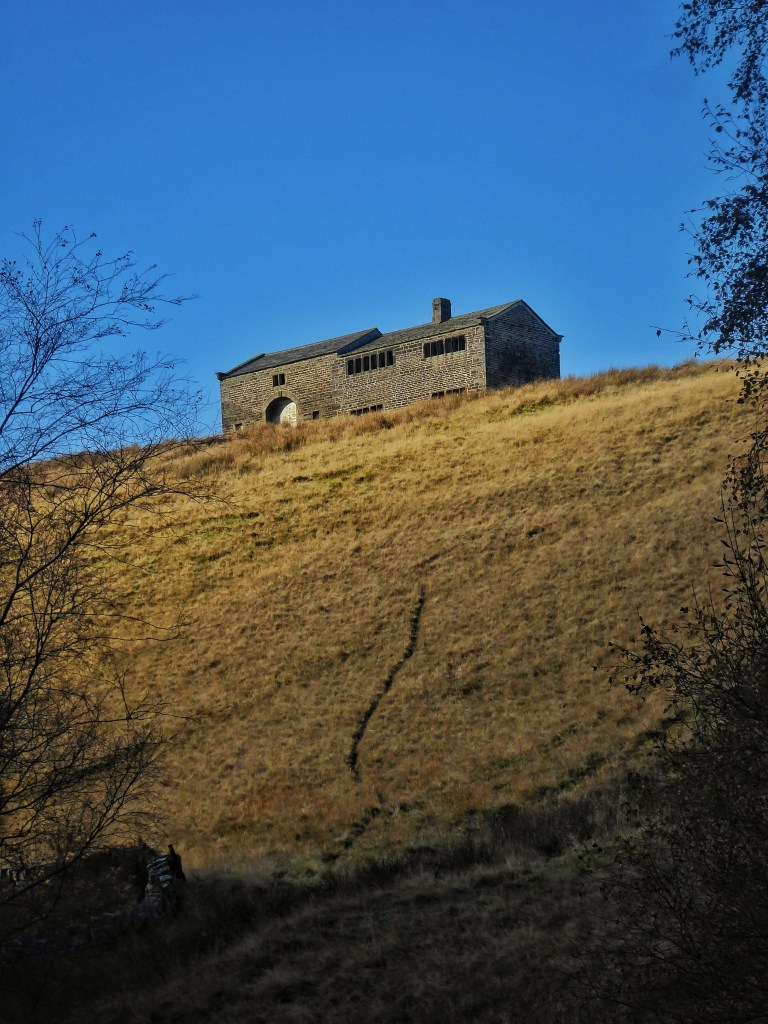
I say that the mistal is ‘beast-warm’. (It perhaps seems unkind to some to refer to the cattle as beasts, but I think this would have been common, and still is in places, and it is not meant to be derogatory.) I pictured this scene as being in late autumn or early winter, the herd not long having been brought inside, so this will perhaps have been Margaret Ackroyd’s first foray out with the sled, but their bodies and steaming breath have already warmed the inside of the mistal.
At day’s end, the rent in Hollow Rough’s wall stitched with stone,
Many farms, particularly those at the highest elevation with fields between 1,200 and 1,400 feet, sometimes allowed part of their land to stay as rough grazing; instead of investing money and effort in liming and muck spreading, a compromise was reached between the moor and the more improved pastures, with a greater proportion of rushes and other tougher vegetation tolerated. ‘Rough grazing’ is one of the three categories—along with pasture and meadow—into which fields were distinguished on the wartime National Farm Survey. Areas named ‘Rough’ survive on the contemporary Ordnance Survey maps, such as Thurrish Rough and Shepherd’s Lodge Rough at the head of Crimsworth Dean, and ‘Rough’ is a very common field name in the Stansfield Valuation, most often with a location prefix, such as ‘Nearer’ or ‘Further’. I named mine ‘Hollow Rough‘, where ‘Hollow’ refers to some shape, perhaps a scoop or scrape or hole, in the terrain.
Repairing any damage to dry stone walls so that they remain stock-proof would have been a job that farmers had to fit in around the fixed tasks in the calendar such as haymaking, and also the textile side of their work. As sheep have become more ubiquitous on Pennine hill farms in a way that they were not always so in the Calder Valley, walling became a winter job that fitted between tupping and the autumn sales on the one hand, and the relentless run of lambing, haymaking and shearing on the other. To reflect this in this last verse, then, I imagined a deep winter twilight at the top end of the highest field on the farm.
I tried to make a last allusion to the dual economy of farming and textiles with the image of the gap in the wall ‘stitched with stone‘.

Samuel Uttley, turning his back on the hungry moor,
The economy of words in a poem prevents the spelling out of much that might be in the imagination of the writer, but I do my best here to suggest where Samuel Uttley has been all day, at the highest point on his land, repairing the wall that abuts the open, unenclosed moor. In calling it the ‘hungry moor‘, I try to convey that it would, given half a chance, reclaim the fields that were once ‘taken in’, or, as W.B. Crump, author of the seminal The Little Hill Farm put it, ‘won’ from the ‘waste’. There are a number of places in the district where precisely this has happened, and fields once green are now virtually indistinguishable from the surrounding moor.
This does raise again the question of the overall effect of farming on the local populations of ancient grassland fungi. How was their abundance and diversity affected by the arrival of the kind of farming that has been practiced over the past centuries? How have they changed, if at all, in response to the relatively recent, post-war increase in sheep numbers and decline of cattle numbers? How will they fare in the future if either agricultural practices continue to intensify on the one hand, with greater use of nitrogen fertiliser and more frequent re-sowing with rye grass to enable greater productivity for silage, or on the other hand more land is abandoned and allowed to revert to rougher vegetation, or is used for tree planting? Steve Hindle’s main message is always that if any of these changes—intensification, ‘rewilding’, tree planting, not to mention building—are proposed for a grassland that has not been previously surveyed, then let’s find out what is there, so that the presence or absence of ancient grassland fungi can enter into the deliberation. Given that on a global scale, these fungi are among the most important of the UK’s contribution to the world’s biological diversity—on a par with snow leopards and polar bears—it is our responsibility to consider their conservation very carefully.
Lopes home between his lowing stock and snowy waxcaps.
Since I could not find a way of directly mentioning that it was winter in this scene, I chose the snowy waxcap as the fungi here. The waxcaps—the H group, Hygrocybes—are the most significant of the CHEG-D fungi for Calderdale. There are many different kinds; we have found blackening, butter, glutinous, golden, heath, honey, meadow, pale, parrot, pink, slimy, snowy and spangle waxcaps at High Hirst.
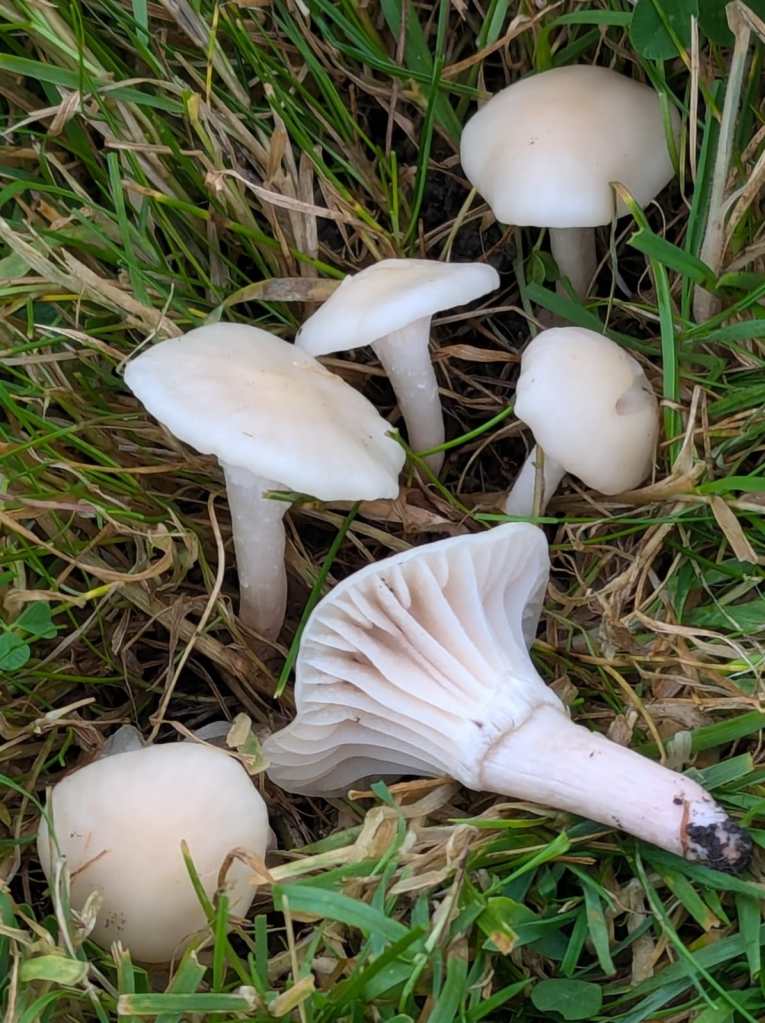
Samuel Uttley ‘lopes‘ home, a reference to an image that I keep returning to that is evoked by Ella Pontefract in her and Marie Hartley’s marvellous first book, Swaledale, from 1934, in which the solitary figure of a shepherd is silhouetted against the sky, high on the hillside: ‘As the shepherds come down from the fells with the rolling gait they develop, theirs seems the kind of life man was meant to live.’ And Samuel’s stock, his cattle, are ‘lowing‘, a term I have always loved since reading as a teenager W.B. Yeats’ ‘The Stolen Child’, in which the eponymous abductee of the faeries, after it enters ‘the waters and the wild’, will ‘hear no more the lowing / Of the calves on the warm hillside’. Samuel Uttley’s homeward stride in the evening at the end of his long day’s work seemed a fitting way to round out the poem.

There we have it. Every line, every word of my poem explained in excruciating detail. Having indulged that part of me that insisted on doing this, I’m not certain it has added much value, and certainly no one else was asking for it, but at least it will stop nagging me now.
Catch the Ancient Underlands exhibition at Hebden Bridge Town Hall from 11th February to 8th March, featuring work from over 40 local artists, makers and writers.


Absolutely brilliant thank you. A wonderful accompaniment to ‘The History.’ Colin New Zealand (of Ratcliffe/Hollings/Pickles/Tasker ancestry.)
LikeLiked by 1 person
Thank you, Colin.
LikeLike
Thanks for this. I’m late to reading it and missed the exhibition but just wanted to say, personally, I love a poem explanation! I think like Dawkins (?) said of the rainbow, it doesn’t become less when explained: there is still magic. BTW re names of fields did you know Haworth based artist Anji Timlin did a project mapping and naming fields in the Yorkshire Dales? It would be lovely to see someone do this here.
LikeLike
Thank you, Laura. I remember reading and enjoying Dawkins’ book, Unweaving the Rainbow, so am glad of your analogy.
I haven’t come across Anji Timlin. Thanks for the recommendation. I shall look her up.
LikeLike