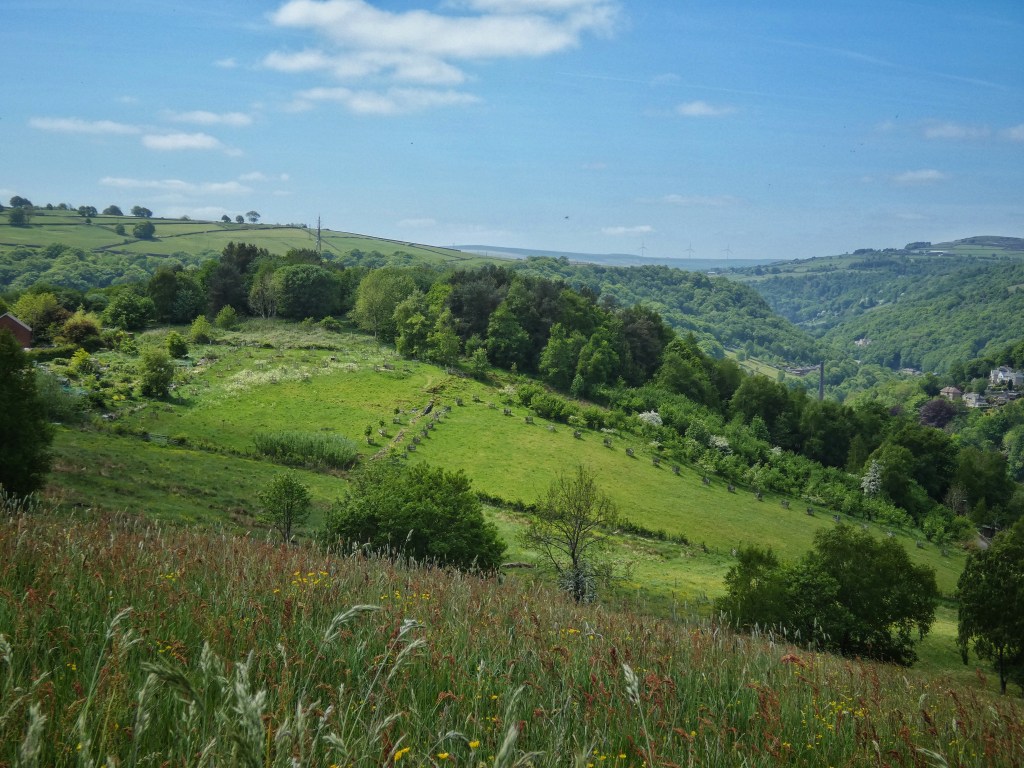
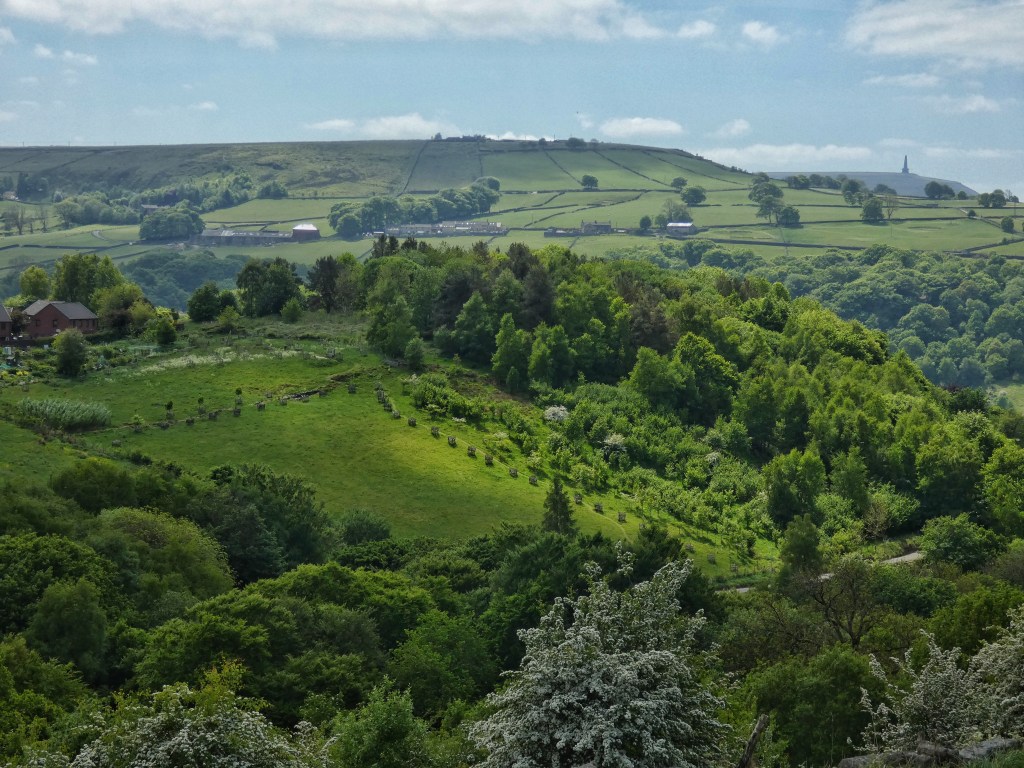
On the hillside above Hebden Bridge, there is a field which, for the past five years, has been the focus of a community project. It has come to be known as High Hirst Woodmeadow. Here’s my son, looking across to it:
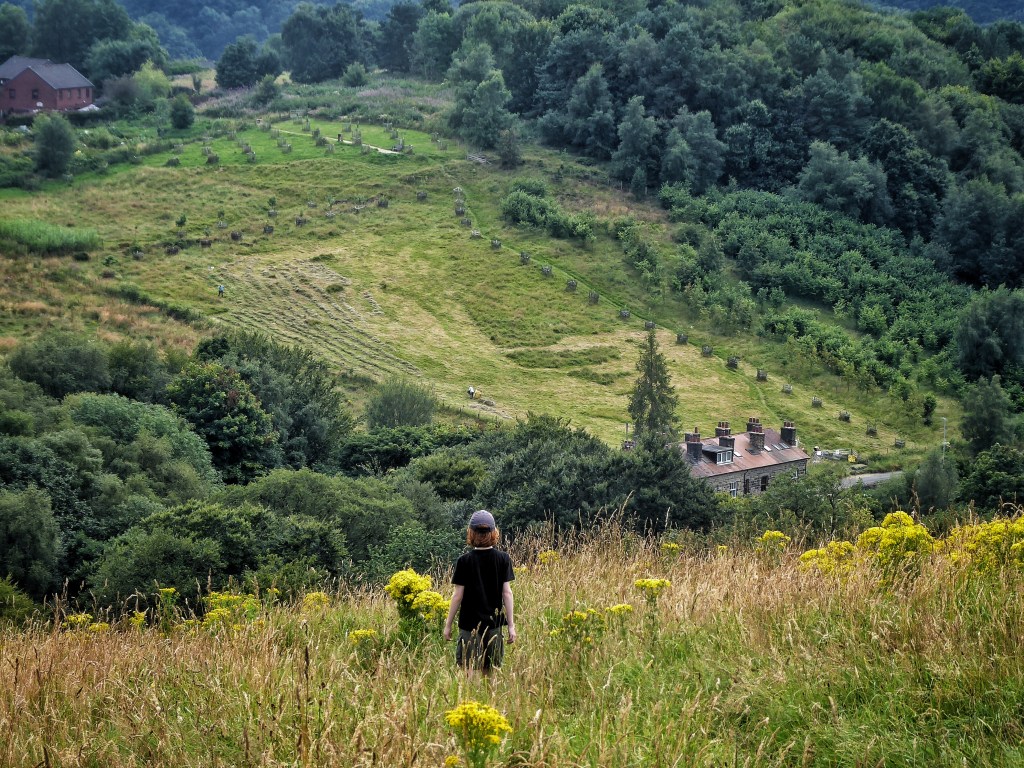
We call it a woodmeadow because it’s part open grassland, on the left, and part young woodland (merging into older woodland) on the right, with the two sections separated by a line of fenced fruit trees running down the slope. More fruit trees are dotted on the upper, flatter part of the field.
If you look closely, you can see the meadow part is in the process of being mown. There are rows of cut grass, and longer swathes still waiting to be tackled. But the work isn’t being done mechanically. It’s being cut by hand – with scythes.


Every July, we gather in the meadow to make hay the traditional way. As we move through the grass with our scythes, we leave ‘windrows’ behind us, which are then shaken out with forks to dry in the sun.
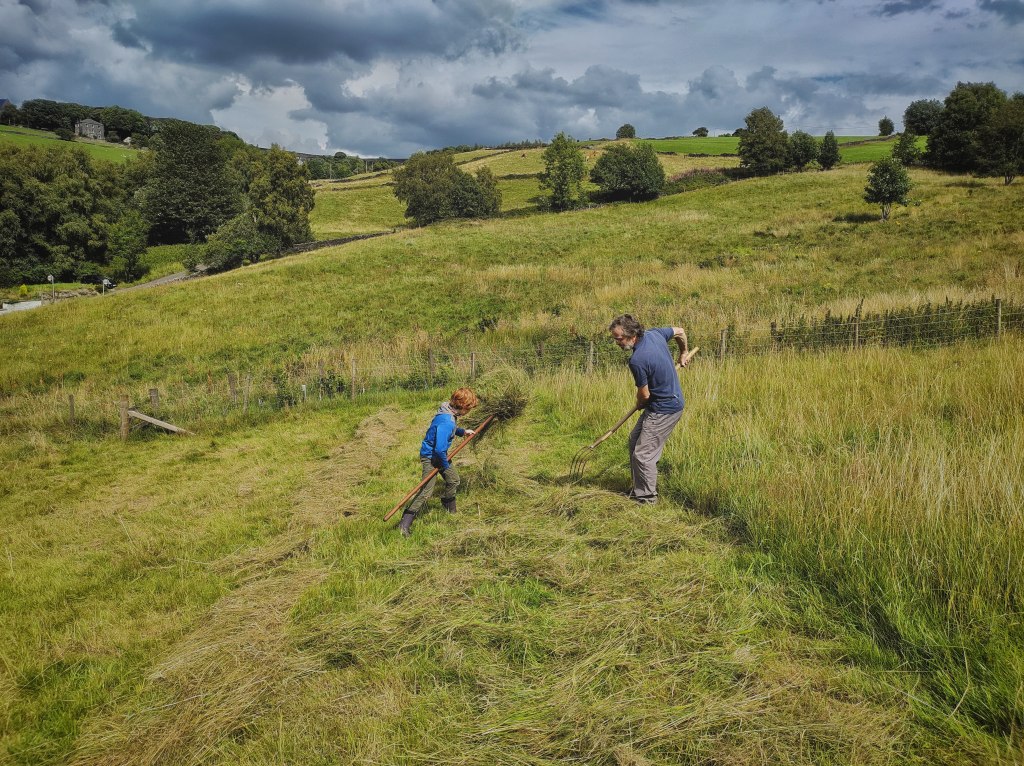
The grass takes a few days to fully dry, and sometimes there’s a summer shower or two in that time. When rain threatens, the hay is gathered into small heaps called haycocks. There are many tarditional names for haycocks all across the country, but we’ve given them a new one: ‘tunnocks’, after their Tunnock’s Teacake-like shape.

Once the weather clears, the tunnocks are spread again. When the hay is dry, it’s carried – sometimes in sacks, sometimes in great armfuls…
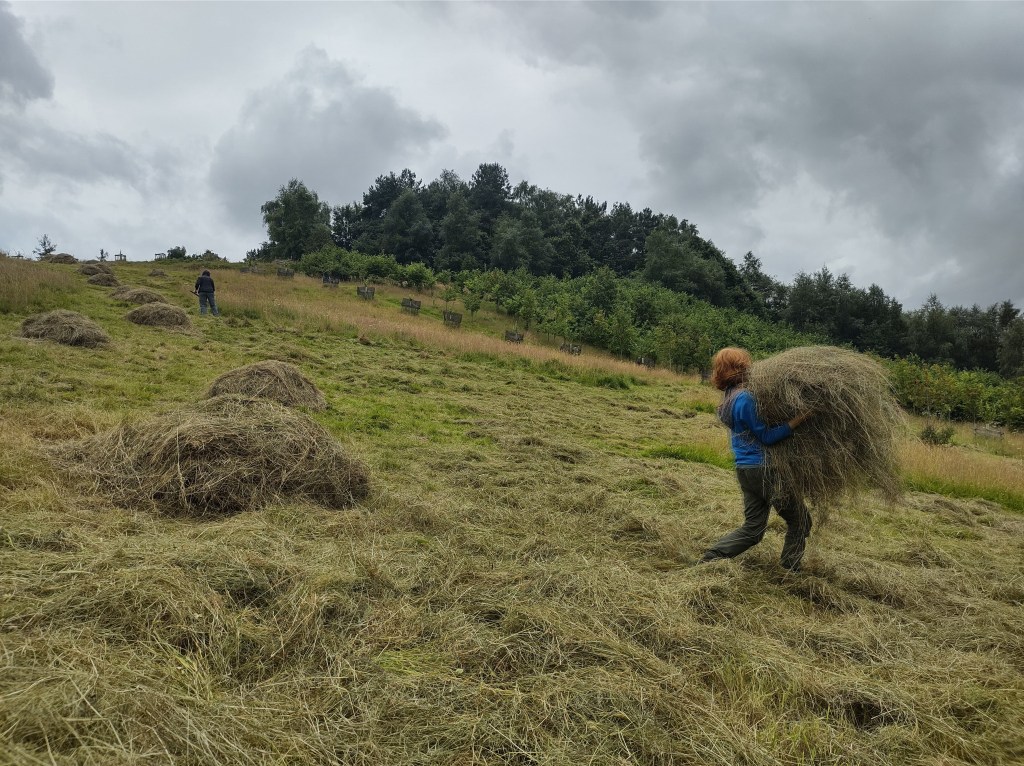
…to our baler. At first, we used a not-so-traditional wheelie bin to bale the hay, with the children doing the compressing…
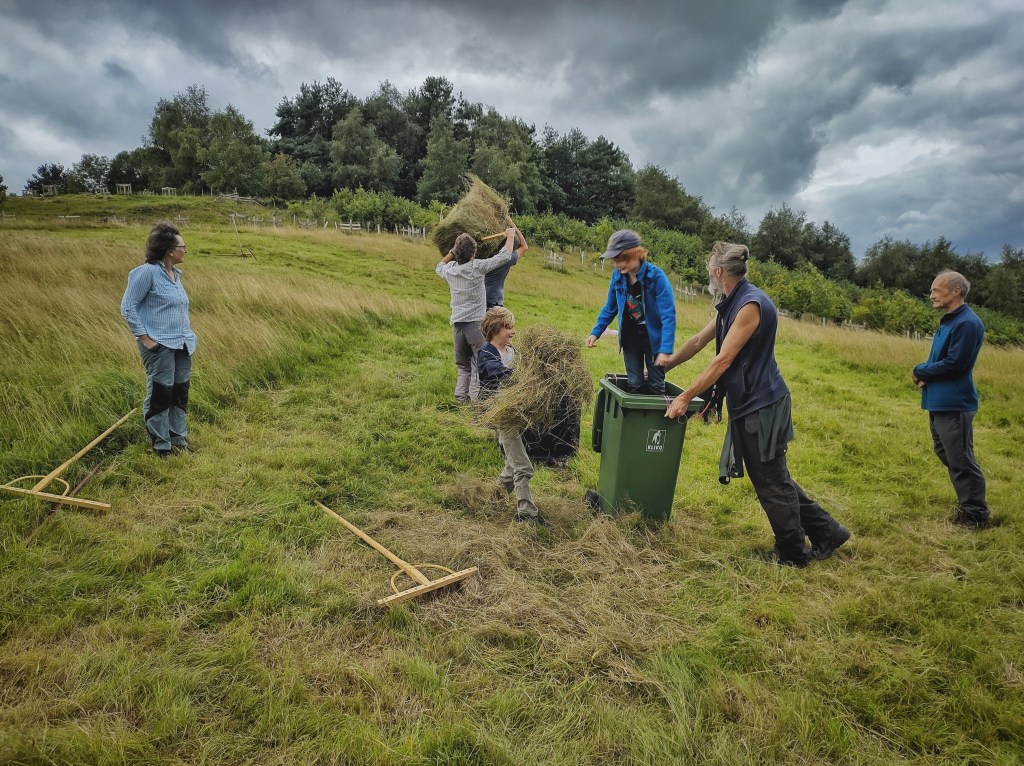
…until Steve knocked together a rather clever wooden baler.


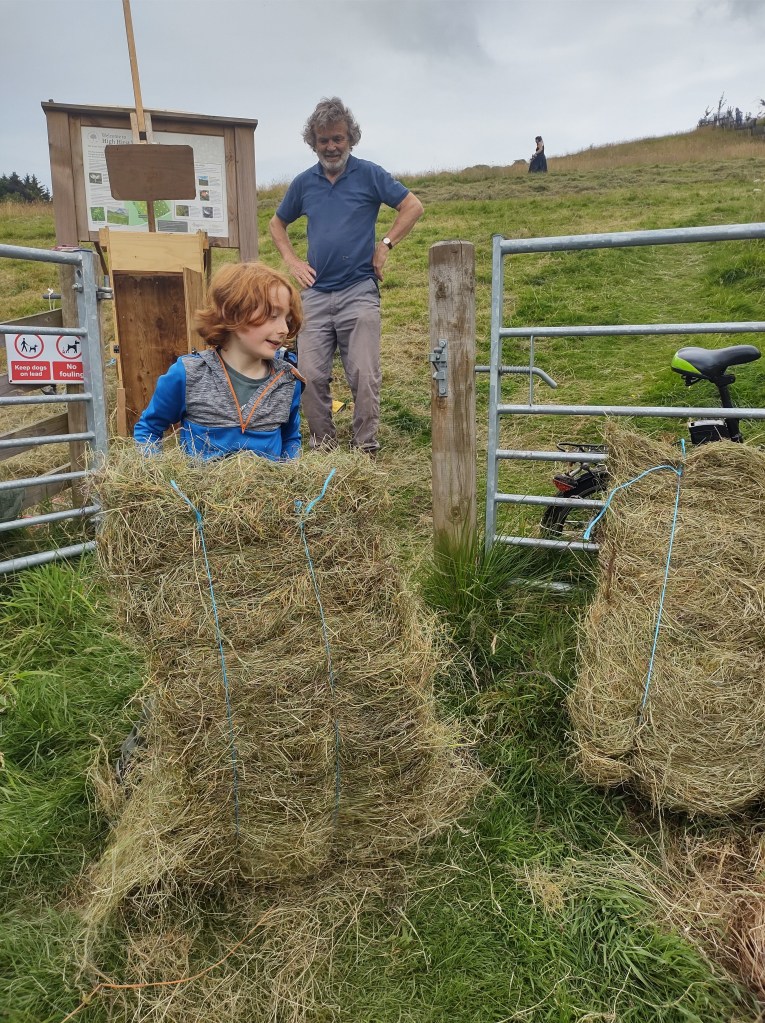
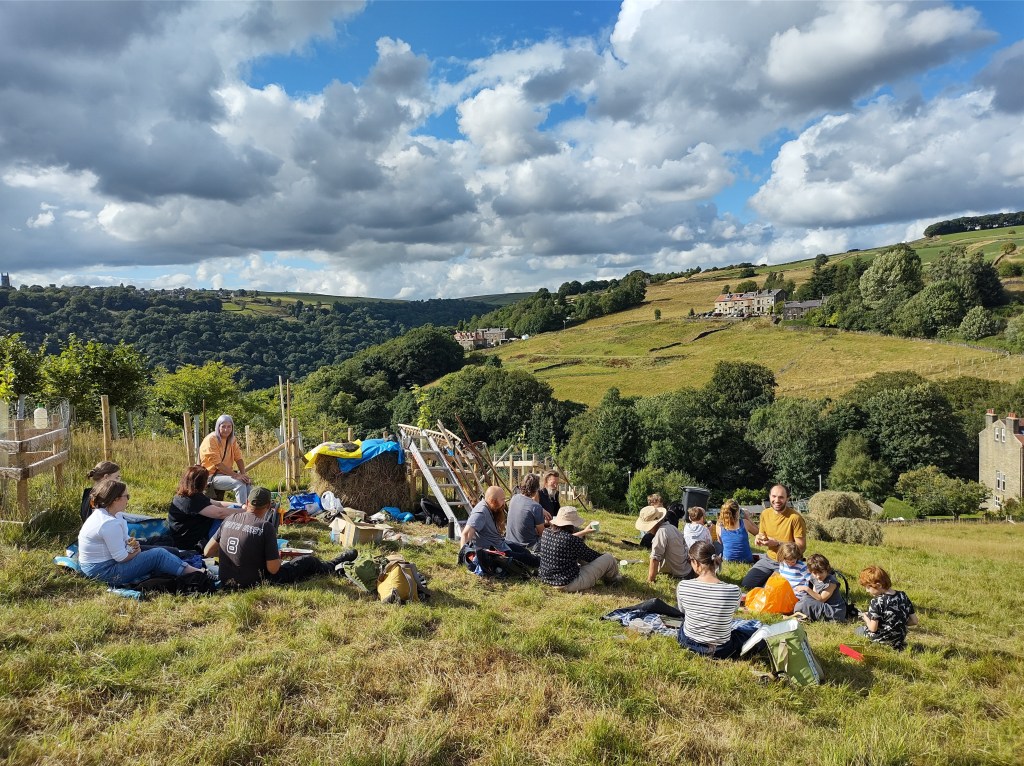
At the end of haytime, there’s a celebration: a shared picnic in the field to mark the bringing in of the harvest.

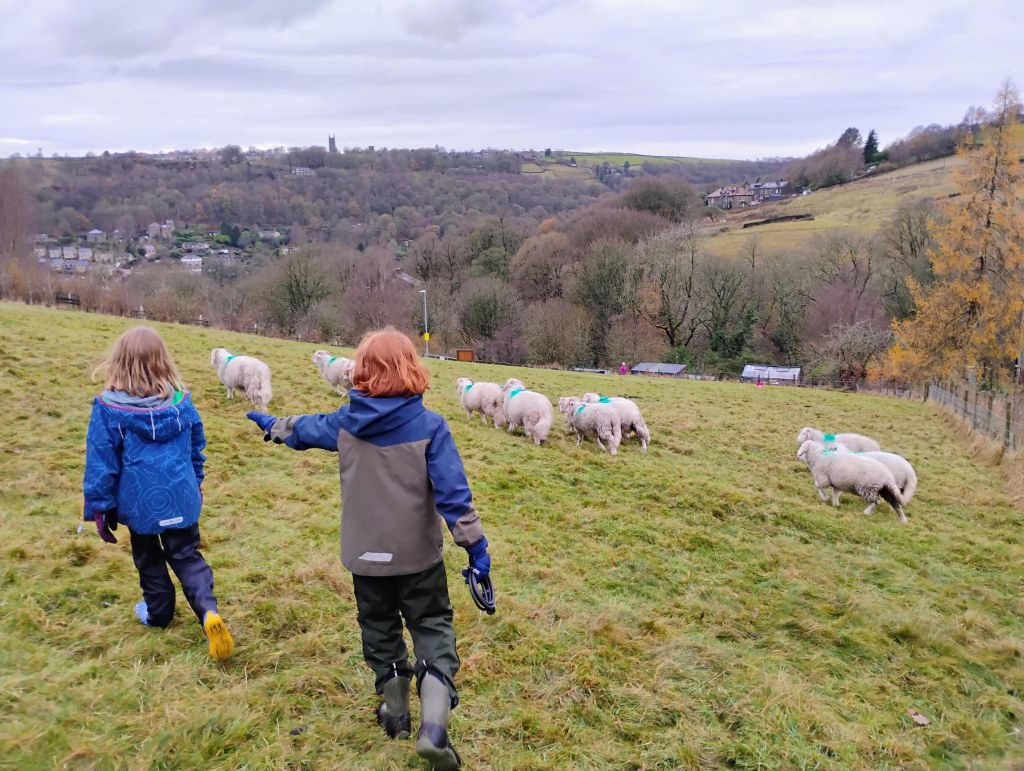
After the cutting, grazing begins. A small flock of sheep, lent by a local farmer, is brought in to graze the aftermath, and a rota of volunteers checks and counts them each morning for the eight or so weeks they’re with us.
We do other things too: fungi surveys…

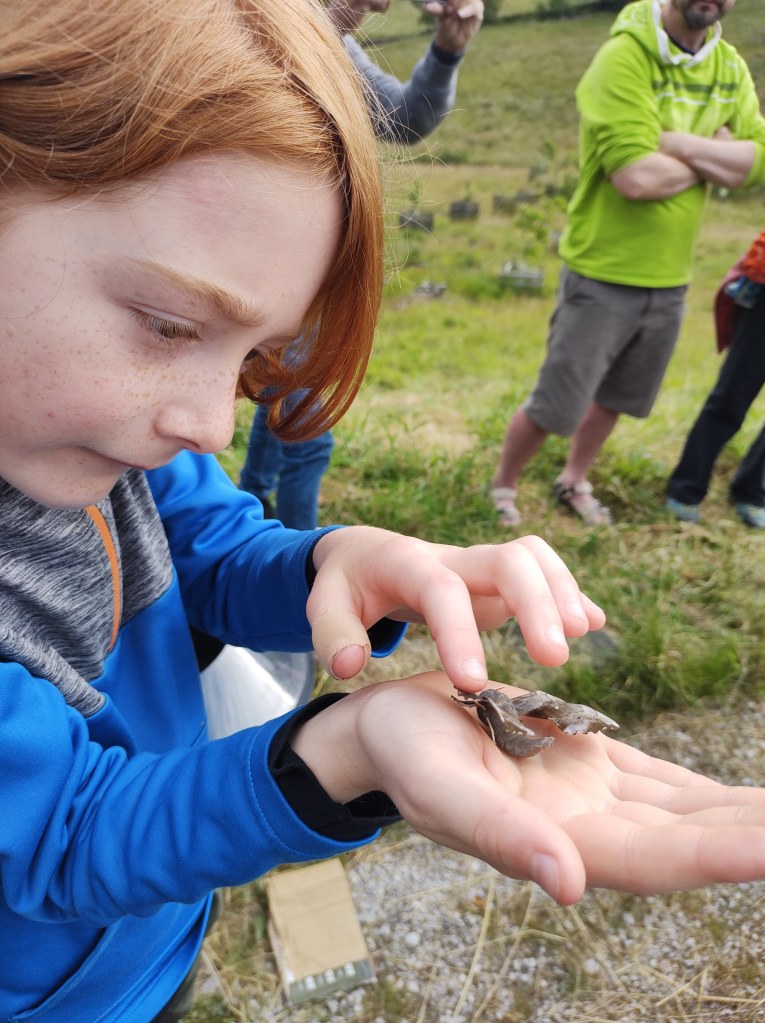
…moth breakfasts…
… and coppicing the hazel trees that were planted in 2014.
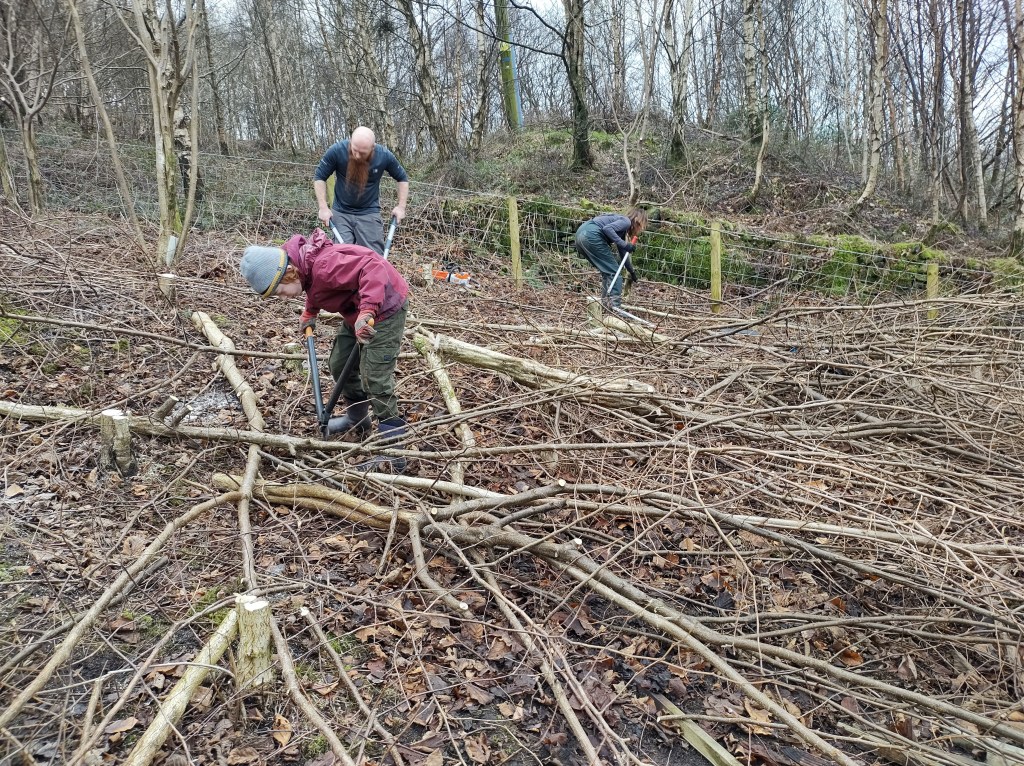
We prune the fruit trees, we’ve planted hedgerows, a pond has been dug. We do all this work for biodiversity, for flood mitigation, for carbon storage, and for community building.
So far, so the present. But I billed this article as a history. Well, I provide all this for context, since while the project is underlain with new, distinctively modern ideas and motivations, it is also about something very old. For at its heart is the meadow and its traditional management: mimicking a farming regime that would have been wholly familiar to those who worked this land in generations past. This is not just restoration – it is also reconnection.
Sometimes as we are scything and haymaking we wonder, who were our predecessors here? For our field is an ancient one, and once belonged to a farm up on the hill that has long since vanished. This is the story of that farm.
Late-16th Century to 1841: High Ground, Deep History
Let’s begin with a name. High Hirst means simply ‘high wood’. The name combines the Old English hēah (high) and hyrst (wood), and it was first recorded in 1305 as Heghhyrst. Variants appear across the centuries – Heghhirst (1442), Hy(e)hurst (1604) and Hiehirst (1640).
The variant that lingered, though, was High Hurst, first recorded in 1609. Even into the twentieth century, debate continued over whether this was the correct spelling. In 1953, a Halifax Courier reader took the newspaper to task for spelling the name with an ‘i’ rather than a ‘u’, pointing out that the name High Hurst was wrought into the iron gates at the arched entrance to the farm’s central yard.
Perhaps we can get some help by looking to its counterpart, for if there is a High Hirst, surely there is a lower partner. Indeed there is. Cross Ibbot Royd Clough (or Nutclough, as most people know it) on the delightful Hirst Bridge (or Kitling Bridge, as it’s more locally known – yet another reminder that the nomenclature of the landscape is never as clear cut as we might wish) and you come to an old farm building now called Lower Hurst, at the end of Hurst Road. But this seems to be quite a recent re-naming. On all Ordnance Survey maps, from the 1850s to at least the late 1960s, that lower farm is labelled simply as Hirst.
But we’re getting enmired here, and we haven’t even started. I shall stick with the most common rendering across the centuries, High Hirst. The spellings may have shifted, but the name’s meaning remained rooted in the land: this was high ground, once wooded, commanding views across the Upper Calder Valley.
Other local names echo the topography. Dodnaze (or Dodd Naze), now the name of the adjacent housing estate, likely comes from dodd (a rounded hilltop) and nase (Old English nasu, meaning nose), a description of the prominent rounded hill-spur on which it sits. Historical forms include Dodnas(e) (1399, 1554) and Dodd nase (1748). Nut Clough, first recorded in 1442, hints at hazel trees growing in a steep-sided valley. Sandy Gate, which runs along the bottom of the woodmeadow, is first mentioned in 1608, its name reflecting a sandy track (gata in Old Norse). That same year, Birchcliffe is recorded – then as Burstcliff, possibly evoking a landslip bank. An early settlement near to High Hirst is Burlees, first appearing as Burleghs in 1393, a name thought to mean ‘clearings near the cottage’; the element bur refers to a dwelling or small house, and legh to an open field or clearing.
So much for names. But what was being named? What was on this high hill-spur that loomed over the valley? In the 1950s, the noted historian of vernacular architecture Christopher Stell examined High Hirst in detail and concluded it likely dated from the late sixteenth century. This was a period of transition in the Pennines, when across the region timber houses were either being cased in stone or replaced altogether by stone buildings. High Hirst was of the latter type – but its form preserved echoes of the timber tradition. Large Pennine stone houses, Stell explained, often followed the same plans as their timber predecessors: a central hall, sometimes open to the roof, flanked by a gabled wing at each end. High Hirst followed this pattern, with a wide double-gabled wing containing three rooms, the central of which would have been the parlour. Stell noted the ‘large hall window under one of the gables’ and observed that, though much altered by the twentieth century, telltale signs such as straight joints and slight differences in construction revealed the original structure.
Here is an image, likely taken around the 1940s or early 1950s. It gives an idea of the house’s grandeur, and that it had found itself a fine position on the relatively flat top of the ‘dodd’, the rounded hill top. This is the east side of the buildings; the long roof with no chimneys is the barn. The main house, with the tall chimneys, is behind, the other side of an inner yard.
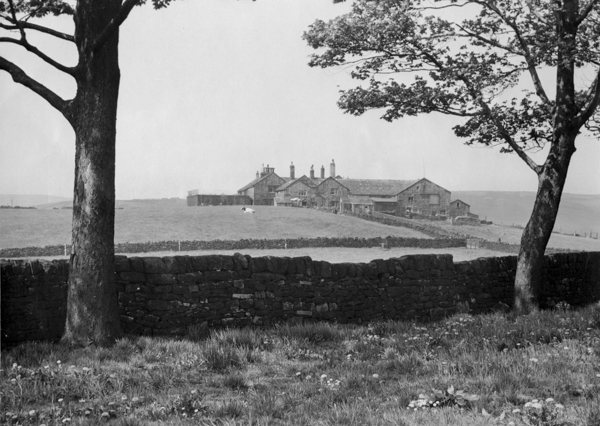
The sycamores the photographer has used to frame the image are two of a line of five that appear in other photographs. Three of these five remain today, on the edge of the playground in the centre of the housing estate, seventy-five years later. The photographer was standing more or less in the middle Manor Drive, outside, roughly, number 35.
Here is a distant view of High Hirst, taken from the Heptonstall hillside, showing it on its hill top against the sky. Again, what a fine position it has. The old Birchcliffe Chapel is below. The manse, abutting it to its left, remains standing today, but the chapel, and the Sunday School to its right, are gone. (Indeed, its replacement, which became the current Birchliffe Centre, is under construction in this photograph, which must have been taken around 1897, for it was finished in 1898.)
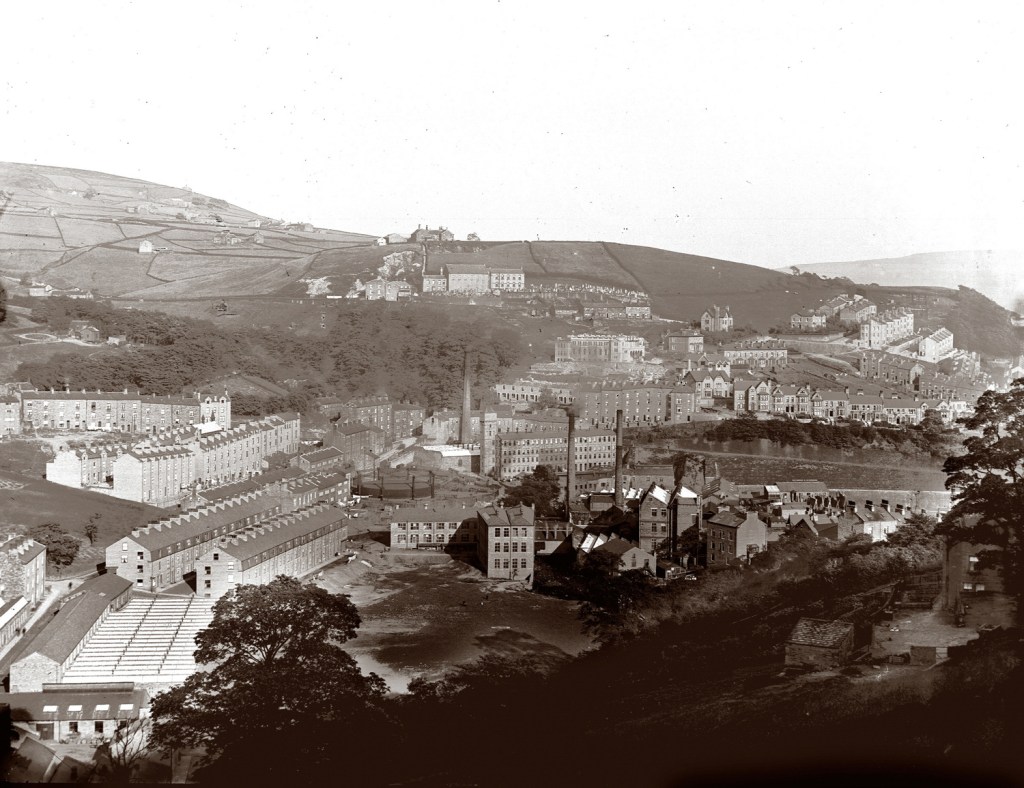
This is not a straightforward image to replicate now, since there are so many trees in the way, plus the format of my camera is different, but this is the best I could do.
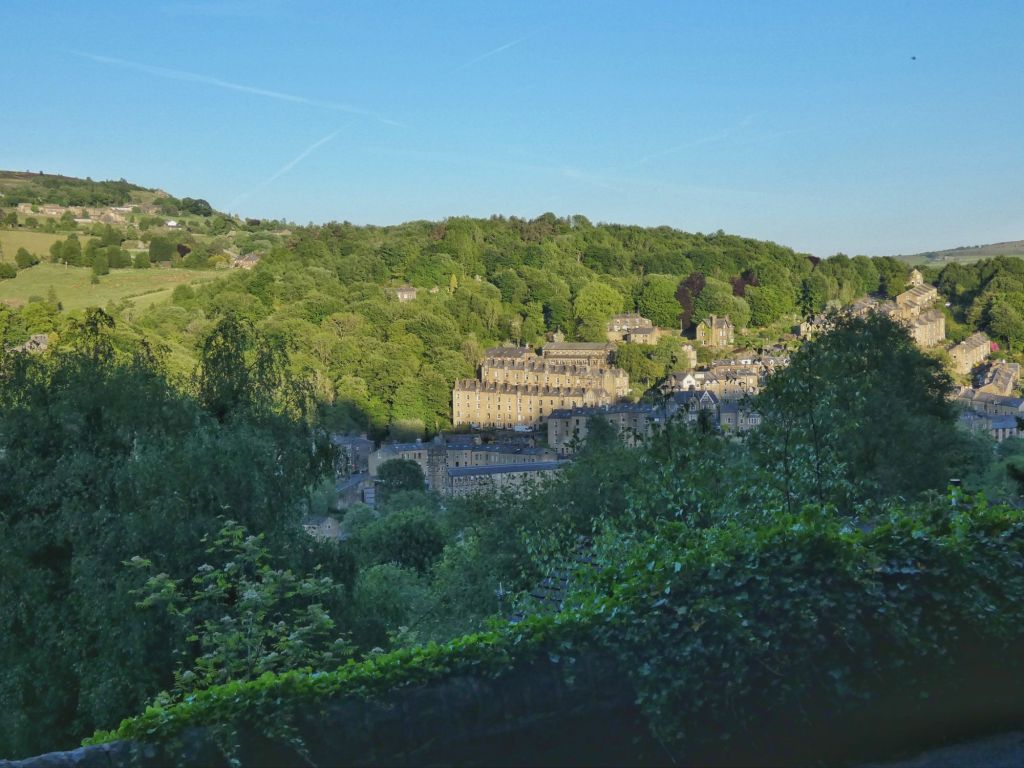
The footpath that can be seen leading up to High Hirst from beside the manse, passing closely to the right of the quarry, can still be followed today, and it is a good way of identifying exactly where it was.
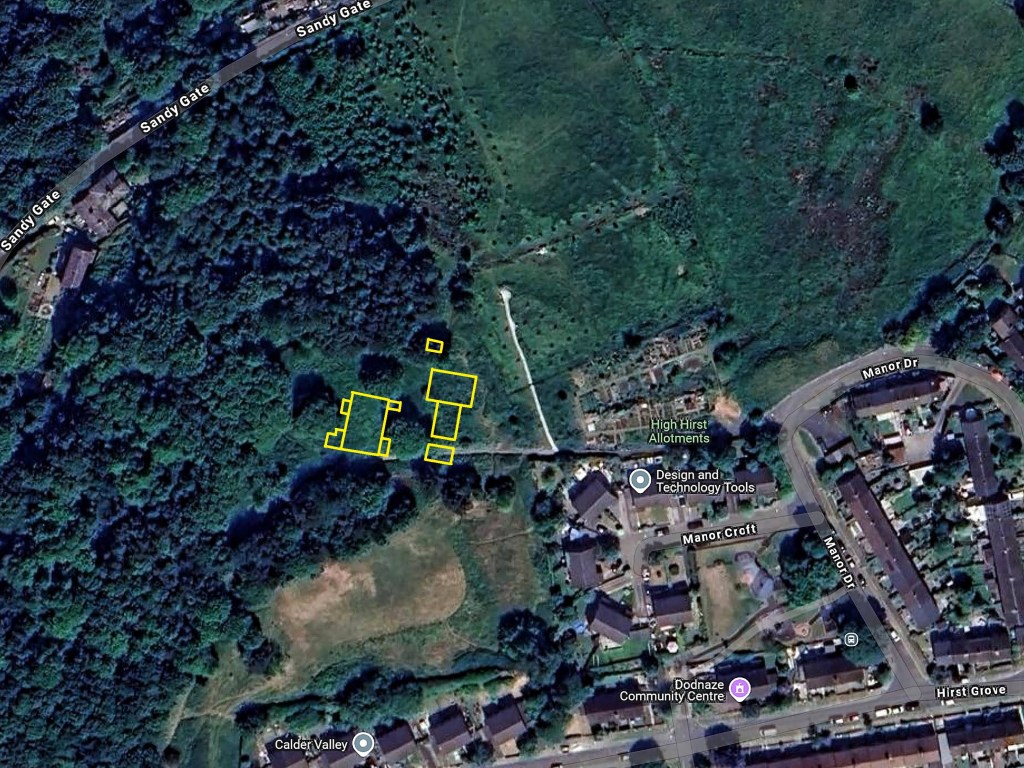
Speaking of which, here is my best effort at outlining where the farmhouse (on the left, with knobbly 19th-century lean-to additions around the outside) and barn (to the right) once stood.
It was a grand house, then, part of a living, working landscape – and can we catch glimpses of the people who inhabited it in scattered records from its earlier history. Abraham Nayler, of ‘High Hurst, Wadsworth’, left a will in 1640, now held in the Hebden Bridge Local History Society archives. Richard Greenwood, described as a ‘yeoman’, is mentioned in an indenture dated 1735. Another Greenwood – Thomas – appears in property transactions of 1760 and again in 1770, in connection with the estate of a bankrupt neighbour.
Later in the 18th century, High Hirst was home to the Reverend Dan Taylor, a noted Baptist preacher sometimes described as the ‘Wesley of the Baptists’. Taylor was born in Halifax and worked in the Beacon Hill coal mines at age five. Originally influenced by John Wesley, he preached his first sermon in 1761 but left the Methodists over doctrinal differences and Wesley’s authoritarian leadership. He began open-air preaching at Far Nook on the hillside above High Hirst, forming a small independent society that met at Higher Needless on Wadsworth Lane. He taught at a school in a cottage during the week. In 1764, he acquired land and built Birchcliffe Chapel – supposedly doing much of the quarrying and building himself. It is unclear whether he purchased the whole of the High Hirst estate in order to build the chapel, but certainly it is sited at the bottom of what would have been the field that swept down the hill from the west side of the farmhouse. It is said he was a part-time farmer and teacher at High Hirst, where he boarded up to 14 pupils. He published tracts, poems and theological writings, and with his brother, the Reverend John Taylor, he also helped establish chapels in Queensbury, Haley Hill, Shore and Burnley. He remained at Birchcliffe until 1783, then served at Haley Hill and later in Whitechapel, London. He married four times (his first three wives dying) and died in London in 1816. He was buried at Halifax Parish Church, where his tombstone was later restored by Birchcliffe Baptists in 1910.
The Birchcliffe Chapel that Dan Taylor built was demolished in 1823, with a new one, the one that appears in 19th-century photographs like the one above, opening in 1825. In 1899, the new, present-day Birchcliffe Chapel (or Church) opened, with the second chapel remaining on the OS maps until 1956, but having disappeared by 1961. Today, just the manse remains standing, with the cemetery engulfed in a wild woodland.
Apart from the foregoing records, we get our first sight of High Hirst in 1771 on cartographer and engraver Thomas Jeffery’s map of Yorkshire. It’s not named, but there it is, to the right of the ‘n’ of ‘Hebden’, nestled in the crook of Wadsworth Lane and Sandy Gate.
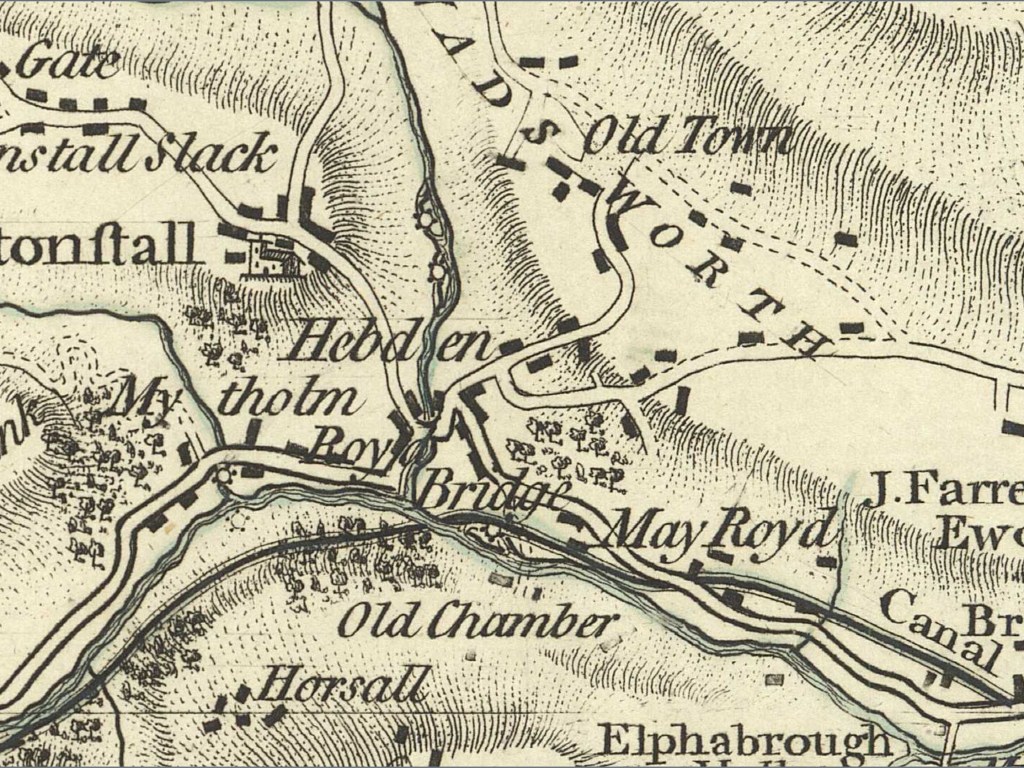
Source: Huddersfield Exposed.
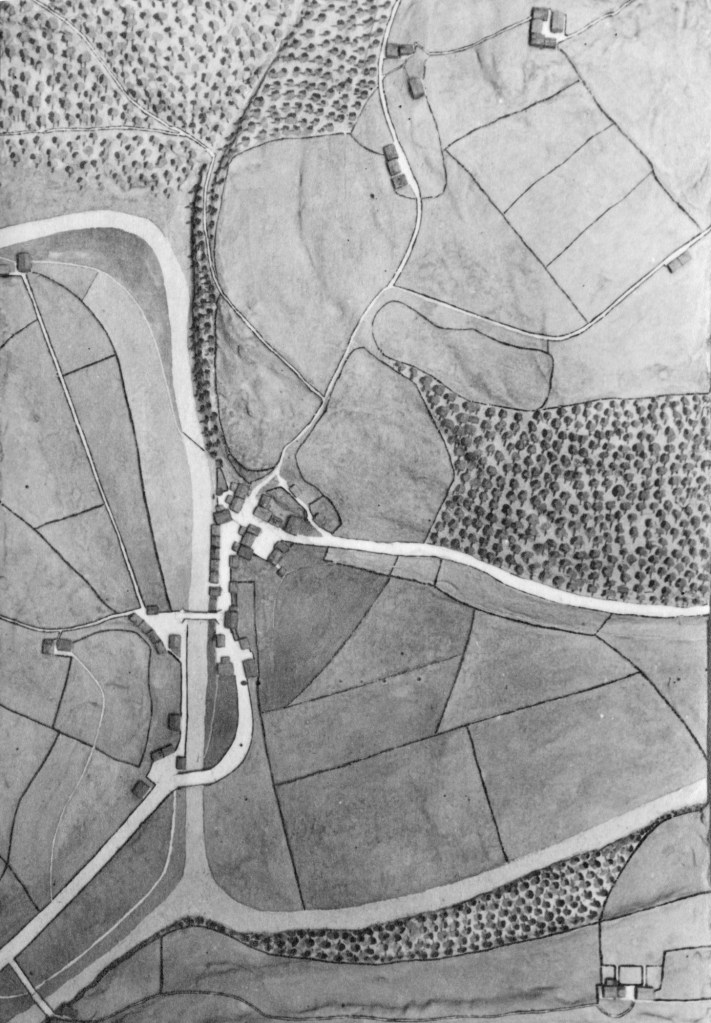
And likewise on this large-scale map of Hebden Bridge around 1780, it appears as the largest single building, at the very top on the right. Even by this time, it appears to have a central yard: the house itself is on the left, and the barn is on the right, with a white yard in between. What must be Dan Taylor’s new(ish) chapel stands at the bottom of the narrow path leading down from the farm.
As we enter the early 19th century, a shift is underway. William Ashworth, a cotton manufacturer, is named in a lease agreement at High Hirst, signalling perhaps the growing influence of the textile industry in rural life. And perhaps by the time Joseph Robertshaw was living there in 1824, and certainly by the time of the first census in 1841, the grandeur of the original house had begun to fragment. Stell records that the house had been divided into no fewer than five cottages – two in the solar wing, two in the service end, and one comprising the old hall and its adjoining room. This fate, he remarked, was all too typical of how Hebden Bridge region’s finest old houses were treated. Rooms were subdivided, lean-tos added, and steep staircases squeezed into the once generous interior. His plan of the building shows four such later additions, and his tone is one of lament for the fading integrity of what had once been an impressive and coherent whole.
We have two more maps from the period. The first is Myers’ map of the Parish of Halifax from 1835, on which High Hirst appears to be labelled as ‘Birch Cliffe’, above which it sits. However, this must instead be naming the chapel and manse above the ‘B’. High Hirst, then, is unlabelled, but it can be seen as a substantial cluster of buildings on top of its hill.
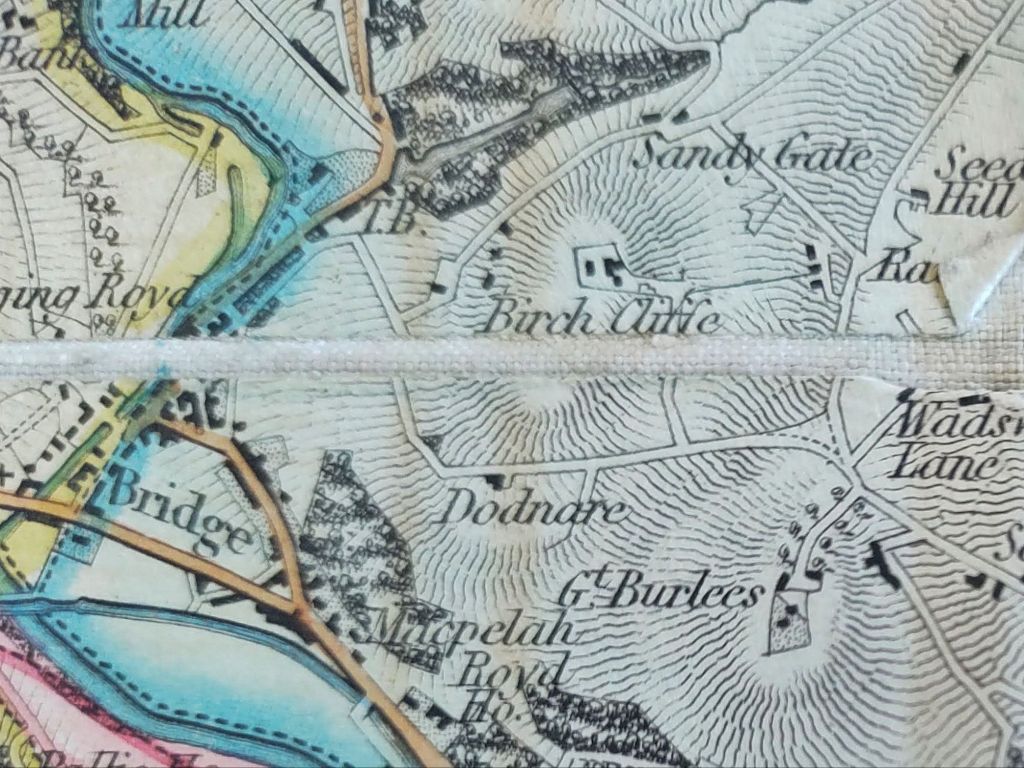
The other map, surveyed in 1839, does name High Hirst. It is the first of the Ordnance Survey maps, part of a series of one-inch surveys carried out between 1801 and 1869.
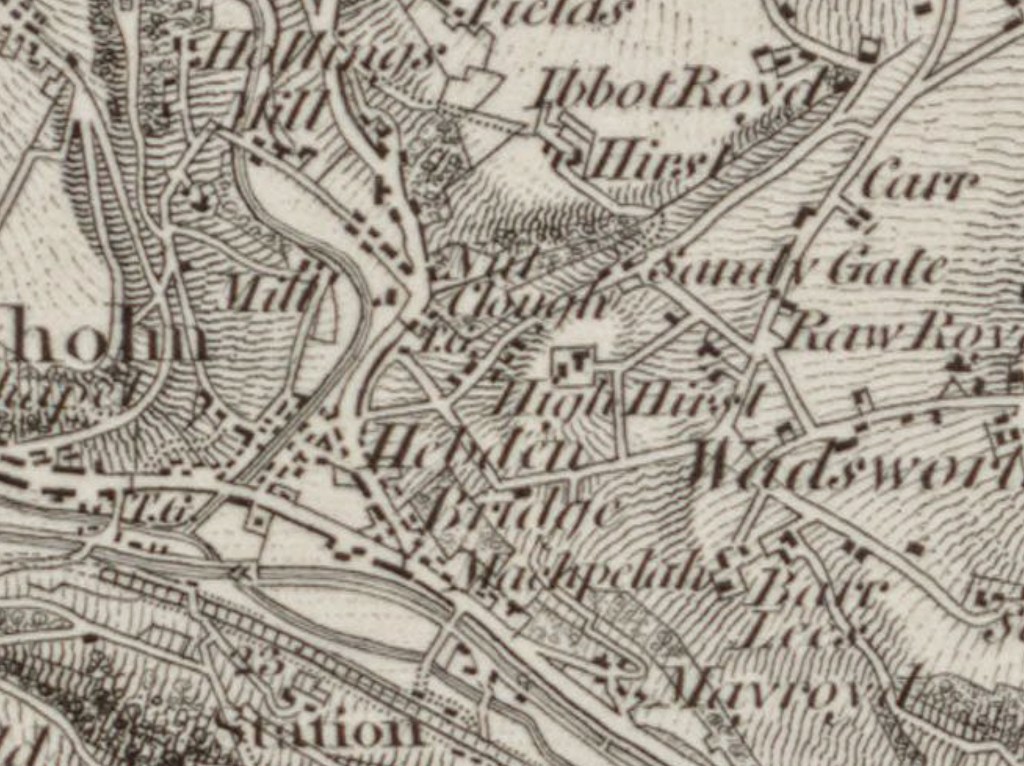
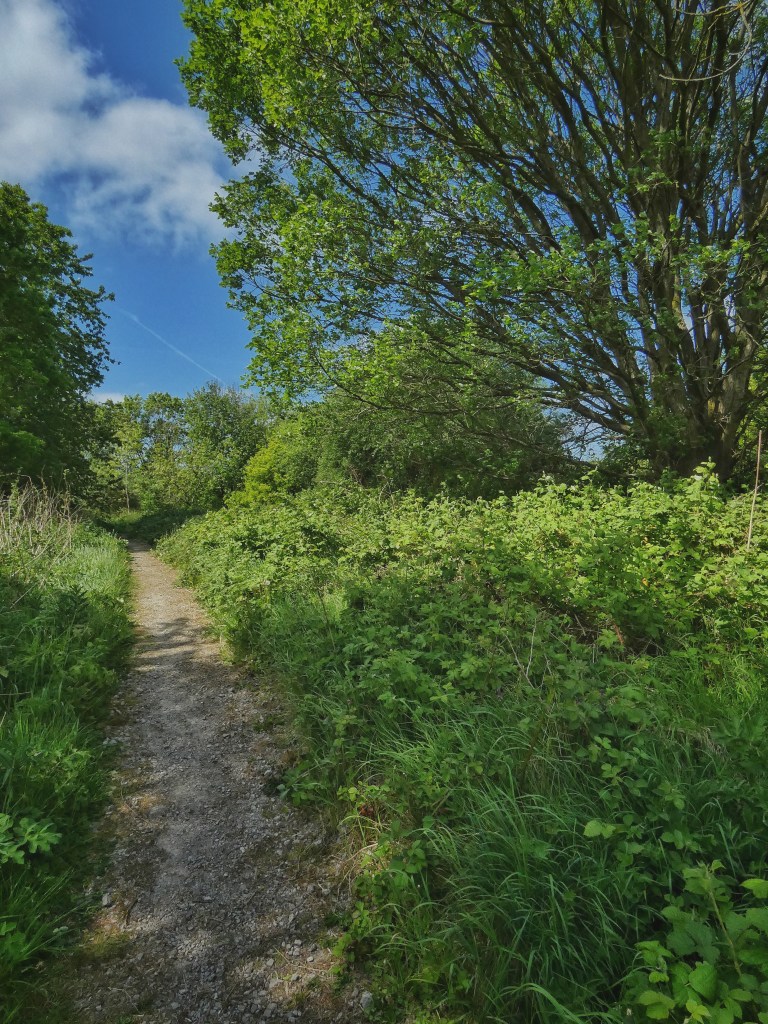
On both of these maps, the main approach track to High Hirst can be seen. This track came off Law Lane, which nowadays is the footpath from Sandy Gate to Rowland Lane running behind the reservoir. The track passed Law House (or as it seems to have been better known, Law Houses), of which just a pile of stones remains under the trees, then briefly joined what is now Manor Drive before running on beside the allotments to ascend the last little slope to the house.
In this photo, the arched entrance to the yard would have been passed through just to the right of the stretch of path in the sun.
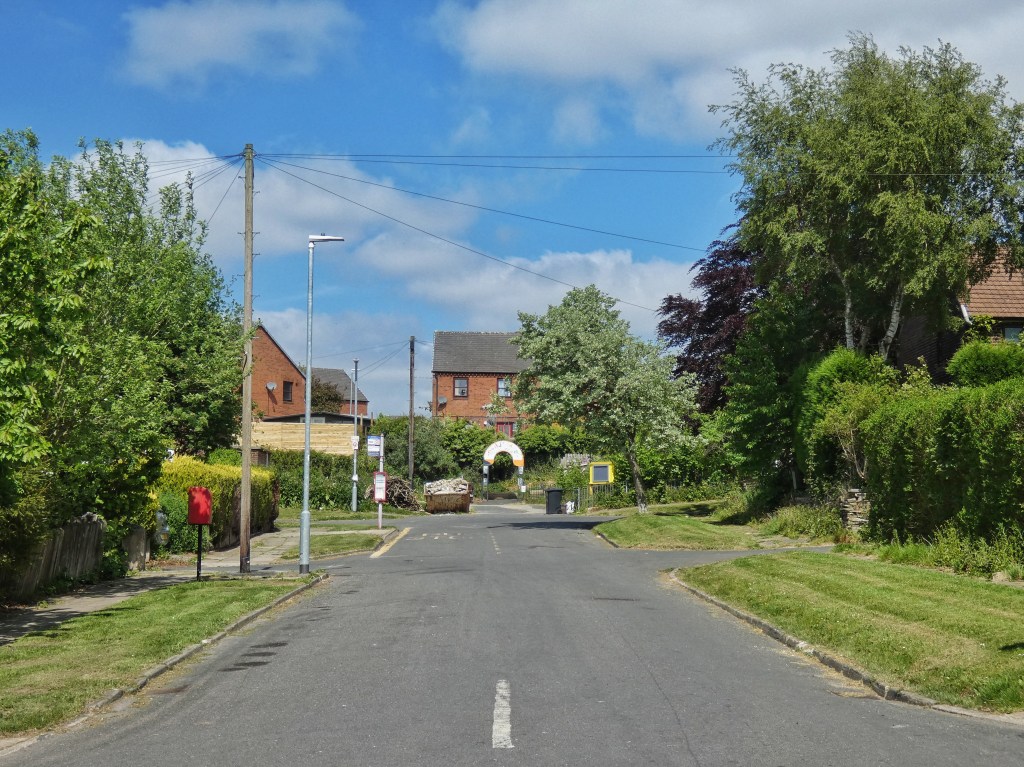
Another approach left Wadsworth Lane just as the road that leads into the Dodnaze estate does today, before making a slight bend to the right at the bus stop, passing just to the right of the arched entrance to the playground beside the Community Centre, and went on to meet the main approach from Law Lane behind number 3 Manor Croft.
This last map is the first six-inch OS map to show High Hirst.
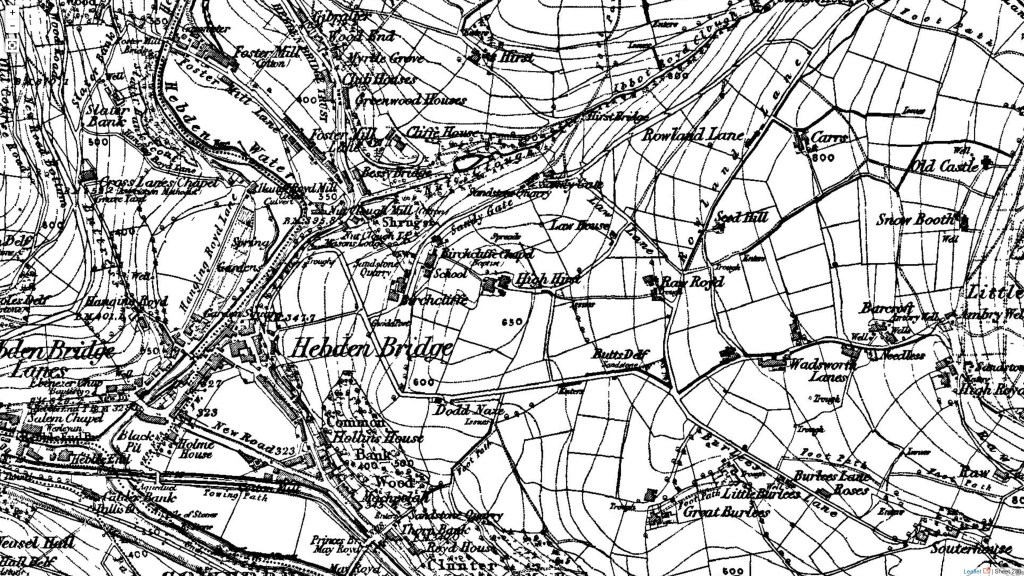
1841–1920: Life in the Landscape
High Hirst may have started as a single, solid house, standing proud on its hill, but by the early 1800s it had become something else: a cluster of cottages within the shell of an older grandeur. At some point in the first half of the 19th century, the house was divided into five separate dwellings, with two further cottages at the south end of the barn. In these changes ‒ the cramming-in of families, the bolted-on lean-tos and tiny sculleries and unsafe, ladder-like stairs ‒ we glimpse a house busier than ever, part of the working and domestic life of the district. What had once been a single dwelling with associated outbuildings had become something closer to a hamlet: a tight-knit group of households arranged around a yard or fold. One of those dwellings was always occupied by a farmer, who worked the surrounding land and used the barn and outbuildings. We will come onto those farmers in a moment, but their lives need to be understood in the context of the succession of fellow residents at High Hirst that they lived among, all pursuing very different, non-farming lives: worsted weavers and bobbin winders, cotton spinners and fustian cutters, dyers and machinists and mill hands of every kind, as well as a butcher’s servant and a railway porter, and stonemasons and quarrymen and iron moulders and wood sawyers.
Some of these residents may have just seen High Hirst as another place to live and may have ended up there by circumstances rather than choice, but in a period when most of the residential building in Hebden Bridge was taking the form of dense terraced streets down in the polluted valley, High Hirst stood apart and may have been attractive for that reason. Perched on its outlying hilltop, it offered a quieter, more rural kind of community. But rural does not necessarily mean tranquil. The census returns from 1841 to 1921 suggest a lively and well-inhabited little place. In 1841, there were 30 people living in nine separate households (so two of the seven dwellings must have accommodated two families). A decade later, 32 people lived there, albeit in only seven households. Across the next eighty years, the population fluctuated ‒ falling to 17 by 1901, and then rising again to 22 by 1921 ‒ but the number of separate households remained steady, usually around six or seven. It must have felt, in its heyday, like a place full of comings and goings: neighbours, relatives, children, visitors, not to mention the cattle, poultry and pigs who must have been a constant presence about the farm.
The local newspapers ‒ the Halifax Courier, Hebden Bridge Times, Todmorden Advertiser and Hebden Bridge Newsletter, Todmorden & District News ‒ help to round out the picture of the domestic and public lives of the residents: births and marriages, furniture sales and wartime homecomings. Louisa Jackson of High Hirst married Joseph Stell of nearby Rowland Farm in 1904; John William Jackson married Miss Betty Greenwood of Carr Head Farm in 1897; Emily Crabtree married John William Cockroft in 1909 at Birchcliffe Chapel just down the hillside.
In 1917, widower James Greenwood, who had a six-year-old child, appealed to the local military tribunal to be exempted from service, explaining that he had just moved to the hilltop farm on the doctor’s advice.
Lives came to an end there, too, of course: 33-year-old Thomas Riley (d. 1870), 76-year-old Grace Greenwood (d. 1872), and Jane Ann Williams (d. 1887) in her 27th year. Clarice Cockroft, only ten months old, died in 1911. Mr Ralph Wright and his wife lost their three-day-old daughter on Christmas Day 1919.
A handful of residents left more public traces. Mr Joseph Dobson, a respected local schoolmaster, lived at High Hirst until his death in 1853. Miss Ann Fielden gave public addresses to congregations of hundreds at Birchcliffe Chapel and the likes of the Yorkshire Women’s Christian Temperance Association, and wrote poetry that appeared in the local press. Mr Emmet Smith, born at High Hirst and later a key figure in local sanitation reform, oversaw the connecting of all Hebden Bridge houses to the sewerage network and helped halve the town’s death rate.
Others found outlets in gardening, horticulture and the friendly rivalries of local shows. Sam Pickles took a bunch of asters he grew in a little garden plot to the ninth Floral and Horticultural Society Annual Exhibition in Mytholmroyd in the summer of 1882 and came second. He did better the following year at the fourth annual show of the Hebden Bridge Floral and Horticultural Society, beating all-comers to carry off first prize in the ‘beans, 12 pods’ category, and also doing well in the ‘4 yellow turnips’ and ‘4 white turnips’ categories. And he wasn’t the only High Hirst resident competing: William Hartley of High Hirst won 2s 6d for a very particular class: ‘best six fuschia blooms, three varieties, grown within three miles of the Old Bridge’.
The community also played a role in wider civic and social life. Mr J. Holroyd contributed to a Jubilee nurses’ fund in 1897. Fred Thomas served in the British Army in Gallipoli and Egypt and returned home on leave in 1916. The year before, after Emily Stott, aged just 24, died in July, Fred Stott auctioned off the whole of his household furniture, perhaps marking the end of his time at High Hirst.
The residents hosted and took part in communal celebrations, too. In 1889, teachers, scholars and friends of the Zion Particular Baptist Chapel made their way up the hill for a Whitsuntide treat in one of High Hirst’s fields, with buns, milk, nuts and oranges sustaining the games of cricket and football well into the evening. Local cricket matches were played there through the 1890s, often by the Hebden Bridge Catholic Association team from St Thomas’s Church on Palace House Road. In May 1894, a 300-strong procession from St Thomas’s Church arrived there for their own Whitsuntide celebration.
High Hirst was even of interest to members of the Hebden Bridge Scientific Association, who paid a visit in 1882, examining sandstone nodules in the quarry just below the farm and remarking on the ‘group of antique buildings’ entered through ‘bold stone arches’. They noted the hill’s status as a geological ‘outlier’, and recorded local lore about how Royalist Sir Francis Mackworth planted his cannon nearby during the English Civil War to fire across to Parliamentary forces at Heptonstall.
For all its apparent seclusion, High Hirst was no rural backwater. It was a place where lives were lived, remembered and remarked upon ‒ with paths trodden daily between house and field, outbuilding and chapel, hillside and town.
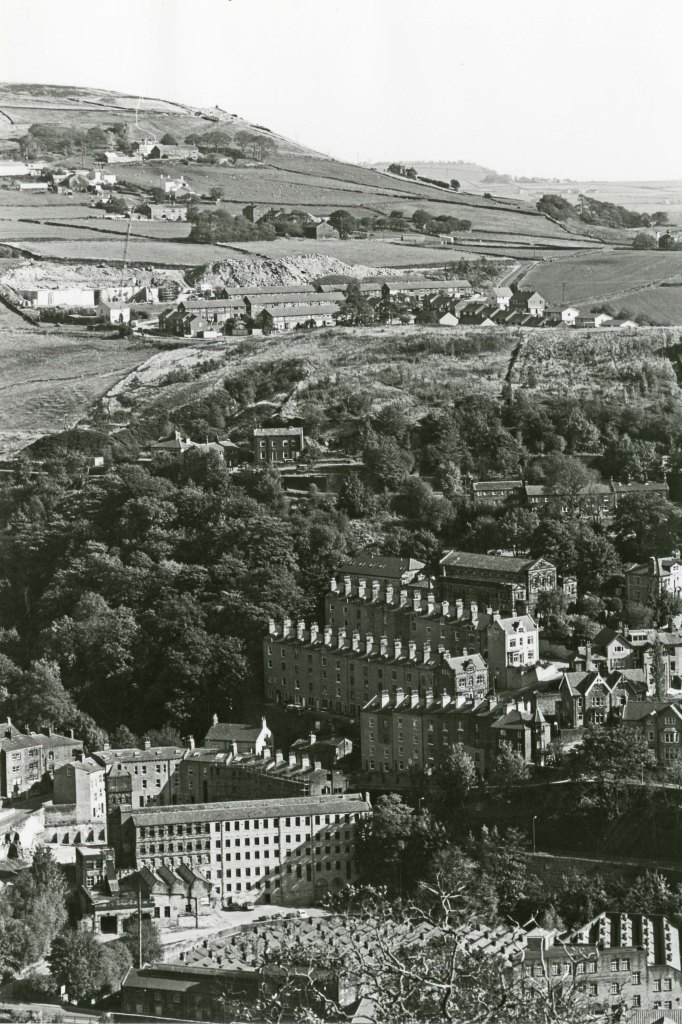
Unfortunately, no photographs survive that can convey what High Hirst must have been like at this time. But now we know something of what was going there at the time it was appearing distantly in images like this, the earliest I can find in which it was captured, its commanding outline against the sky above Hebden Bridge.
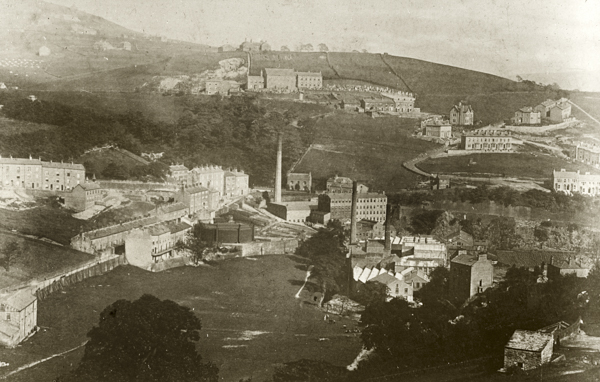
But now we are finally ready to tell the story of the farmers, our predecessors who worked in the woodmeadow. Across the 19th century and into the early decades of the 20th, High Hirst was home to a succession of farmers. Their stories ‒ pieced together from census records, auction notices and snippets in the local press ‒ tell of continuity and change, of family life rooted in the uplands, and of the changing fortunes of small-scale agriculture in the Calder Valley.
Straight away, we have an interesting story, for the farmer at High Hirst recorded in the first census, in 1841, is a Charlotte Robertshaw. Even a century later it was very unusual for a female to be running a farm. A widower aged 50, Charlotte lived with her three children, William, aged 20, and twins Mary and Hannah, both 15, all of whom were worsted weavers. She was born in Heptonstall parish in 1791 and appears to have moved to High Hirst some time after she was 30. Did she move there with her husband, who died after they arrived?
In 1849, Charlotte’ son William married Mary Sutcliffe of Walsden. But the fact that the notice of their marriage in the Halifax Guardian described him as a farmer of High Hirst was not a sign that he was to be taking over from his mother. Indeed, he must have soon after have moved out, for in the 1851 census he no longer resides at High Hirst. Charlotte is recorded as a ‘Farmer of 21 acres, employing 1 man’. She is now 62, and just one of her children, Hannah, now 25, lives with her. Hannah has a one-year-old daughter, Mary Ann. The ‘man’ who Charlotte employs is 29-year-old Joshua Harwood.
A decade later, when the census comes round again, Charlotte, whose age is given as 70, is still farming, this time 18 acres. Hannah, now 35, works as a cotton winder, and has had another child, William. Joshua Harwood is still employed on the farm as an agricultural labourer.
By 1871, the Robertshaws had gone, and the farming of High Hirst had passed to James Greenwood, a 47-year-old from Erringden, who worked 17 acres with the help of his wife Mary. Their two sons, aged 16 and 14, are already employed elsewhere, as a tin plate worker and a cotton spinner, though no doubt they had farm chores to do before and after work.
But by January 1875, James was ready to leave the land. He put his livestock and farming implements up for auction in a sale that gives a rich glimpse into the mixed nature of the little hill farm in the upper Calder Valley. The Hebden Bridge Newsletter detailed what was on offer: ‘9 head of young and healthy horned cattle’, which, the auctioneer James Crabtree claimed, were ‘rich in colour, stately in figure, and healthy in condition, and have been judiciously selected by the present owner for their yielding qualities’. Also up for sale was 100 yards of rich meadow hay, ‘grown upon land in a high state of cultivation…harvested in the best condition’. In addition, there were 17 head of poultry, five ducks, three wheelbarrows, three long ladders, a large provender chest, provender buckets, scythes, hay rakes, ropes, spades, forks, a hay knife, a hay chopper, graving spades, a butter bowl and a milk churn.
Next came Warley-born John Midgley, who by 1881, when he was 61, was farming 20 acres at High Hirst with his wife Grace and three grown children, all employed at textile mills. The eldest of his sons, James Midgley, is noted as a farmer at High Hirst in 1884, when he invested in 30 shares of the Hebden Bridge Fustian Company, so perhaps he was preparing to take over from his father.
However, at the age of 68, in 1888, John died, and another farm auction followed, again recorded in the local press: eight head of horned cattle, comprising ‘two fat Cows; red and white Cow, served Jany. 10th; roaned Cow, served March 22nd; red Cow, served Jany. 23rd; red Cow, served Jany. 27th; red Cow, served Jany. 17th; and roaned Heifer, fresh in milk; all the Farming and Dairy implements; Wood Hen Coote; about 50 Head of Poultry, including 20 Pullets; and the After-Grass up to Feby. 2nd 1889.’ That After-Grass was sold on March 5th 1889, amounting to 150 yards of ‘rich meadow hay, to be sold in lots to suit purchasers.’
The tenancy of High Hirst was being advertised in August 1888, even before the auction. It is through this advertisement that we can identify the owner of the farm, for it was Mrs Mitchell of Boston Hill who was inviting applicants to let the estate, described as ‘43 days’ work, good Meadow and Pasture Land’. (A day work was just under two-thirds of an acre, so the estate was around 26 acres.) The Mitchell Family were wealthy landowners across at Old Town; they had built a substantial house with grounds at Boston Hill and would go on to purchase Old Town Mill. However, High Hirst proved a troublesome part of their holdings, for after six months of advertisements, it was yet to find a new tenant. The notice in the Todmorden & District News was therefore expanded with further details to entice applicants. The good repair of the buildings and the reliable water supply was emphasised, and since prospective tenants might want to calculate the profits to be made from establishing a milk round, the going price for milk in Hebden Bridge was made clear: 3d per quart.
The more fulsome advertisement evidently worked, for by April 1890, 33-year-old Stephen Ridehaugh from Erringden had taken on the land. He came with his wife Ellen and their two young daughters. It was under Stephen’s tenure that High Hirst hosted the local community and its Whitsuntide events and cricket matches.
This photograph of Sandy Gate was taken around this time. It predates the replacement of the building to the left with the terrace that stands there today. A boy leans against the wall at roughly the lower entrance to our woodmeadow; this is the closest photo we have of the sward we scythe today.
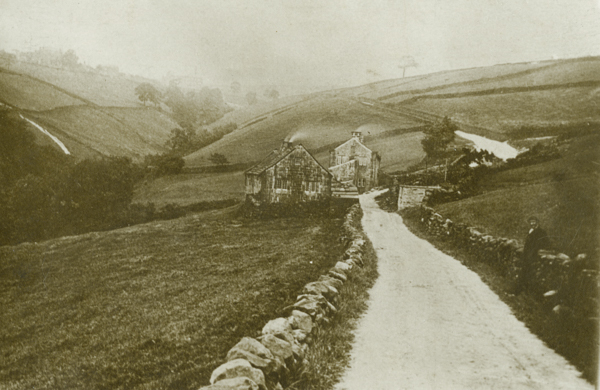

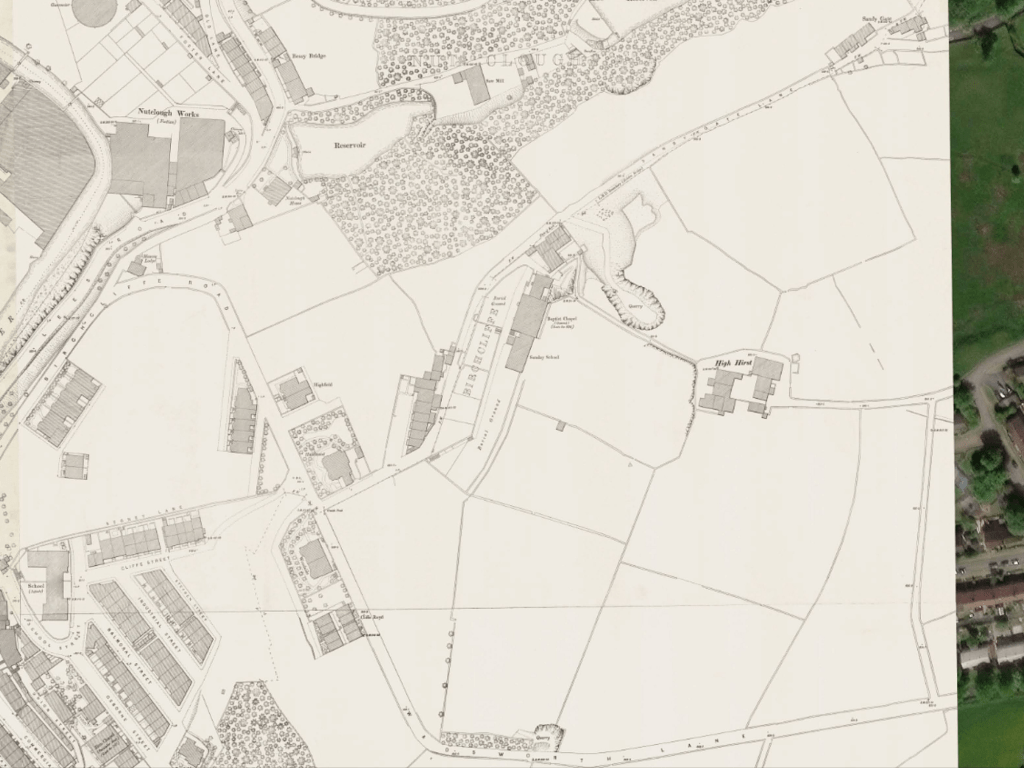
For all that he was hospitable to the community, Stephen Ridehaugh did not stay long; by the turn of the century, William Jackson, a 54-year-old Bradford man, was the farmer. He lived at the farm with his wife Jane, and they had two grown-up daughters who worked in the mills, and two teenage sons who were both listed on the 1901 census as ‘farmers son’, perhaps indicating that they were principally engaged in helping their father on the land. Six years later, when Charles, or Charlie as he was known, was 20, he was at the fifth annual show of the Hebden Bridge and Calder Valley Agricultural Society, taking home first prize in the ‘Magpie, any colour, cock or hen’ class. It also seems likely that the John Jackson residing at number 5 High Hirst in 1901, also listed as ‘farmers son’, was William’s eldest. He already had a young family of his own.
After the flux of three tenants in as many decades, there was a little more stability at High Hirst again: the Jacksons remained there for 20 years. In 1911 William is still going strong at age 65, but Henry, now 26, is preparing to inherit the tenancy, listing himself as ‘Farmer’s son working on farm’. William also perhaps has his eye on retirement, buying up several Hebden Bridge properties at auction for a combined £425 in 1912.
Henry must have taken over from his father some time soon after, but by 1920 he was ready to give up the tenancy. Before he left, he held a sale of ‘the farm stock at High Hurst Farm…The sale includes 7 choice dairy cattle (3 recently calved, 1 due in July, 1 due in September, 1 Fat, 1 fresh in condition), Capital Black Mare, 15.2 hands, 7 years old; 2 sets of Harness, 1 Set Shaft Gears, Light Block Cart, Milk Float, Deering One-Horse Mower, Bamford Hay Maker, Deering Horse Rake, Double-Geared Hay Chopper for hand or power use; Pair Seed Harrows, Chain Draize, American Hay Rake, Cart Shelvings, Manure and Milk Wheel-barrows, Ladders, Corn Bins, G.I. and Oak Lick Pails, a G.I. Water Tank, Waide’s Barrel Churn, 15 Gallon Milk Kit, Delivery and Milk Cans, Cow Chains, Rakes, Ropes, Forks, etc. NOTE – The implements are all in good condition, with some having only been used for a season or two. Auctioneer’s offices are located on Albert Street, Hebden Bridge.’
The 1910 Valuation would contain a wealth of information about High Hirst, including details of the owners and occupiers, the rent and size of the holding, a description of the buildings and land, and so on. Unfortunately, to access this would require a visit to the National Archives at Kew. It is possible, too, that there are other 19th century valuation records which detail the historic names of all the fields, including High Hirst Woodmeadow, but this, too, would require further research in either the West Yorkshire Archives or at the National Archives.
This photograph shows High Hirst above Hebden Bridge at this time, set within a landscape considerably more treeless than it is today.
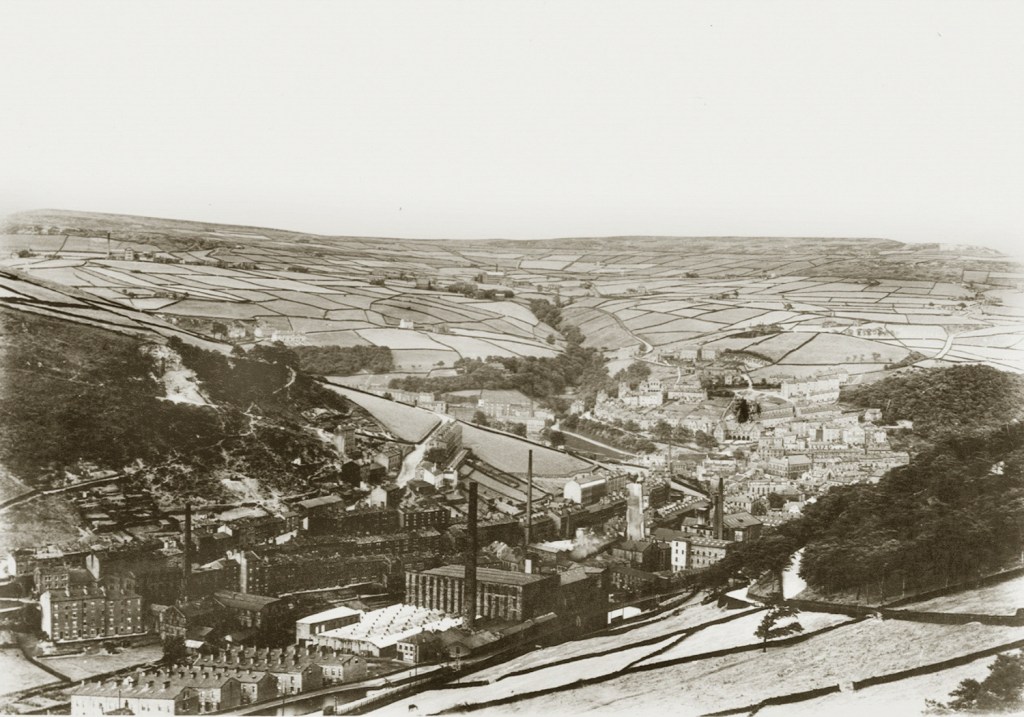
This series of farm sales, notices and census entries reveals the scale, routines and fragility of small upland farms like High Hirst. Each generation left its trace in the inventories, in the gradual changes to acreage and household size, and in the rhythm of farming life across nearly a century of social, economic and agricultural change.
1920–1943: The Heyday of Haytimes
When Harold Lindsay Rutlidge took over High Hirst Farm in 1921, he stepped into a long-established farming landscape, but would take it into the modern era. The 1921 census paints a picture of this small rural community: 22 people living in seven dwellings, still full of joiners and machinists and weavers, but also including Harold’s predecessor, retired farmer William Jackson, then 73, residing at number 4 with his housekeeper Clara. William, still within sight of the farmyard, would no doubt have kept a watchful eye on his successor.
Rutlidge, then 53, hailed from Kirkby Lonsdale in Westmorland. He was accompanied by his wife Elizabeth Ann and their two sons. The elder, Harold, 23, was born in Kirkby Lonsdale, but the fact that 18-year-old John was born in Burnley suggests that the family had had a short stint in Lancashire.
John was already working alongside his father, ‘assisting in general farm work’, but Harold was noted as ‘not occupied’. It seems likely he fought in the First World War. Could this have been connected to the tragedy that struck not long after their arrival? On 7th November 1921, months after he was counted in the census, the younger Harold died at the age of 23, cutting short a life and future that might have been spent on the land.
Through the 1920s and ’30s, Harold senior continued to build a reputation in the district as a capable and sometimes pioneering farmer. He was not afraid to take matters to court when he felt he’d been wronged: in 1927, he successfully sued William Cockshott of Outwood Farm for £8 in damages over a cow sold as in-calf, which turned out not to be. Although the judge believed Cockshott had acted in good faith, he found that a verbal warranty had indeed been made and not fulfilled.
That same year, Rutlidge took part in the bustling Hebden Bridge and Calder Valley Agricultural Show. Held every May and in its 25th year, this was a significant event in the life of the district, with nearly 1500 entries in classes across all kinds of livestock, horses, dogs, pigeons, rabbits and cavies, as well as butter and eggs. Harold entered in the ‘Milk Dealers’ Turnout’ class, where competitors were judged for ‘Best and Neatest Turnout, with harness, conveyance and milk cans, used for the purpose of conveying milk’. We can deduce from this that Harold had a milk round, and his second-place finish to neighbour Clarence Burdess of Mayroyd Farm suggests both a competitive streak and a professional pride. Two years later, he again claimed second prize, this time in the cattle classes, with a young bull, in the ‘Bull, any breed with not more than four teeth’ class.
In September 1927, Harold became something of a local pioneer. He was congratulated by Hebden Bridge Urban District councillors on being the first farmer in the district to adopt electric lighting, with an application for an overhead cable being granted – an innovation that would later underpin the farm’s model dairy operations.
But not everything went smoothly. In January 1928, a milk float belonging to the farm ran away down a steep bank after being left unattended, overturning at the bottom. Though the horse was unharmed, milk was spilled, shafts were broken and a public seat knocked over – fortunately with no human casualties. Trouble with the law came again in 1930 when Harold was fined £1 for moving 10 pigs – bought from Sowerby Bridge market – to a bacon factory without the proper licence, an oversight he admitted in writing. Officials used the opportunity to remind farmers of the strict rules: pigs must remain on the holding for 28 days unless re-licensed.
Perhaps Harold and John were out in the fields the day the aeroplane flew over to take this photograph in 1931.
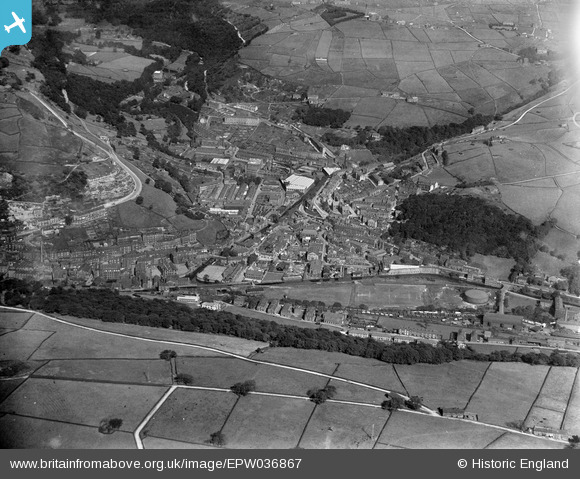
By the mid-1930s, Harold and his son John were gaining recognition for their farming standards. In 1934, both were awarded diplomas in the Yorkshire Clean Milk Competition, a joint initiative of the University of Leeds and the Yorkshire Council for Agricultural Education to improve hygiene and quality in milk production. That September, a group of councillors touring model developments in the area – Gorple Reservoir, the Electricity Works, the sewage works – visited High Hirst, now jointly run by father and son. They found spotless dairy facilities, an electrically cooled and bottled milk operation, and clean cattle – a modern farm of distinction, and said to be the only one in the district with such up-to-date equipment.
Harold had invested in infrastructure too, commissioning a new cowshed in 1933. But it was John who increasingly came to the fore, though in 1936, he was fined £1 for speeding on Burnley Road in the motor milk-van, perhaps a sign of the growing pressures and ambitions of a younger generation.
John also played a role in community life. In December 1938, he presented a silver tea set to Miss Oxley, retiring teacher at Colden School, and spoke warmly of her work. A former pupil himself, he recalled how she had come ‘half across the world to teach such a tough lot as himself and his fellow scholars’.
By 1939, with war looming, the census register shows John as the head of the farming household at number 5 High Hirst. Now 36, he was described as a dairy farmer, living with his wife Sarah and their domestic servant Margaret Cohn, aged 21. Two additional occupants are recorded, though their identities are closed to public view, but we can assume this is Harold and wife Elizabeth.
That same year, John appeared in the Juvenile Court, having reported an 11-year-old boy for smashing windows at nearby Law Houses, where he had been meeting a prospective tenant. The boy was found guilty and fined.
It was more important than ever that farm life continued once war was declared. In May 1942, John was given permission under Defence Regulations to plough up a footpath crossing one of his fields, on the condition that an alternative route be provided and proper notices posted – a small moment, but one that speaks to the changing pressures on land use during the war years. The following month, a disaster was just about averted, when Mrs Rutlidge (either Elizabeth or Sarah) spotted a fire in the main barn. Farm workers tried to control it with buckets before three National Fire Service teams arrived and, using water from a farm tank, contained the blaze. While the fire caused dense smoke and some damage to hay, barn doors and part of the roof, an adjacent cottage was saved.
Harold, at the age of 73, had stepped back from public life the previous year, retiring from the committee of the Hebden Bridge and District Farmers’ Association. By then, the weight of responsibility for the farm lay with John, as confirmed in the National Farm Survey. Conducted in 1941, 42 and 43 inspectors were sent to all 300,000 farms in the country. Detailed returns were filled out on every aspect of their operations. High Hirst’s returns are below, which I will then summarise.


When he visited in March 1943, the inspector J.E. Crabtree found High Hirst to be a well-run, integrated holding of nearly 39 acres, stretching beyond the home farm to include nearby Rowlands and Raw Royd. John also managed the separate 10-acre Carrs Farm, which was record separately. He, like the farmers of High Hirst since at least the 1880s, was a tenant of the Mitchell Estate.
The land was classified as having medium (rather than heavy, light or peaty) soil, and the farm layout was considered moderately good. The condition of the buildings – including the farmhouse, the six cottages (two of which were let on a service tenancy) and other structures – was described as fair, as was the state of the arable land and pasture. While the walls and field drainage were also in fair condition, the farm roads were judged to be in good repair.
There were no problems with pests or weeds, and no fields were judged as having fallen into dereliction. The holding was well supplied with water from a well that served the farmhouse, outbuildings and fields. An electricity supply was in place, and the farm was given an overall classification of A, the highest rating under the wartime National Farm Survey system.
The holding consisted of 25 fields. Two of these contained the farm buildings, one at High Hirst and the other at Raw Royd. Six fields totalling around 10 acres were classed as meadow, with 12 fields, amounting to nearly 21 acres, as pasture. One field was under lucerne (a legume used as a forage crop for livestock), and three were used to grow oats. Two fields shifted between uses across the years 1940 to 1943, one from silage to roots, one from oats to roots and back to oats. The crops of oats, roots and lucerne were unlikely to have been grown were it not for directives from the War Agricultural Committee.
John employed a small team to work the land. There were two full-time male workers over the age of 21, along with one woman or girl (age not given) engaged in farm work. (This female may have been Land Girl Margaret Pickles, who in 1993 recalled working for John Rutlidge 50 years earlier, helping to ‘do the milking by machine, getting up at 5.30 am to make an early start’.) Two more men, also over 21, were employed as casual, part-time workers throughout the year. None of the workers were close family relations of Mr Rutlidge or his wife, though they may have been more distantly related.
He kept 23 head of cattle in total at the time of the survey: 21 cows and heifers in milk, one cow in calf but not in milk, and one bull for breeding. He kept no sheep. The pig stock consisted of one barren sow being fattened and eight younger pigs aged between two and five months. The farm also kept 120 fowls over the age of six months, and there was one working mare. No fruit or vegetables were being grown for human consumption on a commercial basis. The farm was run entirely without mechanical motive power – there were no steam engines, electric motors or tractors.
Using the field records on the primary return, I have determined the extent of the Rutlidges’ holding, and what each field was used for at that time, and made this map. Dark green is pasture, light green meadow, yellow for oats, brown for roots, purple for lucerne, and blue-green for silage. The striped fields, numbers 28 and 150, alternated their use across the years 1940–43 between silage and roots, and between oats and roots respectively.
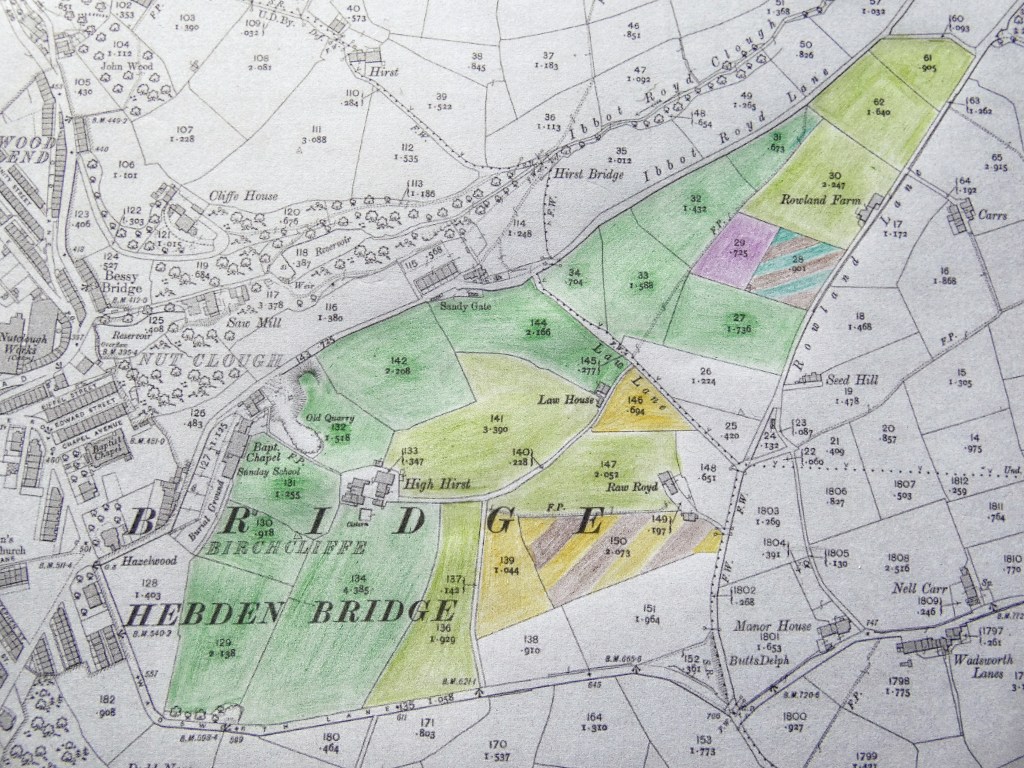
From these records, we get an indication that the main part of the woodmeadow that we scythe today (field 142) was not historically a meadow. We will never know if it was mown at other, earlier times, but it stands to reason that if it was, it was only occasionally, since meadows tended to be the flatter fields that were closest to the farmhouse, as can be seen on this map. The tended to be flatter so that they were easier to scythe, and closer to the farmhouse (or, rather, the barn, or ‘laithe’ as barns are locally called) so that the hay did not have to be transported, or ‘lead’, too far, either carried as ‘burdens’ with hay rope or dragged by sled. Field 142 is neither flat, nor the closest to the barn that is on offer. (The hay from 147 would likely have been stored at Raw Royd, and that from 30, 62 and 61 stored at Rowlands.) However, field 141, which today is split in two by a fence, both sides of which are managed as part of the woodmeadow project, was a meadow, at least in the 1940s. It is perhaps surprising that field 134, to the immediate south of the farm, was not managed as a meadow, but perhaps it was too big, and would have produced more hay than was required.
From the arrival of Harold in 1921 to John’s stewardship in the 1940s, the Rutlidges brought High Hirst through a time of transition – technological, social and agricultural. Their legacy was one of steady progress, local involvement and care for the land. But even as the inspector was judging his farm, the family must have already known their time at High Hirst was over, for just two months later, on 6th May 1943, at 1.30pm, they will have watched as their farm stock, vehicles, tools and all the other paraphernalia accumulated over a lifetime of farming was sold.
Conducted by auctioneers Crossley, Crossley and Uttley of Halifax, the items in the auction were as follows:
20 CHOICE DAIRY COWS (5 Springing, 4 due August, 4 due September, 6 for later dates, 1 Registered Pedigree Ayrshire Bull, 2 years old).
HORSES. Excellent Black Van Mare 16 hh., 8 years old, a very good stamp, well-known, both good workers.
VEHICLES. 16 h.p. Austin Motor with Utility Well Body in Good Order; Pickering Milk Float, Pneumatic Tyres; Steel Tyred Milk Float; Low Manure Cart on Pneumatic Wheels; 2 Hay Carts.
IMPLEMENTS, etc. S.H. Deering Mower; Pair Horse Albion Mower; Bamford Shaking Machine; Martin’s Side Delivery Rake; Ransomes Plough, also Fitted for Ridging; Scruffler Seed Harrows; Spiked and Chain Harrows; Turnip Pulper; Stone Land Roller; Electric Clipper; Lime Washing Machne; Bench and Vice; 12 Single Water Bowls; 2 G.I. Tanks; Pig Stocks; Ladders; Ropes; Cattle Medicines; 2 Sets Shaft Gears; Set Harness; Plough Pad and Chains; and usual small Utensils and Effetcs.
DAIRY. Hall Mark Refrigerator, 6o cubic feet capacity Twin Cylinder Compressor Brine and Water Cooler; Smithfield Refrigerator 90ft capacity; Diablo Cream Separator; Boby’s Butter Churn; Butter Worker; Scales and Weights.
BUILDINGS. Holgate’s Portable Silo; 4 Sectional Hen Cites, 24ft. x 10ft., 8ft. x 6ft.; Garage for two Cars; Old Garage, 20ft. x 10ft.; Wood Cow Shed for 6.
Few items of Household Furniture including Oak Extending Dining Table; Linen Cupboard; Small Bookcase; Penticon Pressure Cooker; Cooking Utensils, etc.
It was an entirely new life they were seeking, for by 1948 John and Sarah were settled on a 1400-acre ranch and coffee plantation in ‘British East Africa’ (Kenya). They were still there in 1955, and their sons, Eric and Harold, were 150 miles away in Kakaru doing their National Service in the Kenyan Police.
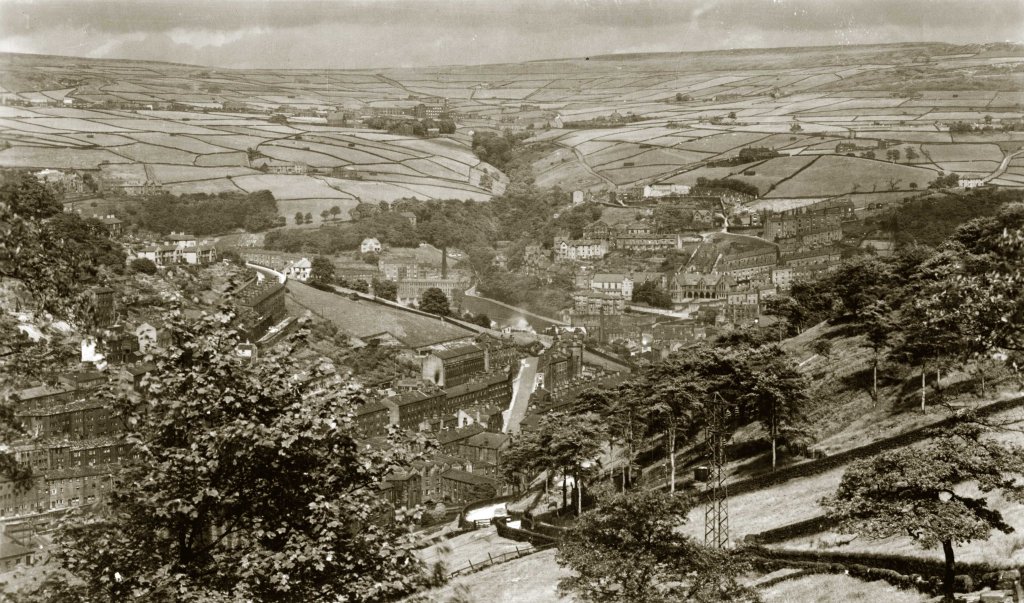
1944–Present: From Dereliction to Reconnection
High Hirst was to have just one more tenant after the Rutlidge family left. But Thomas F. Greenbank barely had time to get to know his land, for in the closing months of the Second World War, Hebden Royd Urban District Council made a pivotal decision. Acting on the recommendation of a sub-committee that had interviewed representatives of the Mitchell Estate, the Council agreed in August 1945 to purchase the entire High Hirst Farm estate, an acquisition that covered an area of 30 acres. (Note: this was not co-extensive with the Rutlidge’s holding in 1943; it excluded everything east of Law Lane, but included fields 138, 151 and 148, which were not part of their holding.)
Just over a year later, then, on 25th September 1946 at 1.30pm, High Hirst was to see one more dispersal sale. Advertised in the Todmorden & District News, the auction featured 20 young dairy cattle, among them four newly calved, two recently calved and a dozen due to calve in October. Thomas also sold a ‘Capital Bay Mare 16 h.’, and a complete array of dairy equipment: a bottle cleaning machine, electric turbine bottle brush, bottling machine, and a large quantity of bottles and cardboard caps. The sale included 20 Ancona hens, four poultry houses, a chick cote and an electric chick brooder.
And with that, farming at High Hirst, at least four centuries from the farmhouse but likely considerably longer on the land itself, was at an end. By January 1947, the Council had completed the land transfer for Dodnaze and began reviewing tenancy arrangements. All tenants across the High Hirst estate with six-month agreements were to be served notice, with the option to enter four-weekly tenancies instead.
That spring, a last echo of Stephen Ridehaugh’s time there 50 years earlier returned, when Birchcliffe Cricket Club briefly established a new pitch at High Hirst, competing in the Hebden Bridge League against teams from Salem, Lumbutts, Old Town and Heptonstall. By November, however, the club had returned to its former field at Nell Carr, where it had played more than forty years earlier.
Plans for the major new housing development were announced in May 1947: 270 houses were proposed, and the farmhouse, barn and cottages at High Hirst were to be demolished, as well as the buildings at Law Houses and Raw Royd. The new development was to be called the High Hirst Estate.
By November 1948, the estate layout was being finalised. It appears that it was due to extend down to Sandy Gate across what is now High Hirst Woodmeadow and Law Field. Indeed, when Kevin and Jackie Bailey moved into No. 2 Sandy Gate in 1980, the previous owner, Mrs. Smith (who died in 1995 in her mid-80s), told them them she recalled the woodmeadow being pegged out for housing. But for the time being that portion was excluded from the first phase of building.
But at least for now, eviction and demolition did not seem to be imminent, with the Council obtaining estimates for reconditioning two cottages at Law Houses and High Hirst. Councillor J. W. Sutcliffe remarked that although these buildings were not ideal, they remained suitable for some tenants. Tenders for repairs to High Hirst farmhouse were accepted in January 1949.
Construction of the new houses was slow. By August 1949, only 20 had been completed, which can be seen on this map revised the previous year.

The Housing Committee even recommended abandoning the High Hirst Estate plans altogether. Of the 30 acres acquired, half was found to be unsuitable for housing. Infrastructure issues, particularly sewerage and excavation near Sandy Gate, had already hindered plans. The Council was urged to sell the land so it could return to agricultural use. Was High Hirst about to get a reprieve?
Cottage repairs continued into the early 1950s. In February 1951, the Housing Committee approved £176 for further work. That March, the Council confirmed it owned 14 properties across Raw Royd and High Hirst, purchased for a total of £2,300.
The farm was still occupied in 1955, and still full of ‘characters’: a resident named Leslie Shaw lived at High Hirst in February of that year, when he was remanded in custody for an attempted robbery at the Hebden Bridge Working Men’s Club.
On the ‘Old Photos of Hebden Bridge Pre 2000’ and the ‘Hebden Bridge History and Memories’ Facebook groups, former residents have reminisced about playing in the area of High Hirst as children. I will summarise these, without identifying the individuals, since they posted their memories in private groups.
One woman calls High Hirst a ‘complete community’ before it was abandoned. She mentions flying a kite while standing on the ruins of the house, and recalls bonfire nights. She remembers the council making safe the water tank at High Hirst by blowing a hole in it. She also discusses the construction of Hirst Grove and Dodnaze. She mentions the years 1961–1963 as a possible time frame for when the buildings were still standing, based on her memory of the area being under construction during that period.
A friend of hers, also recalling these events, was the kite’s owner. She broke and lost a fingernail in the concrete water tank at High Hirst. She remembers trying to protect the bonfire from sabotage by digging a trench around it and covering it up with sticks as a booby trap, but one year it was set alight early and they had to start ‘plotting’ (collecting wood and building the bonfire) all over again. She recalls a belief among the children of the community that there was a passage from one of the High Hirst fireplaces down into the graveyard of the old Birchliffe Chapel, though this passage was never found.
One man remembers playing in the ruins of High Hirst, creating a football pitch with friends and celebrating bonfire nights there. They used the huge roof joists as the centre poles for the bonfires, and he recalls the bonfires being so large that local dads had to help with the construction.
Another contributor was born at number 6 High Hirst in 1950 and has strong memories of living there, including playing in the well and around the farm with friends. He also recalls building large bonfires using materials from the farm.
A former resident of the Dodnaze estate from 1961 to 1973, has memories of the old farmhouse at High Hirst still standing around 1960, as captured in a photo she found at her father’s house.
Another lady recalls growing up on the hillside and mentions the local farmer George Matthews, who lived at Carr Farm, gave her a collie pup when she was a child. The pup would trot across the fields on most days to visit her mother back at the farm.
A man who lived across from High Hirst for six years recalls playing inside the barn and the well.
One woman, who was born at number 3 High Hirst, said her husband’s parents (who must be Thomas F. Greenbank and his wife) came from Cumbria to work on the farm. After a seven-year hiatus away, they returned and took over the farm for three years until they left in May 1947 upon the sale of the farm to build the housing estate.
By the time architectural historian Christopher Stell documented the site in 1956 and again in 1957, High Hirst was indeed falling into dereliction, as these memories attest. The photographs he took, which I have not obtained permission to reproduce here, can be viewed on the Historic England website, with various views of the exterior, including of the arched entrances into the central yard, one of which has iron gates bearing the name ‘High Hurst’. These images can be seen here and here. Others show architectural details like a label stop, a mason’s mark and plaster friezes, as well as the magnificent hall fireplace. These can be seen here, here and here. He also drew an architectural plan, here.
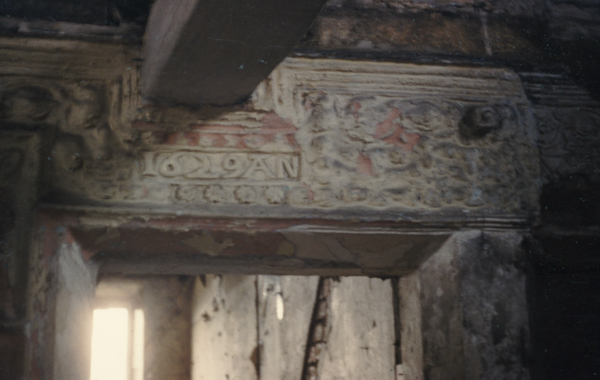
Noted architectural photographer Ralph Cross had also visited a few years before Stell, but we only have his image of the 1629 plaster frieze. This was not the oldest part of the house, which was late-16th century, but was part of a later addition.
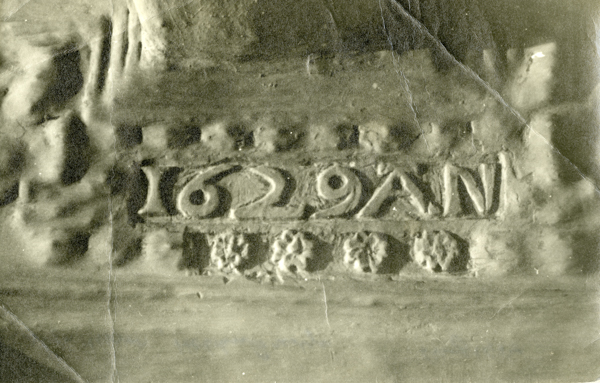
Through the following series of photographs, we can see the last days of High Hirst. The first five seem to have been taken on the same day.
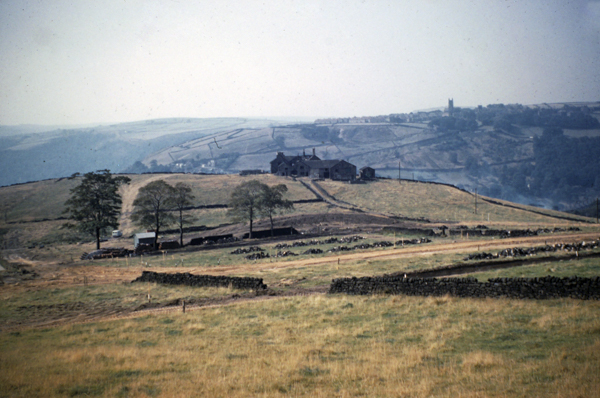
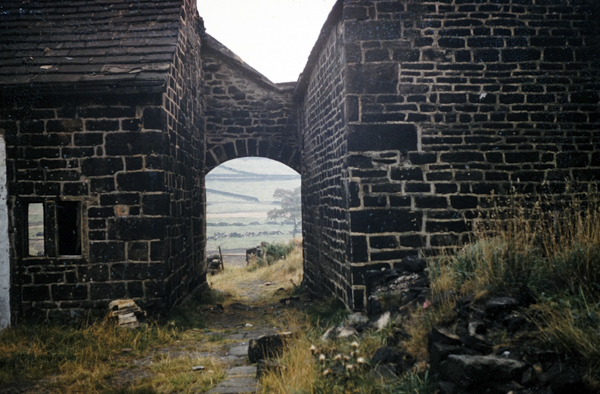
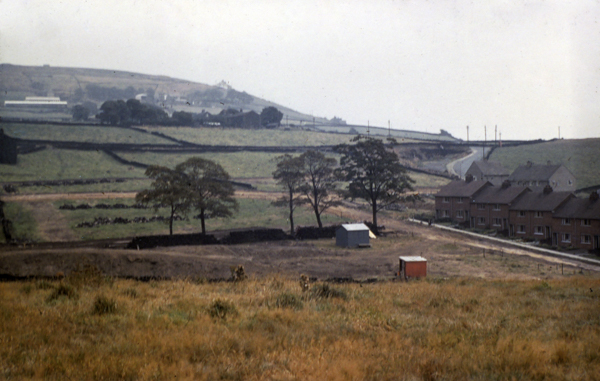
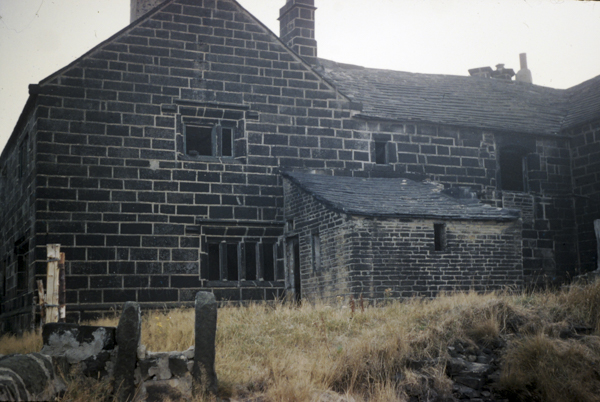
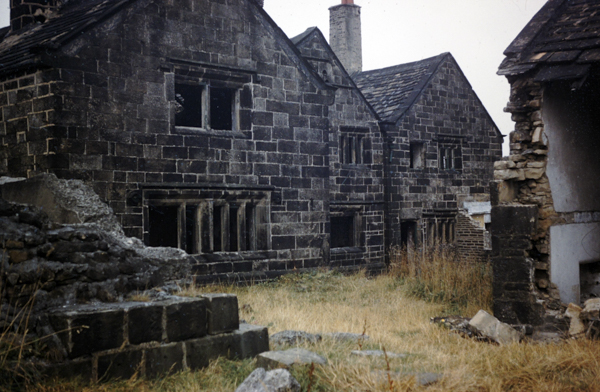
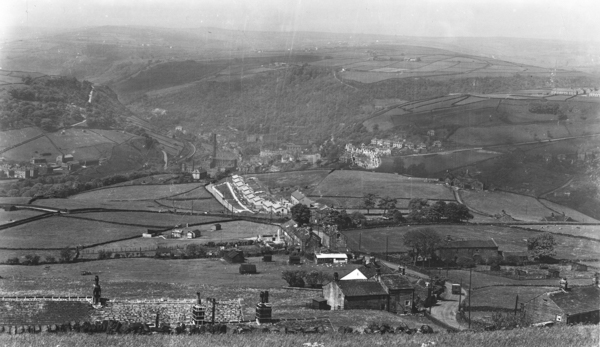

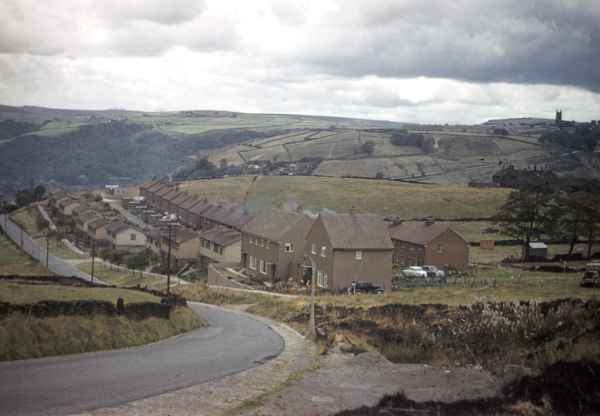
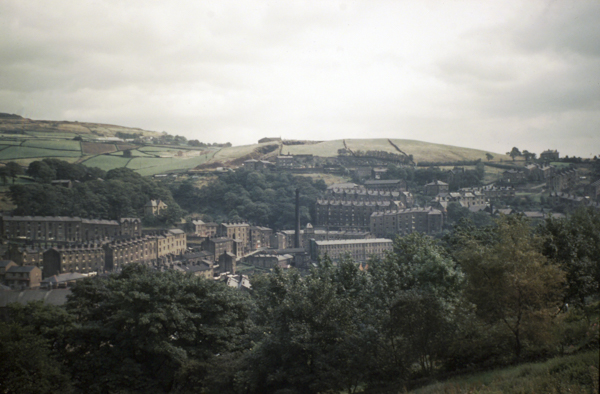
Demolition finally began in August 1960. Its stone was to be reused to build roads and infrastructure for 48 new houses in the area. For a while, most of the farmhouse and adjoining cottages having been dismantled, the barn and other outbuildings remained standing, a hiatus in demolition captured in the 1961 map below. At this time, Law Houses, though still upright, were in poor condition. Raw Royd had already been demolished, making way for the reservoir.

By May 1962, the demolition was complete. All that remained was rubble. A report noted that the rocky foundations made the land unsuitable for further housing. The water tank (where the current-day basketball hoop stands), which also once supplied the cottages at Law Houses and Raw Royd, had been emptied and made safe.
The two photographs below show the aftermath of demolition.
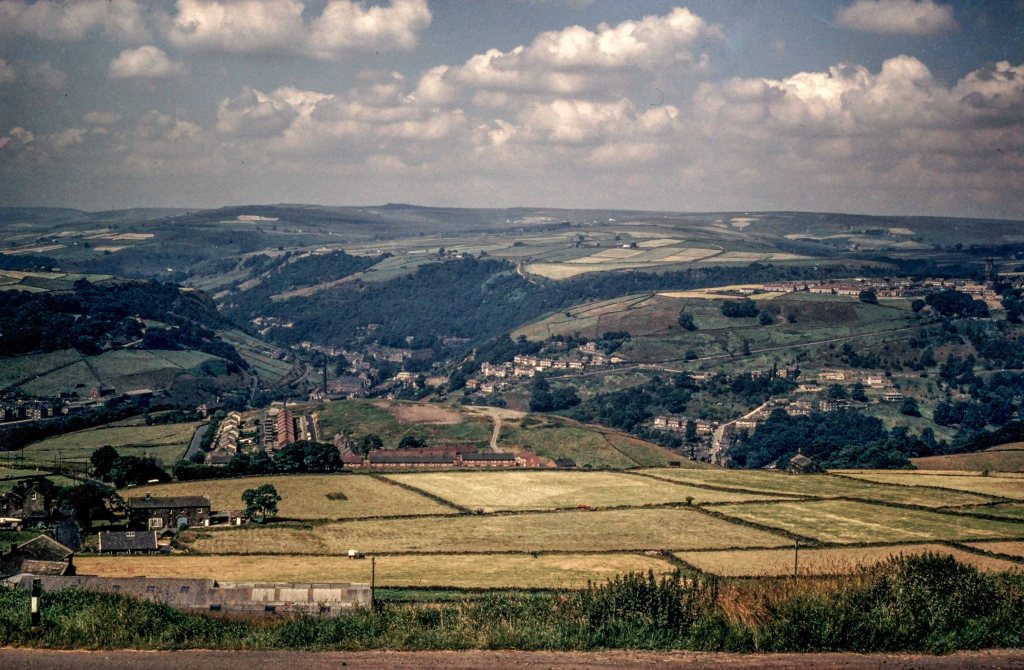
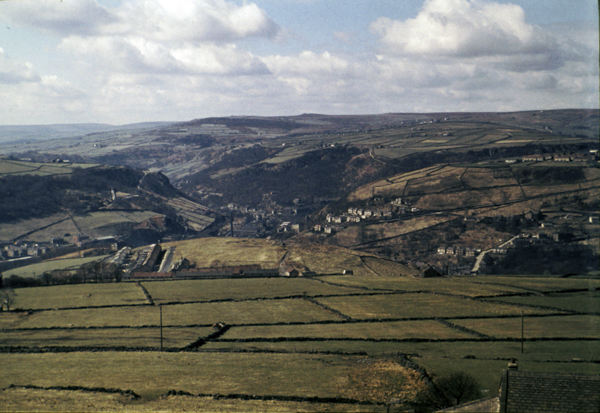
The site today seems to hold no memory of the house and barn.
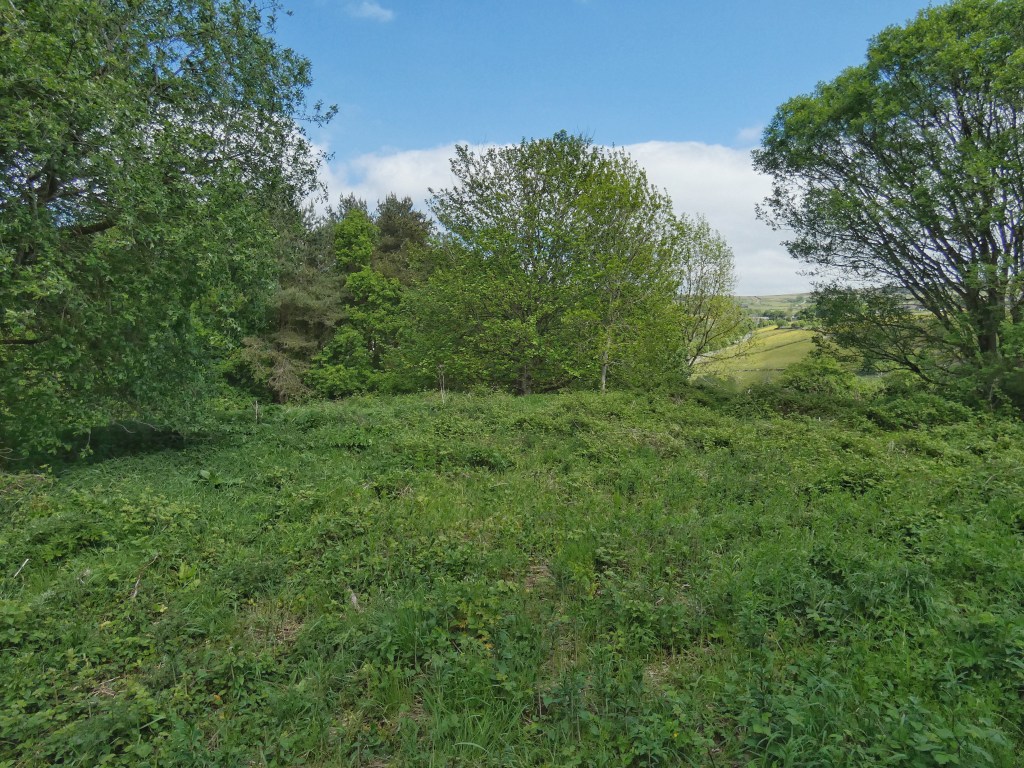
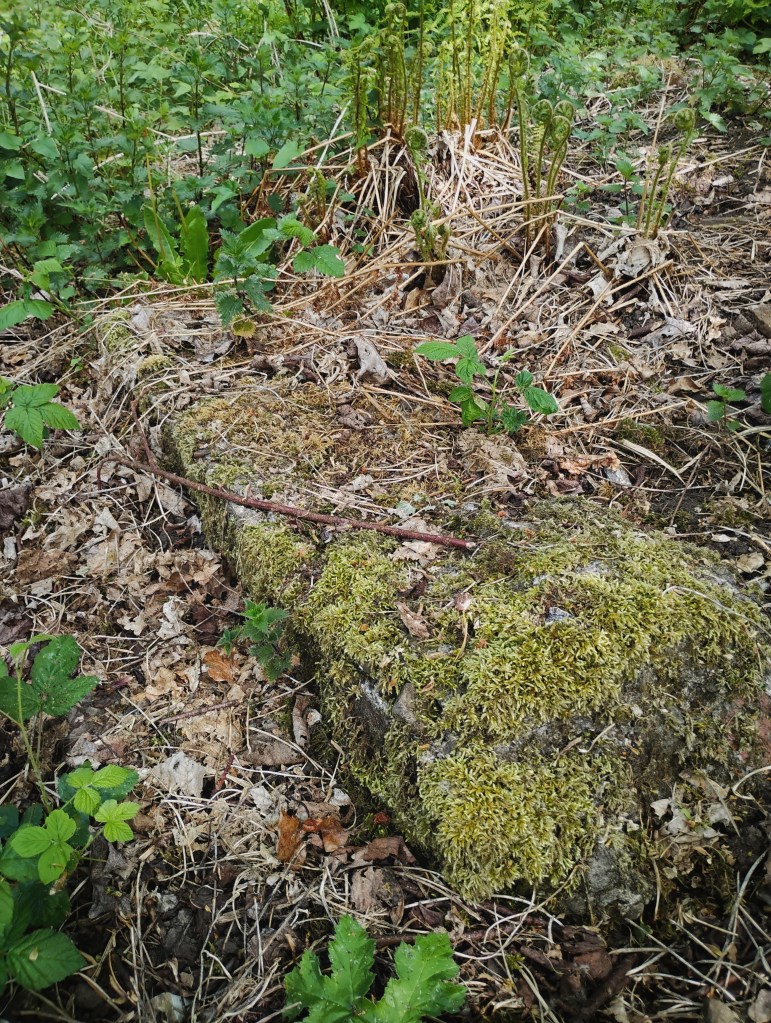
But look closely under the sycamore, and among the nettles and brambles and buckler ferns, you can find a stone or two that was left behind.
And the 1629 plaster frieze was installed in the Chantry House in Heptonstall by Jack Smith in 1965, and remains there still.
Of the 270 houses planned for the High Hirst Estate (which of course never adopted the name, and became known as the Dodnaze (or Dodd Naze) Estate), only half were built, and less than half of the 30 acres were developed, and that includes the reservoir, the playing fields and the allotments.
Kevin and Jackie Bailey, who lived on Sandy Gate during the 1980s, recall that an Ian Matthews farmed the land, maintaining a dairy herd and delivering milk locally. His farmhouse, located near the Hare and Hounds pub, has since been converted into private homes. The Council, having ended farming from High Hirst itself, evidently saw no reason not to lease the parts of its estate not being built upon to local farmers.
When Matthews retired in the early 1990s, John Hitchen of Crib Farm near Luddenden Foot took over the grazing under rental agreement with Calderdale Council, who had taken on the land from Hebden Royd Urban District Council at some point. Hitchen introduced beef cattle, including a bull, which he transported by lorry. Often, the fields were left ungrazed, allowing wildflowers to flourish – an era the Baileys remember fondly. Occasionally, the fields were cut for silage to feed animals back at the home farm.
But not all of High Hirst’s fields continued to be farmed; nine acres of the slopes of High Hirst’s lower pastures quietly re-wooded themselves, with some assistance, over the decades, and it became a hēah hyrst again.
In November 2003, the Dodnaze Community Association secured a Living Spaces grant to complete the High Hirst Walkway, a wheelchair-accessible route along the estate’s edge which passes almost exactly through the vanished archway into the central yard. In its name, carved on a stone along the route, was an acknowledgement of a farm and its cottages that once stood here, and the centuries of lives lived within them.
Continuing the Story
Thanks to today’s town councillors, the successors to those of that purchased High Hirst 75 years earlier, on a July weekend of 30-degree heat in 2022, there was a sight at High Hirst that cannot have been seen in the Calder Valley since the Greenbanks left the farm in 1945: 12 scythe blades slicing through the sward, combing the meadow into stripes of windrows and short-cropped swaths. It was the fulfilment of a vision to revive a traditional form of management that creates and sustains incredible diversity, for sheep’s fescue and sweet vernal grass, meadow vetchling and pignut and dozens of other delicate wildflowers thrive when the summer growth is removed after they have set seed, keeping nutrient levels low and the more vigorous grasses in check. And this is not even to mention the wealth of fungi held within the undisturbed soil, the extent of which is still being discovered.
Somewhere in the minutes of meetings long forgotten is recorded the reason why our field was never built upon, but whatever it was, it evaded the bulldozers and slipped past the post-war transformation of agriculture, and was unknowingly preserved – not as a fossil, but as a seed. In our work – of scything, baling, grazing – we are continuing a conversation with the land, using old methods to meet present needs.
And in uncovering the history of this place, we can now honour those who stewarded these fields before us – Thomas Greenwood, Harold and John Rutlidge, William and Henry Jackson, Stephen Ridehaugh, John Midgley, James Greenwood, Charlotte Robertshaw and all the rest back to Abraham Nayler – and see our labours on the land as the latest part of a centuries-long arc of care.
Acknowledgements
Thank you to Neil Diment for inviting me to write this history, to Ann Kilbey for supplying me with the photographs from the Pennine Horizons Digital Archive, and to Renos Christodoulou for his invaluable help with the census data.
References and Resources
High Hirst Woodmeadow Moth Report, 01/07/2023, Charlie Streets and Anthony Arak, 2023.
Britain from Above, https://www.britainfromabove.org.uk/
British Newspaper Archive, through which I have accessed newspaper articles from, among others, the Halifax Evening Courier, Todmorden & District News, Yorkshire Post and Leeds Intelligencer, Leeds Mercury, Yorkshire Evening Post, Todmorden Advertiser and Hebden Bridge Newsletter, Halifax Guardian.
Malcolm Bull’s Calderdale Companion, http://www.calderdalecompanion.co.uk/
1841–1921 Censuses
High Hirst Woodmeadow: ‘a Field Full of Flowers’, Neil Diment, 2022.
Hebden Bridge Local History Society archive catalogue, https://www.hebdenbridgehistory.org.uk/catalogues/hblhs-archive-catalogue
Ordnance Survey Maps, viewable at the National Library of Scotland map images site, Six-inch maps 1842–1952 (https://maps.nls.uk/os/6inch-england-and-wales/), 25-inch maps 1841–1952 (https://maps.nls.uk/os/25inch-england-and-wales/)
Pennine Horizons Digital Archive, https://penninehorizons.org/
The Place-Names of the West Riding of Yorkshire, Part III, Morley Wapentake, A.H. Smith, 1961
Settlement and Field Patterns in the South Pennines: A Critique of Morphological Approaches to Landscape History in Upland Environments (PhD thesis), Nigel Smith, 2013.
‘Settlements, Buildings and Fields of the Upper Calder Valley’ map (https://settlements.hebdenbridgehistory.org.uk/map/305), produced by the South Pennine History Group.
‘Pennine Houses: An Introduction’, Christopher Stell, published in the journal Folk Life, 1965.
West Yorkshire Archive Service archive catalogue, https://www.catalogue.wyjs.org.uk/
Below are the specific references to newspaper articles, and to the catalogues of the Hebden Bridge Local History Society archives and the West Yorkshire Archive:
In the Hebden Bridge Local History Society archives at the Birchcliffe Centre (catalogue location: DD 23/2 M) is the will of Abraham Nayler of High Hurst, Wadsworth, dated 6th November 1640.
Richard Greenwood, yeoman, of High Hirst was mentioned in an indenture of 1735. (Halifax Evening Courier, 24th November 1956.)
In the 1760s, Thomas Greenwood, a yeoman, was living at High Hirst, appearing in a property transaction in 1760 and again in 1770 in correspondence relating to the estate of a bankrupt neighbour.
According to Malcolm Bull’s Calderdale Companion, a Reverend Dan Taylor (1738–1816), a prominent preacher who was said to be the ‘Wesley’ of the Baptist movement, lived at High Hirst in the late-18th/early-19th century, taking in boarding pupils there. He and is brother the Reverend John Taylor founded several Baptist chapels in the district.
By 1802, William Ashworth, a cotton manufacturer, was associated with High Hurst, named as trustee in a lease agreement.
A Joseph Robertshaw was living there in 1824.
William Robertshaw farmed there in 1849, and was married to Mary Sutcliffe of Walsden in October of that year. (Halifax Guardian, Saturday 27th October 1949.)
A highly respected schoolmaster, Mr Joseph Dobson of High Hirst, died aged 64 on 24th December 1853. (Halifax Courier, 31st December 1853.)
In March 1866, James Greenwood of High Hirst was charged with the non-delivery of a licence to remove a calf from his farm to Hebden Bridge within 12 hours after the time for which it was granted. He was fined 1 shilling, and the costs were 8 shillings. (Hebden Bridge Newsletter, Saturday 31st March 1866.)
Thomas Riley of High Hirst died, aged 33 years, on 26th September 1870. (Todmorden Advertiser and Hebden Bridge Newsletter, 1st October 1870.)
Grace Greenwood of High Hirst died, aged 76 years, on 13th March 1872. (Todmorden & District News, 15th March 1872.)
At midday on January 26th 1875, James Greenwood’s decision to leave the farming life behind became irreversible as his farm sale auction got underway. On offer were ‘9 head of young and healthy horned cattle’, which, the auctioneer James Crabtree claimed, were ‘rich in colour, stately in figure, and healthy in condition, and have been judiciously selected by the present owner for their yielding qualities’. Also up for sale was 100 yards of rich meadow hay, ‘grown upon land in a high state of cultivation…harvested in the best condition’. In addition, there were 17 head of poultry, five ducks, three wheelbarrows, three long ladders, a large provender chest, provender buckets, scythes, hay rakes, ropes, spades, forks, a hay knife, a hay chopper, graving spades, a butter bowl and a milk churn. (Hebden Bridge Newsletter, Friday January 22nd, 1875.)
In September 1882 the Hebden Bridge Scientific Association visited High Hirst. They arrived there by way of Nutclough and the ‘Birchcliffe quarry along Sandy Gate, at which they examined the notable round nodules of sandstone embedded in the series here. They described High Hirst as ‘a group of antique buildings which form an enclosure or ‘fold’, the north and east sides of which are entered by bold stone arches which add much to the antique appearance…The Hill on which the group stands is what is called in geology an ‘outlier’ – a portion of land which is isolated from the main mass; and near to it is Gunhill, the place where it is said Sir Francis Mackworth planted his cannon at the time of the civil war between Halifax and Heptonstall forces; the latter fixed their cannon immediately above Cross-lanes Chapel, on the hill called Pepper-hill, which is directly opposite.’ (Todmorden & District News, 15th September 1882.)
In the summer of 1882, Sam Pickles of High Hirst took his asters to Mytholmroyd to enter into the ninth annual Floral and Horticultural Society Annual Exhibition. He came second in his class. (Todmorden Advertiser and Hebden Bridge Newsletter, 18th August 1882.) He did better the following year at the fourth annual show of the Hebden Bridge Floral and Horticultural Society, beating all-comers to carry off first prize in the ‘beans, 12 pods’ category, and also doing well in the ‘4 yellow turnips’ and ‘4 white turnips’ categories. And he wasn’t the only High Hirst resident competing: William Hartley of High Hirst won 2s 6d for a very particular class: ‘best six fuschia blooms, three varieties, grown within three miles of the Old Bridge’. (Hebden Bridge Times, 8th August 1883.)
Just before Christmas 1882, Miss Ann Fielden (sometimes spelt Fielding) of High Hirst gave a seasonal address to a crowd of 300 at the Christmas tea at Birchcliffe Chapel. (Todmorden Advertiser and Hebden Bridge Newsletter, 29th December 1882.) She was evidently a sought-after speaker, appearing elsewhere giving addresses at, for example, the Yorkshire Women’s Christian Temperance Association, and writing an In Memoriam poem for H. W. Horsfall of Mytholm Hall in 1884 (Hebden Bridge Times, 7th January 1885.) and poems (Hebden Bridge Times, 25th March 1885.)
A James Midgley was farming at High Hirst in 1884, at which time he purchased 30 shares in the Hebden Bridge Fustian Company. (Hebden Bridge Times, 29th October 1884.)
Twenty-seven-year-old Jane Ann Williams of High Hirst died on 5th January 1887. (Todmorden & District News, 7th January 1887.)
John Midgley of High Hirst died on 21st February 1888, aged 68 years. (Hebden Bridge Times, 24th February 1888.) His estate was administered by his wife, Grace. The sale by auction of John Midgley’s estate was held in October of that year. Eight head of horned cattle (comprising ‘two fat Cows; red and white Cow, served Jany. 10th; roaned Cow, served March 22nd; red Cow, served Jany. 23rd; red Cow, served Jany. 27th; red Cow, served Jany. 17th; and roaned Heifer, fresh in milk; all the Farming and Dairy implements; Wood Hen Coote; about 50 Head of Poultry, including 20 Pullets; and the After-Grass up to Feby. 2nd 1889.’ (Todmorden Advertiser and Hebden Bridge Newsletter, 28th September 1888.) That After-Grass was sold on March 5th 1889, amounting to 150 yards of ‘rich meadow hay, to be sold in lots to suit purchasers.’ (Todmorden Advertiser and Hebden Bridge Newsletter, 22nd February 1889.)
In August 1888, Mrs Mitchell of Boston Hill, Old Town, was inviting applicants to let High Hurst Farm. It was described as ’43 days’ work, good Meadow and Pasture Land’. (Todmorden & District News, 31st August 1888.) It was still for let in February in 1889. The additional enticing information was offered: ‘with all the necessary Buildings in good repair, and well watered with good water. Milk in Hebden-bridge sells as 3d per quart’. (Todmorden & District News, 1st February 1889.)
In June 1889, teachers, scholars and friends of the Zion Particular Baptist Chapel celebrated their Whitsuntide treat, processing from the chapel to a field at High Hirst for an efternoon of cricket, football, currant buns, milk, tea, nuts and oranges. They partied on as the shadows lengthened until 8.30pm. (Hebden Bridge Times, 14th June 1889.)
In April 1890, the land and buildings at High Hirst had its rateable value reduced from £45 5s to £40, after a complaint from Stephen Ridehaugh. (Todmorden Advertiser and Hebden Bridge Newsletter, 3rd April 1890.)
Sarah Pickles of High Hirst died, aged 62 years, on 16th January 1891. (Todmorden Advertiser and Hebden Bridge Newsletter, 23rd January 1891.)
A cricket match was played at High Hirst in June 1892, Knowlwood beating the Hebden Bridge Catholic Association with four wickets to spare. (Todmorden Advertiser and Hebden Bridge Newsletter, 3rd June 1892.) Another match, with the Hebden Bridge Catholics playing Mytholmroyd, took place in July. (Todmorden Advertiser and Hebden Bridge Newsletter, 8th July 1892.) The catholic cricket team were associated with St Thomas’ Church, and were playing again in Stephen Ridehaugh’s field at High Hirst in 1893. (Todmorden Advertiser and Hebden Bridge Newsletter, 26th May 1893) and several times through the spring and summer of 1894 ( for example, Hebden Bridge Times, 11th May 1894).
A John Pickles was living at High Hirst in October 1892. (Todmorden Advertiser and Hebden Bridge Newsletter, 14th October 1892.)
Stephen Ridehaugh’s field was in use by the Roman Catholics of St Thomas’s, after a 300-strong Whitsuntide procession arrived there for buns and coffee in May 1894. (Todmorden Advertiser and Hebden Bridge Newsletter, 18th May 1894.)
A J. Holroyd of High Hirst subscribed to a Diamond Jubilee Commemoration Fund in connection with a Nurses’ Home in June 1897. (Hebden Bridge Times, 18th June 1897.)
Elizabeth Jackson of High Hirst died, aged 20, on 28th August 1897. (Hebden Bridge Times, 3rd September 1897.)
John William Jackson of High Hirst married Miss Betty Greenwood of Carr Head Farm on 20th December 1897. (Hebden Bridge Times, 24th December 1897.)
The Mitchell Brothers (the owners of the High Hirst estate), were directed to address the dangerous state of the footpath from Birchcliffe to High Hirst by Hebden Bridge Urban Council’s Highways and Lighting Committee. (Todmorden & District News, 1st February 1901.)
Louisa Jackson of High Hirst married Mr Joseph Stell of Rowland Farm on 16th February 1904. (Todmorden & District News, 19th February 1904.)
In May 1907, at the fifth annual show of the Hebden Bridge and Calder Valley Agricultural Society, Charlie Jackson of High Hurst Farm took home first prize in the ‘Magpie, any colour, cock or hen’ class. (Todmorden & District News, 31st May 1907.)
Miss Emily Crabtree of High Hurst married Mr John William Cockroft at Birchcliffe Chapel on 5th August 1909. (Todmorden & District News, 6th August 1909.)
Fred Thomas was residing at High Hirst in October 1910 at the time he had an accident while working on Hope Sunday School. (Todmorden & District News, 21st October 1910.)
Clarice Cockroft of High Hirst was just 10 months old when she died on 9th April 1911. (Hebden Bridge Times, 14th April 1911.)
In September 1911, an outbreak of lead poisoning, which affected six residents of Cliffe Royd on Birchcliffe Road, one of whom was paralysed for 21 days and later died, was traced to a length of lead piping. The water originated from a cistern at High Hirst, fed by several springs in Wadsworth. (Hebden Bridge Times, 22nd September 1911.)
The health committee of Hebden Bridge Urban District Council required the owners of High Hirst and Raw Royd to provide an extra closet at each place. (Hebden Bridge Times, 29th September 1911.)
William Jackson, farmer of High Hurst, won several Hebden Bridge properties at an auction in September 1912, paying £425. (Todmorden & District News, 13th September 1912.)
Mr Emmet Smith, who was born at High Hirst but moved to Midgley as a youngster, and had a significant career as a sanitary inspector in Hebden Bridge for 35 years and during which he oversaw the connecting of every property to sewage outfall works and a halving of the death rate, was given good wishes upon his retirement in April 1915. (Todmorden & District News, 16th April 1915.)
Emily Stott of High Hurst died, aged 24 years, on 17th July 1915. (Todmorden & District News, 23rd July 1915.) In September of that year, Fred Stott sold the whole of his household furniture at auction. (Todmorden & District News, 10th September 1915.)
Fred Thomas of High Hirst, a private in the British Army, came home on leave after a long spell in Gallipoli and Egypt, in January 1916. (Halifax Evening Courier, 28th January 1916.)
In February 1917, James Greenwood, aged 32, who had one child aged 6 years, made an appeal to the Hebden Bridge Tribunal on the grounds of his wife’s death. He said that ‘he had just removed the hill top on the doctor’s advice’. (Todmorden & District News, 23rd February 1917.)
Mr Ralph Wright, mechanic, and his wife lost his three-day-old daughter at High Hirst on Christmas Day 1919. A post-mortem concluded that death was due to malformation of the heart and lungs associated with premature birth. (Halifax Evening Courier, 29th December 1919.)
Another farm auction took place at High Hirst on January 31st 1920. Messrs. Greenwood and Parker were selling 80 head of poultry, including ’30 White Leghorn, 19 Black Leghorn, and 9 Brown Leghorn Pullets, 3 White Wyandotte Pullets, 8 Hens, 1 Black Leghorn Cockerel, 2 Wood Hencotes…Capital 3-division Corn Bin (joiner made), Quantity of Useful Timber, etc.’ (Todmorden & District News, 30th January 1920.)
In April 1920, Mr. Henry Jackson (who was leaving High Hurst), put up for auction ‘the farm stock at High Hurst Farm…The sale includes 7 choice dairy cattle (3 recently calved, 1 due in July, 1 due in September, 1 Fat, 1 fresh in condition), Capital Black Mare, 15.2 hands, 7 years old; 2 sets of Harness, 1 Set Shaft Gears, Light Block Cart, Milk Float, Deering One-Horse Mower, Bamford Hay Maker, Deering Horse Rake, Double-Geared Hay Chopper for hand or power use; Pair Seed Harrows, Chain Draize, American Hay Rake, Cart Shelvings, Manure and Milk Wheel-barrows, Ladders, Corn Bins, G.I. and Oak Lick Pails, a G.I. Water Tank, Waide’s Barrel Churn, 15 Gallon Milk Kit, Delivery and Milk Cans, Cow Chains, Rakes, Ropes, Forks, etc. NOTE – The implements are all in good condition, with some having only been used for a season or two. Auctioneer’s offices are located on Albert Street, Hebden Bridge.’ (Todmorden & District News, 16th April 1920.)
Clara Jackson of 4 High Hirst was invited by the Todmordem Board of Guardians to attend an interview for the post of cook at the Institution in March 1925. (Todmorden Advertiser and Hebden Bridge Newsletter, 13th March 1925.)
In January 1927, H.L. Rutlidge, farmer at High Hirst, sued William Cockshott of Outwood Farm for £8 in damages over a cow sold as in-calf, which turned out not to be. Rutledge claimed Cockshott had assured him the cow was due to calve in June, but by mid-June it showed no signs of pregnancy and later came into service, indicating it was not in calf. Cockshott argued the cow might have slipped her calf after the sale. Witnesses gave conflicting views on whether the cow appeared in-calf in April. The judge found that a warranty had been given and not fulfilled, and although he believed Cockshott had acted in good faith, he ruled in Rutledge’s favour and awarded £8 and costs. (Todmorden Advertiser and Hebden Bridge Newsletter, 14th January 1927.)
In May 1927, D. Eastwood recounted a little well-known ‘ditty’ associated with the area of what he called the ‘hamlet’ of High Hirst: Carrs, bars, Rowland Lane, Seedhill beans / Nobody knows what Law House means; / If yerst leet to fall / Yo’ll find old Joss in Dodnaze hoile.’ (Todmorden & District News, 13th May 1927.)
H.L. Rutlidge attended the annual show of the Hebden Bridge and Calder Valley Agricultural Society on 28th May 1927. Inaugurated in 1903, it was a significant event in the life of the district, with nearly 1500 entries in classes across all livestock, horses, dogs, pigeons, rabbits and cavies, as well as butter and eggs. Harold entered in the ‘Mild Dealers’ Turnout’ class, where competitors were judged for ‘Best and Neatest Turnout, with harness, conveyance and milk cans, used for the purpose of conveying milk’. We can deduce from this that Harold had a milk round. He came second, being beaten to the first-prize rosette by near neighbour Clarence Burdess of Mayroyd Farm. (Todmorden Advertiser and Hebden Bridge Newsletter, 3rd June 1927.) He was back again, this time coming second in the ‘Bull, any breed with not more than four teeth’ class, in May 1929. (Todmorden & District News, 31st May 1929.)
Harold Rutlidge was congratulated by Hebden Bridge Urban District councillors on being the first farmer in the district to adopt electric lighting in September 1927, with an application for an overhead cable being granted. (Halifax Evening Courier, 29th September 1927.)
In January 1928, a milk float owned by Mr. H. Ratcliffe of High Hirst Farm ran away after being left unattended during a delivery. The horse moved off, and the float descended a steep bank, overturning at the bottom. The horse was shaken but uninjured, though the shafts were broken and a large quantity of milk was spilled. A public seat was also knocked over, but fortunately no one was in the cart’s path. (Todmorden & District News, 13th January 1928.)
The Halifax Antiquarian Society visited High Hirst in July 1928. At High Hirst, where ‘the occupants kindly allowed members to see the plaster work in the passage. At the end the date 1689 and in initials “A.D.” can just be made out, though better results would obtain if all the coating of white-wash were picked off.’ (Halifax Evening Courier, 16th July 1928.)
Harold Rutlidge was summoned to the Todmorden Petty Sessions court in June 1930, and was fined £1 for moving ten pigs without the required licence. He admitted the offence in a written statement, saying it was an oversight. The pigs had been brought from Sowerby Bridge market under licence but were later sent to a bacon factory without proper authorization. Police and court officials clarified that pigs must remain on the farm for 28 days unless a new (free) licence is obtained for further movement. (Todmorden Advertiser and Hebden Bridge Newsletter, 20th June 1930.)
A coroner returned a verdict of death by natural causes at the inquest on the death of Anne Butterworth, aged 61, of High Hurst. (Todmorden & District News, 20th June 1930.)
In 1934, Messers H. and J. Rutlidge obtained diplomas as part of The Yorkshire Clean Milk Competition, run by the University of Leeds and the Yorkshire Council for Agricultural Education, promotes high standards in milk hygiene and quality. (Yorkshire Post and Leeds Intelligencer, 23rd June 1934.)
Councillors were given a tour of significant progressive developments in the area in September 1934. Among visits to the Electricity Works, sewage works, the new Gorple Reservoir, High Hirst Farm, run by H. L. and J. Rutledge, was visited and praised for its model farming practices. Visitors noted the cleanliness of the cattle, the careful milking system, and the spotless, electrically-operated dairy. The milk was cooled and bottled hygienically, and visitors who sampled it were fully satisfied with its purity and the farm’s high standards. They were said to be the ‘first, indeed the only, farmers in the Hebden Bridge area to install modern equipment.’ (Halifax Evening Courier, 12th September 1934.)
H. L. Rutlidge is recorded commissioning a cowshed at High Hurst in 1933, with references to sewage issues at 7 High Hirst between 1927 and 1934 and water supply in 1934–1935.
John Rutlidge, farmer, High Hirst, was fined £1 for driving motor milk-van at more than 30 m.p.h. on Burnley Road. (Halifax Evening Courier, 7th August 1936.)
Jane Ann Williams of High Hirst died, aged 27, on 5th January 1937. (Todmorden & District News, 8th January 1937.)
Mrs Jowett (née Ada Grace Midgley) celebrated her Golden Wedding Anniversary, having married her George Jowett in 1887. Mrs Jowett grew up at High Hirst. (Todmorden & District News, 30th April 1937.)
The children of St John’s Church Sunday School held their annual Whitsuntide treat in a field at High Hurst in May 1937 (Todmorden & District News, 21st May 1937.), with sports, games and refreshments. (Todmorden & District News, 2nd June 1939.)
A group of older scholars and teachers from St. John’s Church visited High Hirst’s fields at Whitsuntide in June 1938, although due to the wet weather the full customary programme of races, games and picnics was not possible. (Todmorden & District News, 10th June 1938.)
In December 1938, John Rutlidge presented a silver tea set and spoke warmly of retiring teacher Miss Oxley, after her 26 years of service at Colden School. (Halifax Evening Courier, 19th December 1938.) A former pupil, he said it was ‘wonderful that Miss Oxley should have come from half across the world to teach such as a tough lot as himself and his fellow scholars.’ (Todmorden & District New, 23rd December 1938.)
In June 1939, John Rutlidge, farmer at High Hirst, testified at the Juvenile Court against an 11-year-old boy. He said that on April 15th, he was visiting Law Houses with a prospective tenant and was in the front bedroom when he heard the sound of glass breaking in the back bedroom. On going to investigate he saw a boy outside the house in the act of throwing another stone at the windows.’ The boy was ordered to pay 9/4 damages and the court costs. (Todmorden & District News, 9th June 1939.)
Sarah Pickles, of High Hirst, died on January 16th 1941, aged 62. (Todmorden & District News, 10th January 1941.)
Harold Rutlidge retired from the committee of the Hebden Bridge and District Farmers’ Association in March 1941. (Todmorden & District News, 7th March 1941.)
In May 1942, John Rutlidge was given permission to plough up a path crossing one of his fields on condition that an alternative path was provided and notices posted. This action was taken under the Defence Regulations. (Halifax Evening Courier, 20th May 1942.)
Mr John Uttley of High Hirst celebrated his 80th birthday on Saturday 23rd May 1942. (Halifax Evening Courier, 25th May 1942.) He celebrated in 83rd there (Halifax Evening Courier, 23rd May 1945.) 84th. (Halifax Evening Courier, 23rd May 1946.) 86th (Halifax Evening Courier, 21st May 1948.) but for his 87th he had moved to Wood End. (Halifax Evening Courier, 23rd May 1949.)
In June 1942, a fire broke out in the main barn at High Hirst Farm, Hebden Bridge, occupied by H. and J. Rutledge, when recently stored hay caught alight. Mrs. Rutledge spotted the fire, and farm workers tried to control it with buckets before the fire brigade arrived. Three National Fire Service teams responded quickly and, using water from a farm tank, contained the blaze. While the fire caused dense smoke and some damage to hay, barn doors, and part of the roof, a nearby cottage was saved. (Halifax Evening Courier, 24th June 1942.)
On 6th May 1943, at 1.30pm, John Rutlidge’s time at High Hirst came to an end, as he watched his farm stock, vehicles, tools and all the other paraphernalia accumulated over a lifetime of farming sold. (Todmorden & District News, 23rd April 1943.) Conducted by auctioneers Crossley, Crossley and Uttley of Halifax, the items in the auction were as follows:
20 CHOICE DAIRY COWS (5 Springing, 4 due August, 4 due September, 6 for later dates, 1 Registered Pedigree Ayrshire Bull, 2 years old).
HORSES. Excellent Black Van Mare 16 hh., 8 years old, a very good stamp, well-known, both good workers.
VEHICLES. 16 h.p. Austin Motor with Utility Well Body in Good Order; Pickering Milk Float, Pneumatic Tyres; Steel Tyred Milk Float; Low Manure Cart on Pneumatic Wheels; 2 Hay Carts.
IMPLEMENTS, etc. S.H. Deering Mower; Pair Horse Albion Mower; Bamford Shaking Machine; Martin’s Side Delivery Rake; Ransomes Plough, also Fitted for Ridging; Scruffler Seed Harrows; Spiked and Chain Harrows; Turnip Pulper; Stone Land Roller; Electric Clipper; Lime Washing Machne; Bench and Vice; 12 Single Water Bowls; 2 G.I. Tanks; Pig Stocks; Ladders; Ropes; Cattle Medicines; 2 Sets Shaft Gears; Set Harness; Plough Pad and Chains; and usual small Utensils and Effetcs.
DAIRY. Hall Mark Refrigerator, 6o cubic feet capacity Twin Cylinder Compressor Brine and Water Cooler; Smithfield Refrigerator 90ft capacity; Diablo Cream Separator; Boby’s Butter Churn; Butter Worker; Scales and Weights.
BUILDINGS. Holgate’s Portable Silo; 4 Sectional Hen Cites, 24ft. x 10ft., 8ft. x 6ft.; Garage for two Cars; Old Garage, 20ft. x 10ft.; Wood Cow Shed for 6.
Few items of Household Furniture including Oak Extending Dining Table; Linen Cupboard; Small Bookcase; Penticon Pressure Cooker; Cooking Utensils, etc.
In August 1945, Hebden Royd Council, after receiving a report from a sub-committee which interviewed representatives of Mitchell’s Estates, decided to purchase the whole of the High Hurst Farm estate, including Dodnaze, together with the buildings on the estate. The area will be 30.55 acres. (Halifax Evening Courier, 30th August 1945.)
On Wednesday 25th September 1946, at 1.30pm, Thomas F. Greenbank’s short-lived tenure at High Hirst came to an end, when he sold off his farm stock at auction (Todmorden & District News, 20th September 1946.). He too had ’20 choice young dairy cattle’ to sell, ‘4 Nwly Calven, 2 Recently Calven, 1 in full milk, 1 due in September, 12 due in October.’ He also had a ‘CAPITAL BAY MARE 16 h.’, and among the other items were all the equipment for milking, including a bottle cleaning machine, an electric turbine bottle brush and a bottling machine, and a ‘large quantity’ of bottles and carboard bottle caps. He also sold ’20 ANCONA HENS’, four poultry houses, a chick cote and an electric chick brooder.
In January 1947, the Council completed the transfer of land at Dodd Naze from Mitchells Estates and reviewed the tenancy list. The occupier of High Hirst Farm expressed willingness to release land for urgent housing needs, so the Council resolved to give him 12 months’ notice to end his tenancy, with further contact planned regarding land for the Housing Scheme. Additionally, all tenants on the High Hirst Estate with six-month tenancies will be served notice, with the option to enter new four-weekly agreements. (Todmorden & District News, 31st January 1947.)
In April 1947, Birchcliffe Cricket Club secured a new field at High Hirst to play against other teams in the Hebden Bridge League, like Salem, Lumbutts, Old Town and Heptonstall. (Todmorden & District News, 25th April 1947, Todmorden & District News, 23rd May 1947, Todmorden & District News, 4th July 1947.) They soon moved to a field at Nell Carr, the same field they used over forty years ago. (Todmorden & District News, 28th November 1947.) (A picture of the cricket club members can be seen in the Hebden Bridge Times, 1st May 1998.)
In May 1947, the plans for the proposed 270-house estate at Dodd Naze was set out. It is proposed to demolish the present properties on the High Hirst Farm land, including the farmhouse, barn, and cottages at High Hirst. and also the cottages at Law Houses and Raw Royd. (Halifax Evening Courie, 2nd May 1947.) It was to be called the High Hirst Estate. (Halifax Evening Courier, 26th June 1947.)
On 20th December 1947, John William Jackson of High Hirst married Miss Betty Greenwood of Carr Head Farm at Wainsgate Chapel. (Todmorden & District News, 24th December 1947.)
By August 1948, Mr. and Mrs. John Rutlidge, formerly of High Hirst Farm, were settled on a 1400-acre farm at Kitale, British East Africa. (Halifax Evening Courier, 6th August 1948.) It was a large ranch and coffee plantation, and he was still there in 1955. At that time, he was 150 miles from his sons, Eric and Harold, who were in Kakaru doing their National Service in Kenya Police. (Halifax Evening Courier, 12th February 1955.)
Alfred Leach of 6 High Hirst Cottages testified as a witness in a dangerous driving case at a magistrates court in August 1948. (Todmorden & District News, 6th August 1948.)
It appears that the estate was due to extend down to Sandy Gate: ‘It was agreed to offer a plot of land at Dodnaze. to the County Council, as a site for a new police house. The new lay-out for Dodnaze estate (excluding the portion near Sandy Gate-lane) is being submitted to the County Planning Committee for approval. It was agreed to obtain an estimate of the cost of reconditioning two cottages at Law House, and of High Hirst farmhouse. Coun. J. W. Sutcliffe said houses of that type, though not ideal, were suitable for some tenants.’ (Halifax Evening Courier, 25th November 1948.) Tenders were accepted for repairs to High Hirst Farmhouse in January 1949. (Halifax Evening Courier, 19th January 1949.)
In February 1949, an inquest recorded a verdict of accidental death in the case of John Greenwood, 86-year-old retired farmer of 2, High Hurst. It was determined probable that in trying to light his pipe he set himself on fire. (Halifax Evening Courier, 2nd February 1949.)
There were repairs to 1 High Hirst in 1948–49, and a new electricity connection in the 1950s.
By August 1949, only 20 houses had been built, and the Housing Committee of Hebden Royd Council were recommending that the High Hirst estate plans be abandoned. (Halifax Evening Courier, 30th August 1949.) Of the 30 acres of High Hirst Farm, half was unsuitable for housing purposes, and the hope was that the Council would decide to sell the estate so that it could revert back to agriculture. (Bradford Observer, 1st September 1949.) The Council had ‘already been warned off the Sandy Gate area because of sewer and excavation costs. (Halifax Evening Courier, 1st September 1949.)
A noted resident of High Hirst was local historian Jack Uttley, who was instrumental in setting up the Hebden Bridge Local History Society and also founded the Mytholmroyd Historical Society in 1991. It is not clear when he lived there, but is was likely some time immediately after the Second World War. (Halifax Evening Courier, 10th February 2003.)
By February 1951, cottages at High Hirst were still being repaired (Halifax Evening Courier, 24th February 1951.), with the Housing Committee recommending spending £176. (Halifax Evening Courier, 29th March 1951.)
In March 1951, it was reported that Hebden Royd Council owned 14 properties at Raw Royd and High Hurst, which they purchased for £2300. (Todmorden & District News, 16th March 1951.)
In April 1953, when playing near to High Hirst, 11-yearold lan H. Russell, son of Mr. and Mrs. W. Russell of Martin Mill, fell 30 feet to the bottom of Hirst Quarry. His right arm and both legs were fractured. After being attended by Dr. Dowdalls the boy was taken by ambulance to Halifax Infirmary. (Halifax Evening Courier, 30th April 1953.)
High Hirst appears to still be inhabited in 1955, for Leslie Shaw resided there in the February of that year when he was remanded in custody for attempting to rob the Hebden Bridge Working Men’s Club. (Halifax Evening Courier, 7th February 1955.)
In May 1960, Maurice Boulton, a schoolboy of 4 Hirst Grove, was ‘playing in a delph below the old High Hirst Farm…[when he] found part of a shell. He carried it to Hebden Bridge police station, where it is awaiting identification by bomb experts.’ (Halifax Evening Courier, 18th April 1960.) It turned out to be a dummy shell used for firing practice. (Halifax Evening Courier, 21st April 1960.)
In August 1960 High Hirst was demolished. The Halifax Evening Courier (4th August 1960) reported that ‘the stone is being used for the construction of roads and other purposes in connection with the building of forty-eight more houses for the Hebden Royd Urban District Council…Most of the farmhouse and four adjoining cottages have been taken down, but the farm building, including the barn, is still standing.’ (It was also reported that Law Houses were still standing but in a dilapidated state, and that Raw Royd had already been demolished.)
By May 1962, High Hirst Farm had been demolished ‘some time ago’, and all that remained to be done was the clearing of the masonry from the site. ‘What the site will be used for has not yet been decided. The farm and other buildings were on a rocky foundation and it will be difficult to use the site for house building…Adjoining the property was a water tank which also served the cottages at nearby Law Houses and Raw Royd. This has been emptied and made safe.’ (Halifax Evening Courier, 17th May 1962.)
Dodnaze Community Association received a grant from Living Spaces to complete the High Hirst Walkway, a wheelchair-accessible path on the outskirts of the estate, in November 2003. (Halifax Evening Courier, 26th November 2003.)
 Landscape Story