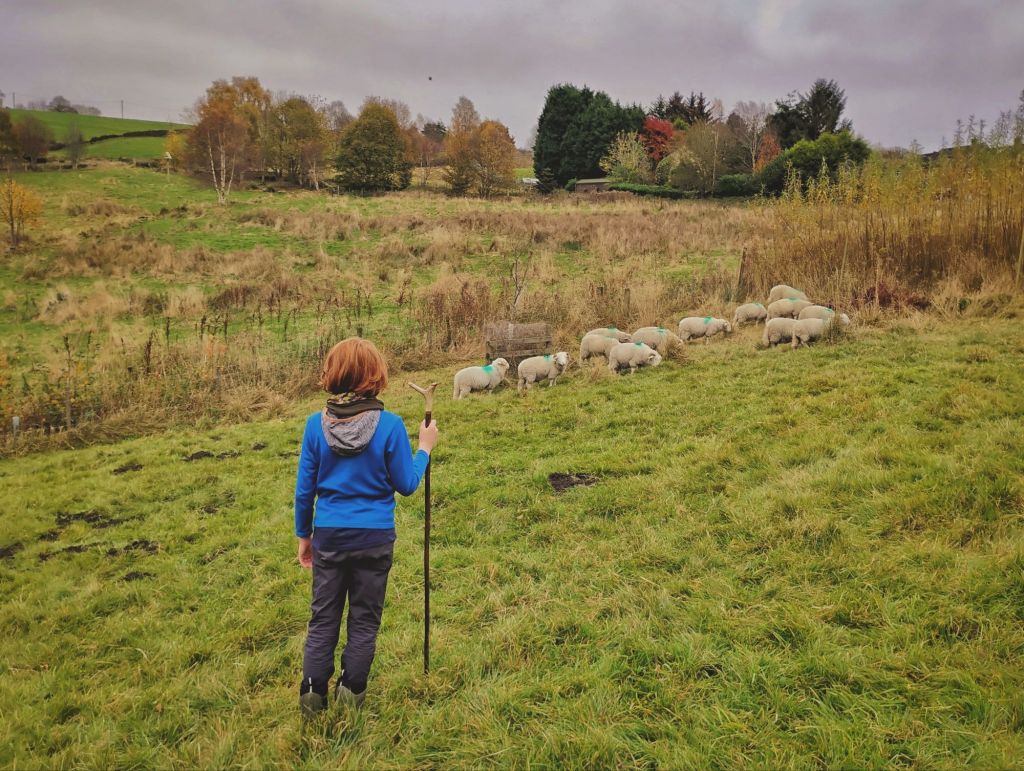
We were back at High Hirst Woodmeadow every Sunday through November, playing our part in Sheepwatch, a rota of volunteers making daily visits to check on the flock grazing the aftermath, the regrowth from the scything we gave it in July. The 14 whitefaced woodland lambs – a hardy traditional Pennine hill breed – have been leant to us by Ed Sutcliffe, a local shepherd. On each visit, after a steep climb from town past the site of the vanished Birchcliffe Methodist Chapel and its ivy-wreathed cemetery, we round the scattered sheep up, count them to make sure there has been no rustling, and check that none are limping or otherwise looking poorly. We then check the three gates to the field are secure and locked, make sure the water trough is full, and report that all is well (or not) to the WhatsApp group.
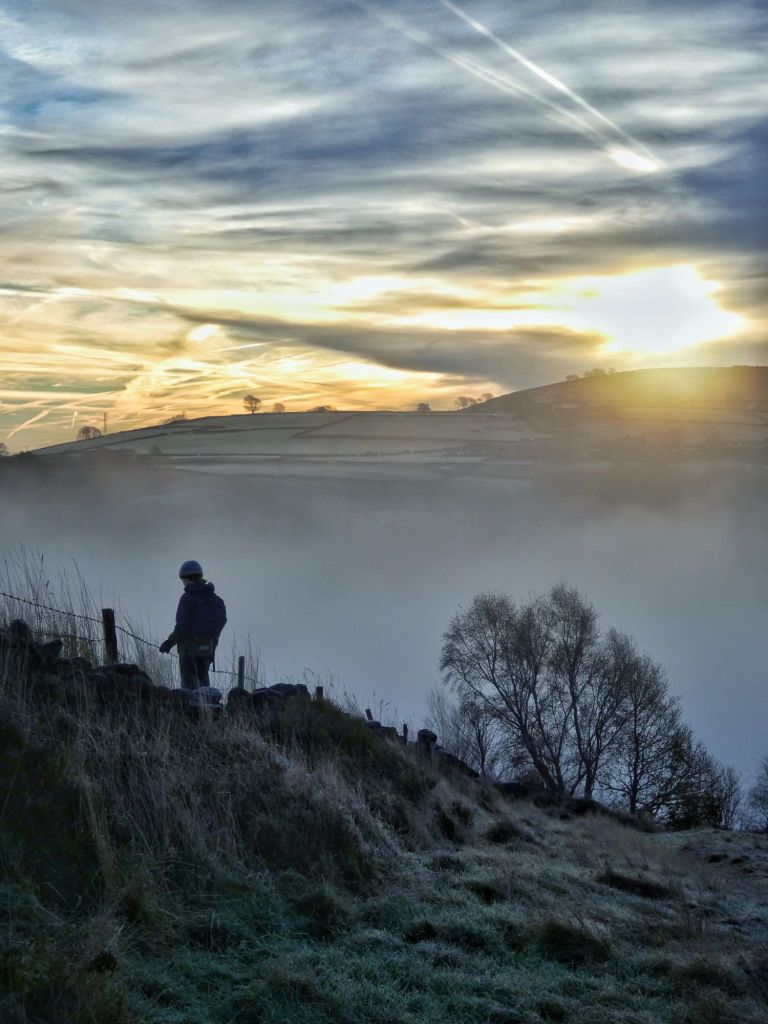
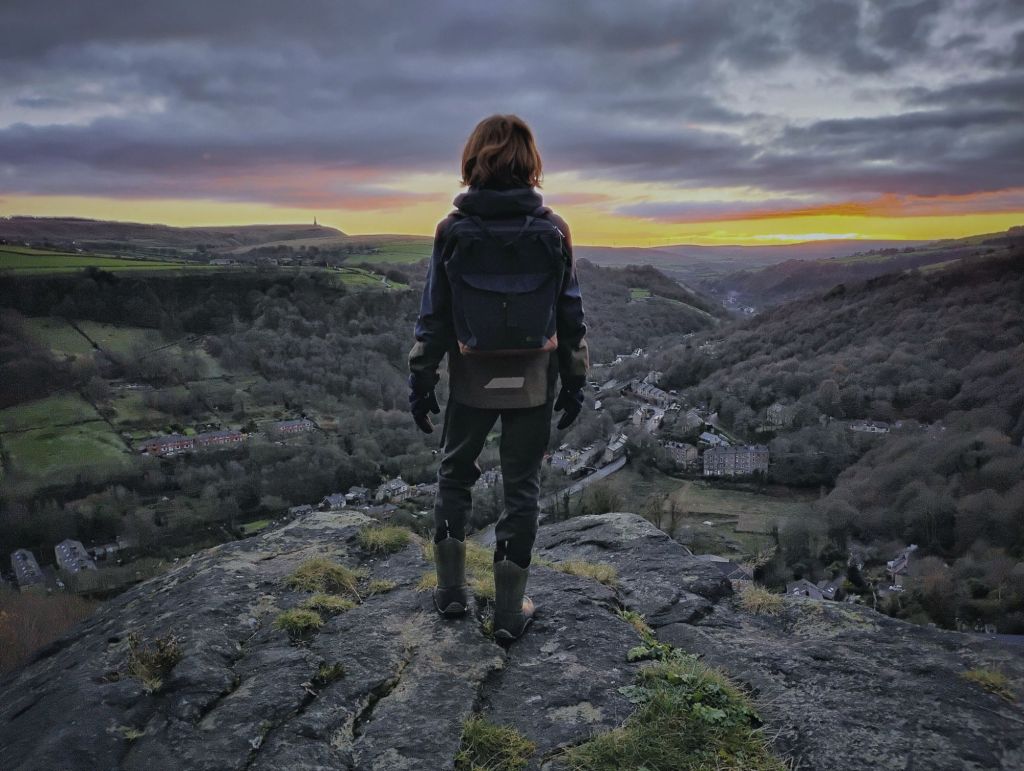
We tried, as always, to keep in touch with the natural world around us in everyday life, whether that was craning our necks out of his bedroom window to watch the ragged clouds scudding across the moon as we were turning his light out at bedtime, or whispering to each other as we looked out of the back window so as not to alert a roe deer browsing our garden plants that its every move was being watched, or catching oak and wych elm leaves that spontaneously fell in a crackling shower without the slightest disturbance of a breeze after the previous night’s hard frost, or noting how Jupiter had sped across the night sky between our going into the Town Hall one evening for the launch of a new community car share scheme, and coming out again for the walk home, by which time it was so bitterly cold we broke into a jog to keep warm. But it is the school run that reliably keeps us in daily touch with the outdoors, and it is beginning to dawn on me how much I shall miss it when he has to get the bus to high school. For now, I am savouring each and every drop-off and pick-up, especially the ones where we make an extra effort and get ourselves further up the hill. This month, we bolted up through the misty woods and crunched over the frosted sward a little earlier than our usual leaving time to heave ourselves above the cloud that had sunk into the valley, and watch the sun blearily peer through the sleep in its eye over the shoulder of Erringden.
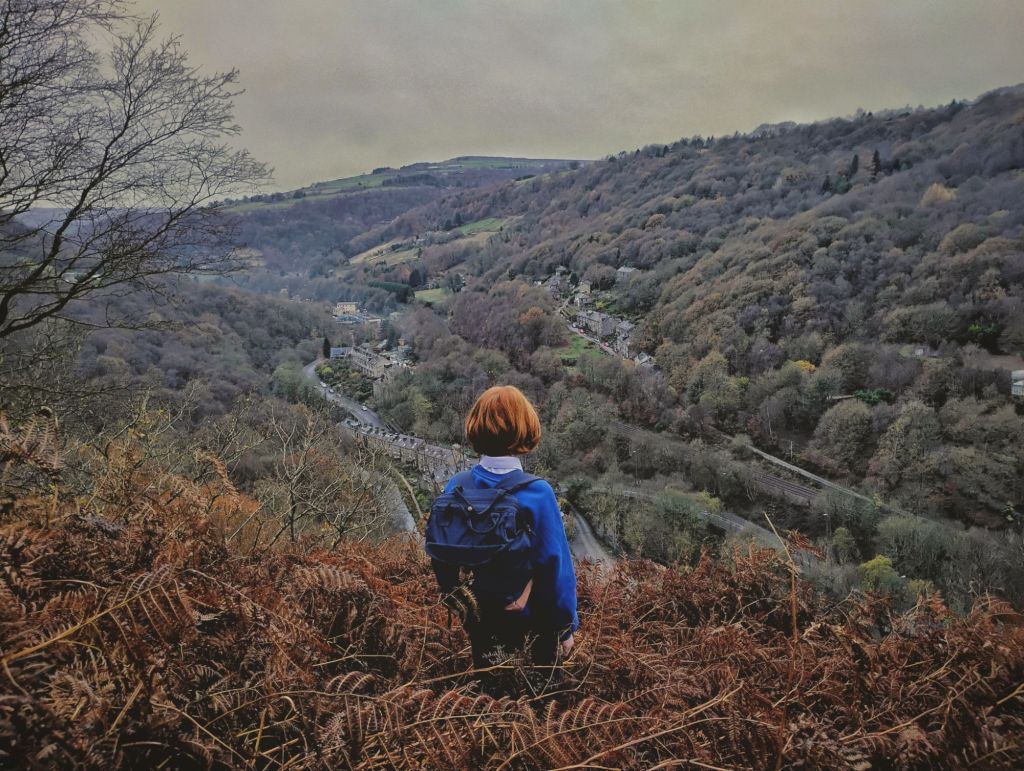
On an after-school walk, we made our annual pilgrimage to the last birch standing in Horsehold Wood, the one that always manages to cling on to its leaves longer than all its compatriots. After traversing over the first two of the three thrusting, craggy scouts, we slid down a slick of wet leaves beside the third to the base of our birch’s slender trunk. Thirty feet above us, its leaves, which from our usual vantage on the other side of the valley are a flare of sparks among the extinguished embers of the surrounding wood, were silhouetted against the white sky. We squinted up as we gave it a congratulatory pat for holding onto its title for another year, and to our surprise, the reverberations we made were enough to shake free a few of the leaves we had come to admire. Although perhaps it was a coincidence, we thought; perhaps there was a slight breeze high up there in the canopy just as we patted, for it did not seem plausible that we could have been responsible. We could not resist giving it a more vigorously affectionate thump on its figurative back to see whether it would happen again, and sure enough, though there was no detectable give in its trunk or shiver up its spine, more leaves fluttered down, spending long moments spinning gently down to us. Our respect only deepened, but so did the mystery: if this was how delicately each curled golden leaf was attached, how was it still holding on to any at all?
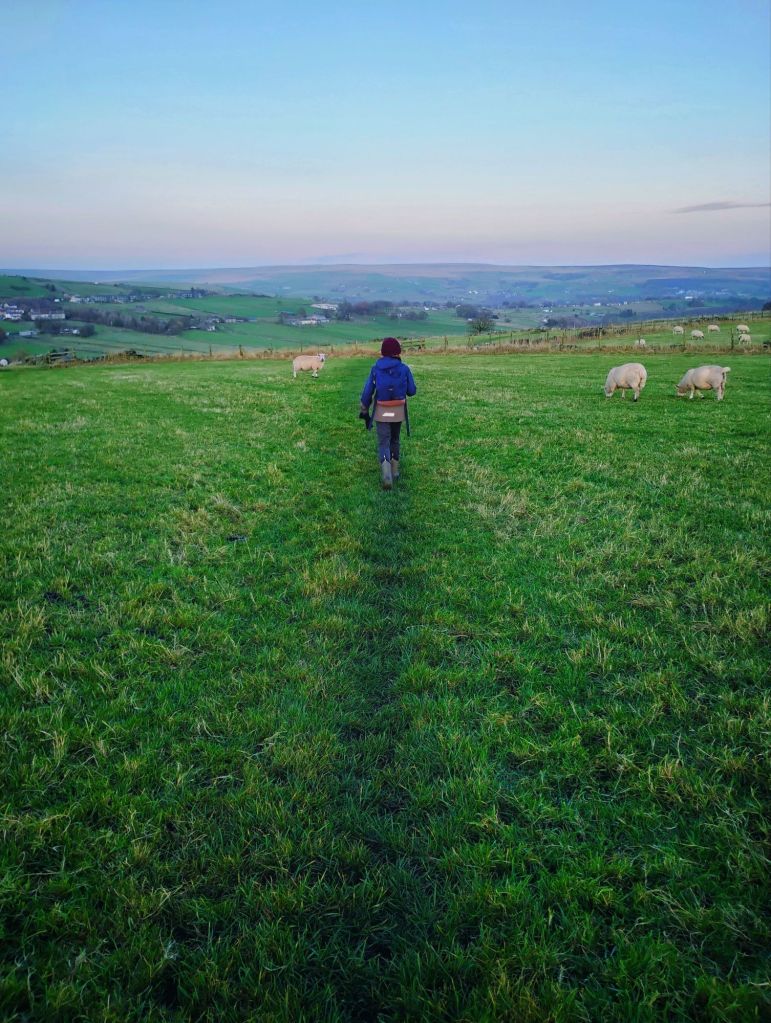
On another after-school walk, we cheated and hopped into one of his friend’s cars on their way home to Blackshaw Head, jumping out at the Methodist Chapel and spending a happy couple of hours wandering the high pastures in the frigid gloaming, first towards the sun as it sank towards the black stencilled shapes of the Bride Stones, then we traced the layout of the produce tent and the dog agility course and the games ring in the empty fete field where we have spent many a halcyon late summer day, before ambling over one shoulder of Pry Hill down to Shaw Bottom and then back up towards the moon, which was perched, glowing in the grey-blue twilight, on the hill’s other hunched shoulder. We stealthily crept towards a particular scruffy field corner where we sometimes find brown hares crouched in their forms, though it was empty this time. Further down the hill, we found an easy way around a vast forest of nettles that is our nemesis all summer and even now has a sting in its tail at the end of the season; we were bewildered at how we had never spotted this workaround before. We drank great draughts of chilled November air as the cloud bank in the west glowed a livid pink, and a skein of 98 pink-footed geese made us shudder thinking how much colder it would be up there for them.
On our final after-school walk of the month, we mounted the Eaves Wood paths, where flash streams from the deluge the previous week had parted the bronze sea of beech leaves, leaving trails and channels in their wake. We chased the sun up to the the quarries at Hell Hole, where he had a scramble on the leaning megalith of Lad’s Law. After sitting on the edge of the Eaves escarpment itself with a snack to watch the sun submerged into the bogs of Freeholds Top, we spied a path we had never noticed before, and it teetered us south along the crags into what appeared to be an old tip. Here we were pleased to find two mighty willows which, from the valley bottom, we have often noted as standing out on the skyline. They have so far avoided the fate of all the other willows that have colonised this disturbed place, which have all lost their rootholds in the loose debris and detritus and are in various states of toppling over. In doing so, they have upended the earth and created dark caverns amongst the refuse, in which we glimpsed rusting metal and cloudy glass bottles and a skull that seemed too large to be a sheep but not quite right to be a horse. We half expected Stig from Stig of the Dump to emerge and chase us off. Despite finding a viewpoint of the valley that must count as the finest from Heptonstall, we were glad to extricate ourselves from this strange maze of mounds and maws without having disappeared down a sinkhole. On our descent, we met Nigel, who we know from High Hirst Woodmeadow, making his way home from a gardening job. He pointed us down the little-used path he had come up, which took us past the Bankfoot Mill chimney, doing its best to blend into the trees and avoid the approaching fate of the nearby Mytholm Mill chimney, which faces imminent demolition. By then we were down to the very last of the day’s light, so by phone torch, at the opening in chimney’s base, we raked out the build-up of leaves and twigs, which somehow make their way down it despite it overtopping the canopy, but we could not get far enough in to be able to peer up the chimney, so we contented ourselves with poking our heads down into the tunnel of the 300-foot long flue which elevated the chimney 150 feet above the mill, finding its stonework to be largely intact despite a century of roots attempting to prise it apart.
On one Sunday afternoon we took in Mill Town Arts’ ‘… of the heather’ exhibition at the newly-reopened OPEN HOUSE space under the Trades Club, closed for the last nine years since the Boxing Day 2015 floods. Once we entered the hall, I asked my son if he had any memories of the many Tuesday mornings we spent there between his first and second birthdays at Icky Sticky Kids, submerging his hands in containers of baked beans, digging in trays of compost, painting his own feet and vigorously chalking on huge rolls of paper, but those times are lost to him. It was good to see the hall come to life again, though, graced with stunning photographs by Will Lake and Clive Horsman, paintings by Dorothy Ann Simister and Phil Taylor, and drawings by Tracy Waddington, all of moorland landscapes and wildlife. After checking on the sheep, we joined my wife on the bus up to Pecket Well, from where we descended into the golds and coppers of the autumn woods, past the Smeekin Hill War Memorial, on Ray Gate and Jockey Gate to Midgehole, through Hebden Hey scout hostel, across the Hebden Hippins stepping stones, and so finally coming to Gibson Mill for the second of the day’s exhibitions. This one, called ‘Ancient Underlands’, was oriented around the ancient grassland fungi that we have helped to survey at High Hirst. The fruits of a year’s work by Katie Bates, with help to bring it together from Rebekah Fozard, it brought together forty or so artists and writers, with everything from ceramics to cyanotypes, weavings to watercolours, stoneware to sculpture, feltwork, collage, embroidery, tapestry, poetry and short story. Demonstrating the depth and ingenuity of the valley’s creative community just as much as the wonderful world of its endangered mycelia, it was a triumph. Having a poem in there myself (which I will reproduce on this site soon), I returned to do my stint of invigilating later in the month, but after a good first look round, late in the day, we left and clambered our way back out of the deep valley, under grey skies flitting with fieldfares and redwings fresh in from Scandinavia, up Acre Lane and down across Popples Common to Slack, where we waited for the bus listening to the rooks in the sycamores at Lower Slater Ing.
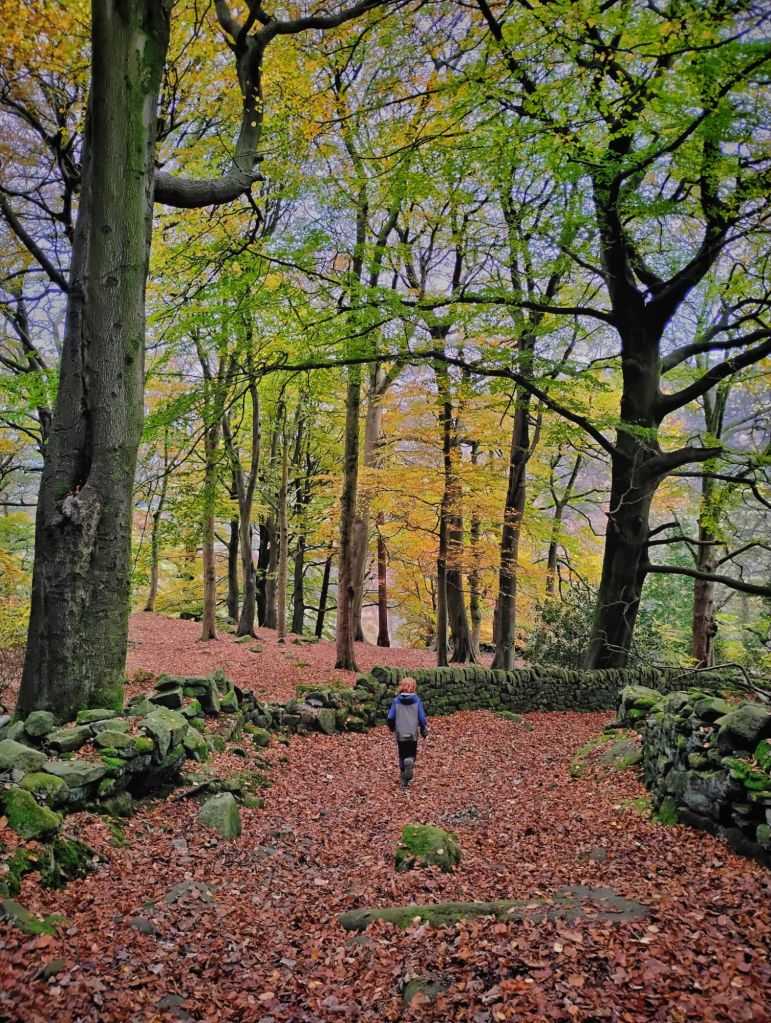
On the morning of the following Saturday, dull but more or less dry, we made our way round one of our favourite local loops. Up through the oaks of ancient Knott Wood, past last night’s deer beds scraped among the leaf litter and under a flock of long-tailed tits purring among the birch; through the 12th-century hamlet of Lower Rawtonstall and on up beside an unnamed stream with still-flowering balsam at one end and a vivid green mat of vernal water-starwort at the other; through a copse of sycamore that used to shelter a chicken coop and beside the vast stones of what must be a significantly old field boundary; into the farmyard at Pry, where a dunnock calls and the barn silently waits for its winter inhabitants, still out in the pastures; onto the shoulder of Pry Hill where we scan the 220-degree view, ranging from Egypt at the head of the Colden Valley round to the Erringden skyline; down the long plunging fields of Rawtonstall Hey to join the Pennine Way, where we about turn to cross the ridge of Pry Hill again and descend past Scammerton Farm, where we note with sadness that the fine old hawthorn at the end of its track, already battered by Storm Arwen in 2020, has finally succumbed to its exposed position. We meet our neighbour, Tara, in the meadows under the farm, and exchange intelligence about intimidating dogs on various local footpaths, and watch the deer in the meadow at Marsh.
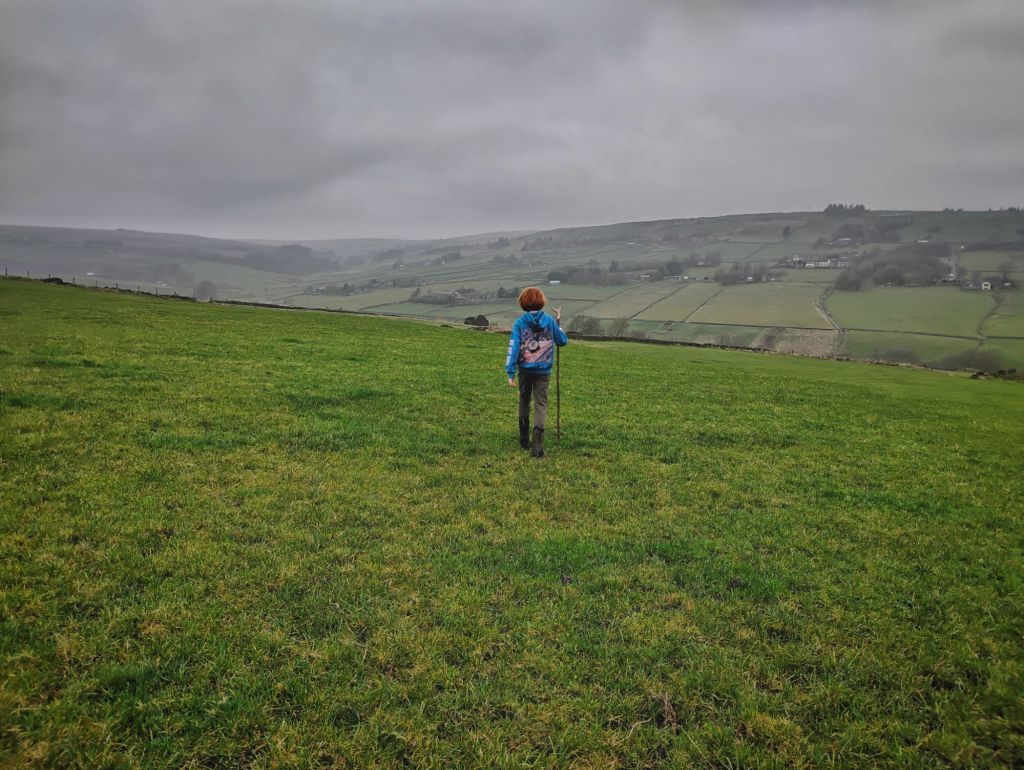
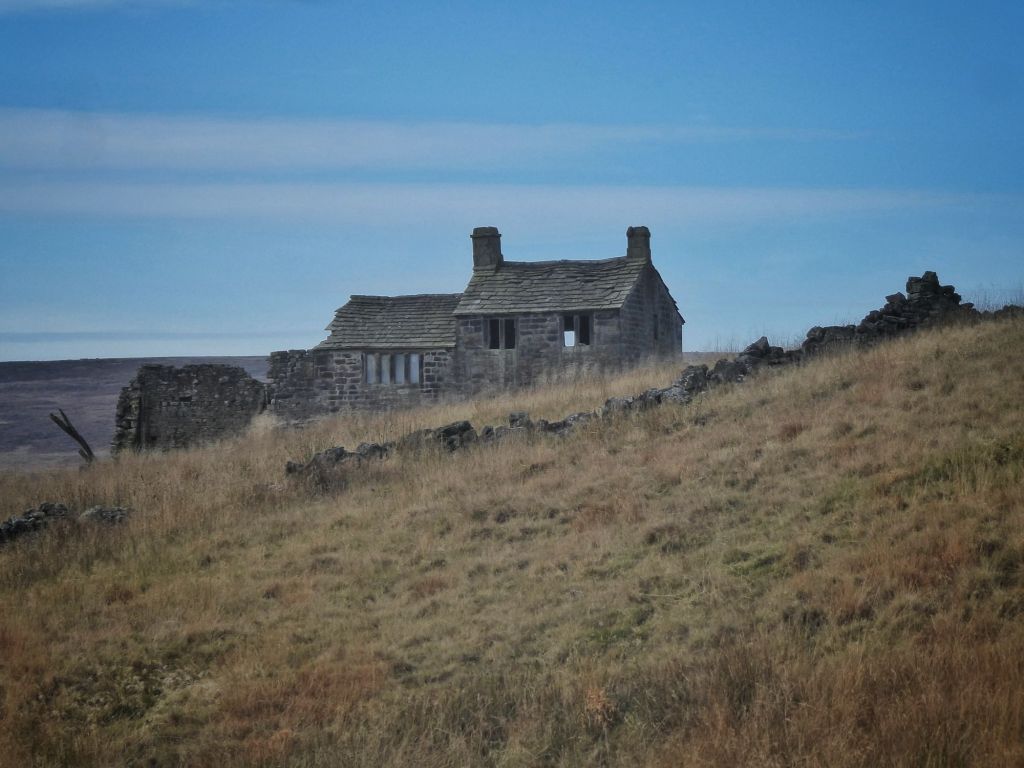
I took three walks without my son during the month. On one, I joined a trio of fantastic photographers – Ron Pengelly, Neil Horsley and Terry Roberts – for a little foray around Luddenden village, where they were gathering images and inspiration for their ongoing project to capture the richness of the Calder Valley. The weather was hardly playing ball, but such was their eye and experience that they were finding images and visual interest amongst the lanes and crooked slate roofs where I could see none. On another, I took the long way to the school pick-up one afternoon, zig-zagging up Foster’s Rake, golden with birch leaves, to find a fresh dressing of muck on Square Field and sheep seamed into the gullies on Edge End Moor like old snow. On my way down Horsehold Road, I encountered one of many signs that had been put up around the Borough warning that it was going to be removed from the list of highways benefitting from precautionary gritting, as part of an effort to make budgetary savings and, I suppose, to avoid the bankruptcy that has been declared by other councils and the even more catastrophic cuts that follow. Along with the recent plan to remove parking on the main road near the railway station to improve the flow of traffic and introduce cycle lanes, and also a proposed cycle lane in Todmorden, the council were forced to pause and re-think by a storm of protest from those reliant on cars. I do not envy councillors the choices they must make concerning which essential services to cut, or how to nudge us towards ‘active travel’, in ways that command popular support. When the sun finally broke through the anticyclonic gloom that had been oppressing the UK for the previous 10 days, I spent the six school hours in the glowing Colden Valley. With grouse chuckling and a chill sighing wind in the Sitka spruce that cloister Long High Top, I took in the rolling horizons of Walshaw Moor and tried to imagine it bristling with spinning wind turbines, then descended to May’s shop, through the bleating of the High Gate sheep kept by her son Martin, and a swirl of clucking, seeping redwings. On Edge Lane I passed a barn belonging to Ed, who has lent us his lambs at High Hirst; another farmer closely inspecting the extent of molehills spreading across a meadow; fencer Jack Whittaker installing a new gate at Everhill Shaw; a foxglove blooming like it was July on the verge by 17th-century Old Edge; and the iron-red chalybeate beside New Edge. A Texel tup was in with the ewes beside Popples Close, and in the time it took me to cross his territory to the moor he increased by several the number of coloured behinds among his flock with the raddle that had been applied to the fleece on his chest and between his forelegs, allowing the farmer to keep track of which ewes have been served, and when. At Egypt, serious sheepdogs paced the kennels waiting for work, spring water spilled into an old stone trough, starlings cascaded from the wires, toy tractors were parked beside real ones, and the radio was on in the barn. I passed the Logg brothers, who farm this uppermost stretch of the valley, heading back for dinner on their quad bikes from their barn at Rough Hey. Peter stopped for a chat with me, and as ever, in a short conversation with a farmer – about the previous generations who farmed here, about their Aberdeen Angus herd and how they differ from large modern breeds, about grass and soil, weather and water and walls – I learn more about this landscape than from any number of books. I passed their herd on my way to Pad Laithe, where I went to pay my respects to the ghosts of the Hargreaves and the Stansfields, the Pickles and the Garnets and all those who briefly greened the moor and made a living here until it could not be kept green any longer, but in doing so I disturbed the inheritors of their estate – a barn owl and two little owls, who were rightly indignant at my presence. Across Pad Laithe Bridge and up Noah Dale Road, which is entirely lost to the moor, I find another fencer, Paul, securing his field at Greenland, where he has lived for 30 years, from the half-wild horses that live on the seahorse-shaped leftover of moor known as Lord Piece. He explained to me how his field, which I had noticed was furzed with a fine white frosting, had had lime applied, reducing its acidity in preparation for receiving a treatment of United Utilities biosolids, recycled waste which is delivered to around 1,500 farms as fertiliser and soil conditioner. It will, he explained, improve the yield of silage taken from it by a neighbouring farmer. This was the first I had heard about this new fertiliser, but by a remarkable coincidence a United Utilities tanker bearing the slogan ‘From our plants to yours’ passed me an hour later at the New Delight while I waited for my bus down for the school pick-up, so Paul cannot be the only local landowner participating in this scheme. I had been so enjoying talking to him that I had to race for that bus, down through the rushy fields below Slade, which had also been limed, through a crumple of woodlands, along old lanes lined with new hedge and through a skeletal larch plantation, where I accidentally herded a roe deer, its white rump bouncing along in front of me until it realised I was not to be outrun and so would need to be outmanoeuvred. On my way past Land Farm, I peered into its remarkable six-acre garden, remembering the times we visited in the years when the botanist John Williams, who began creating the garden 60 years ago, still opened it to visitors. The shadows of the trees on New Road were stretching themselves down to the Colden Water, and the children at the village school were being called in from their last playtime, by the time I reached the bus stop.
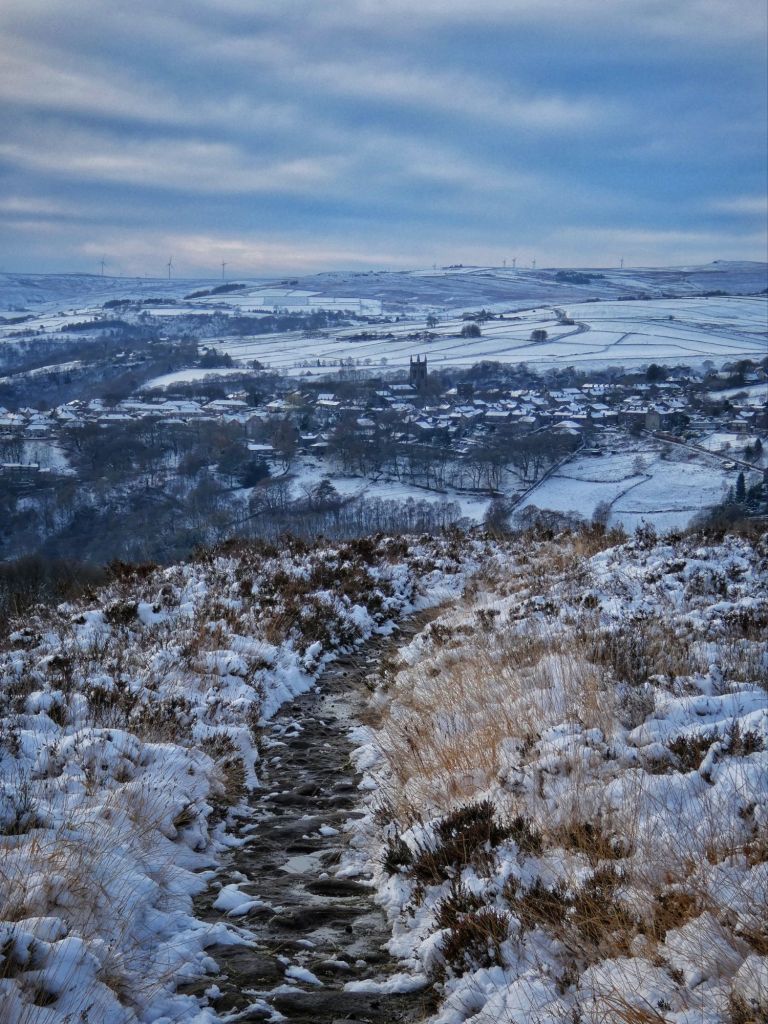
We woke to a quite significant snowfall one Tuesday morning. The neighbourhood sledges were broken out, and stayed in use for more or less every non-school waking hour. He racked up a solid 12 hours snowball fighting, snowman building and sledging for the four days it stayed, even with dodgeball club and karate after school on two of those days. Many of those hours were in the dark, with dinners delayed and the bedtime routine rushed to accommodate as much icy play with his friends as possible. On the first day, I took the opportunity of a meeting at Old Town Post Office cafe, to discuss possible future projects with the good people taking on Wainsgate Chapel and developing it further as an arts and culture centre, to stay high for the day, taking in the views of the ashen woods, speckled moors and the patterns of enclosures revealed anew by the snow. On the second day, I wandered the lanes of Heptonstall and Colden, the landscape blazing white and shining under clear skies. By the Friday evening, the village green sledge run was threadbare, but there was a last fall of plump flakes on the Saturday morning, which brought the entire neighbourhood out, parents and all, for a final gargantuan snowball fight. But even as we were playing, an astonishing 11-degree temperature rise had started, which would take but six hours. Everyone suddenly realised that they were soaked through to the skin with the now wet and slushy snow, and children that they were desperately cold, and the gathering dispersed in search of dry clothes and hot chocolate. For the rest of the day, we watched the snow disappear, and to add to the melt from the moors and pastures pouring down the cloughs, it torrentially rained for six hours. By lunchtime, it became clear that this combination was going to cause problems, and the flood sirens duly went off just before 1.00pm, with the (admittedly oversensitive, but nonetheless indicative) Environment Agency river level predictive models warning disastrous flooding was on the way. At last light, I took my son and one of his friends to see the river at the Stubbing Wharf pub, where the landlords had salvaged as much as they could from the inundated cellar but still lost much of value. The river was just about managing to squeeze itself under the bridge, and was inches from overtopping its containing wall and spreading across the floodplain, an area that has for years been subject to planning application after application, variously for houses, a supermarket, a hotel and industrial units. While we were marvelling at the power and speed of the water gushing down through the woods and swamping the main road at the bottom of Stony Lane, and not a moment too soon for a much larger number of properties that would have been flooded within the next hour, the rain stopped and the river dropped. While some were tragically hit hard, it was a near-miss for many more, of a kind which will only increase in frequency while the latest estimate for the completion of the Environment Agency’s flood alleviation scheme for the town is 2029, 14 years after it was promised in the aftermath of 2015’s Storm Eva. In the days that followed, we could see boulders in the bed of the Colden Water that had been overturned and scrubbed clean of lichen and moss by the force of the flow.
 Landscape Story
Wonderful landscape writing Paul. A superb read on this cold and misty day.
LikeLike
Thank you, Mo. I’m glad you enjoyed it. It is bleak out there today, isn’t it?
LikeLike