A maelstrom of swifts swept us into July. The Stubbing Bridge is a favourite spot of theirs to feed, charging up and down the canyon made by the deep river walls before either darting under the bridge’s arch or launching over its parapet to scythe past the ears of anyone who happens to be passing. Year after year, when we find them here, we deliberately position ourselves in the eye of the whirlwind of wings and dare each other not to flinch or duck, to trust utterly that if these aerial masters’ aim and reflexes are good enough to catch 20,000 insects a day, then they are more than equal to avoiding two human faces beaming their presence with wide eyes and joyful smiles. We stayed there for nearly an hour with them tearing past our faces at 50mph, whipping our heads round as they bolted past to try and make inches-apart eye contact. The docile moths that Andrew Cockroft and Charlie Streets delicately brought out of their trap at High Hirst Woodmeadow and allowed us to hold were a lot easier to look in their unfathomably strange eyes. True lovers knot and beautiful golden Y, brimstone and snout, map-winged swift and marbled white spot, green arches and clouded border, we passed them round among the group gathered in the pale early light. Us amateurs were enthralled, but the expert mothers were disappointed that only thirty-five species were recorded, less than half of last year’s event.

The nights were soundtracked by the hoarse coughing calls of tawny owl chicks in the woods behind our home, and the days were honey-scented by privet flowers wherever this typically manicured suburban hedge tree had escaped the tyranny of the trimmers. In the school run woods we were suddenly struck one morning by another strong scent, of freshly splintered green wood and uprooted earth, and as we rounded a grove of holly we were confronted by the shocking sight of a grand old oak slumped on the slope, a new cavity in the canopy and a crater in the stony ground it had lost its grip upon only hours before. We looked at each other in disbelief, and spent the rest of the walk to school counting our blessings that it was only the scent and sight that had been striking, and not the considerable branch that lay shattered across our path. The oak was perhaps 65 feet tall, but the gravity-fed Castle Carr fountain, for just a few minutes and to the delight and cheers of the assembled crowds, reached twice that height. While on the hillside above Wainstalls the cars of the hundreds of other ticket-holders for this annual event were marshalled by the Rotary Club, we snuck along the other side of the Luddenden valley on the little Team Pennine bus and into Bob’s Tearoom for a slab of cake and a milkshake before entering the haunted grounds of Captain Joseph Priestley Edwards’ doomed country house, its last remaining stones lying scattered among brambles and nettles, a sycamore growing out of the stump of its gatehouse, willows crowning the vast fireplaces of its kitchens. After the fountain had ebbed away, we made our way home up and over the moor to Old Town, spotting on our way a substantial patch of white on distant Erringden Moor, which we resolved to investigate the next day after school. On our way up the hill, we met farmer Ann on Haven Lane on her way to check on her cattle, and she confirmed our suspicions; that it had been a spectacular year for cotton grass, presumably because it had been so wet, and that we would find a great field of it up there. We climbed through the highest old enclosures past the crab apple that has planted itself in sunken, forsaken Snail Lane, and made our way on precarious paths through the sodden mires marked by ancient leaning boundary stones ever in danger of teetering into the sucking swamps, which were studded with yellow bog myrtle and prowled by the insectivorous jaws of sundew. Every sprig of heather was wreathed in the blown cobwebby down of the bog cotton, and we feared we were a little too late to see it at its best, but once we reached the one-and-a-half-acre pale pool we had spotted from three miles away yesterday, we found its every soft seedhead to be intact, and as we waded in, the sun ignited its surface into a blaze of waving white flames.

After the gleaming bog cotton, and the golden meadow at Rake Head that we went on to find afterwards, rippling like the fields of oats that would once have been grown in the district, and the glitter of grass pollen released by the brush of his wellies on Foster’s Rake in the late sun as we finally made our way down off the tops, we had an altogether duller, more muted tramp under slate skies some days later. From the straggling hilltop settlement of Blackshaw Head, we traversed the south-facing slopes of Stansfield. The stuttering calls of curlew came from the Holroyd’s mown meadows in Hippins Clough, and we herded meadow pipits along the coping stones of the newly-repaired walls of the moorland track of Horsfall Road. We clambered about on Great Rock’s stacked folds of gritstone while a family harvested bilberries at its base. Before us, as John Brown’s poem displayed at the nearby cloistered old farmhouse of Staveley Cote says, ‘the world lies open’ under ‘slow-sailing clouds’. We waved to TJ and Liz at their Full of Joy Sanctuary for animals, tending to their rescued pigs and donkeys and geese and goats, though we did not know them yet as we would come to later in the month by helping to supply them with hay from our efforts at High Hirst. On we went, past the firework explosions of wild angelica in Birks Clough; pausing to pick our own bilberries as we crossed the defile of Ashes Lane; through the busy farm of Peter Boddy, licenced horse and cattle slaughterer, with the latest coming in the entrance, blood dripping from the van; and on to the Todmorden golf course, surely the only one where a 100-foot-diameter prehistoric cemetery cairn that once contained cremation urns now forms an unobtrusive, unheralded part of the fairway. Tucked into the rough at the edge of the course, while we were forlornly conceding that we would have to return on a quieter day with less chance of being struck or shouted at to take a closer look (despite the cairn being on a right of way), we spotted a withered willow sapling whose curled and blackened leaves were shrouded in sticky gossamer. We scoured it, and found the culprit; the black and white polka-dotted willow ermine moth. Sitting on the rocks of Hole Bottom Delph at the edge of the course, we watched, 500 feet below us, Todmorden’s first XI take on Norden at the cricket club, but of even more interest was the flock of colourful bouncy castles which had gathered next door in Centre Vale Park. After a bounce on the best of them, we crossed back over the Calder to Mr Beans cafe and sat with an ice cream, watching the swifts wheeling over the waste ground where recently-demolished Adamroyd Mill once thrummed.
Hebden Bridge Arts’ The Man Who Planted Trees project, for which I had been leading walks for the past couple of months, reached its culmination with exhibitions of all the art made at the public workshops and a run of performances of the beautiful stage adaptation, which we caught at the Little Theatre. My last joyous role was to guide a group of asylum seekers and refugees from the St Augustine’s Centre in Halifax up to Forus Tree’s tree nursery above Mytholmroyd for a day of tending to thousands of seedlings that will be planted out all over the valley. I enjoyed visiting the CROWS team as they were overseeing the completion of a long-planned repair of the miniature packhorse bridge over Daisy Bank Clough, arriving just as the expert wallers from the Mid Lancs Dry-stone Walling Group were putting the finishing touches to the 55-inch span of the remarkable little structure, making sure it is capable of carrying cargo across the stream for another century or so. On the south side of the valley, I climbed through the tallest foxgloves I had ever seen above Lobb Mill, read names on the gravestones at the burial ground of the vanished Wesleyan Methodist Chapel at Mankinholes, and chatted to Anthony, who had been bouncing down the stones of the Long Causeway, test riding a beast of an electric bike. Beyond the leaning ancient waymarker stone of the Long Stoup, I threaded my way through the ghosts of The Withens, the community of farms that was once cradled in the high wide clough among the embowering moors. I visited some of the few traces that remain – a fern-stocked cellar here, a grand pair of gate stoops there, fading outlines of foundations among the sighing grasses – before crossing over to living Erringden, where Ian and Rachel’s sheep, gathered at the farm and newly sheared, were awaiting release back into their pastures.

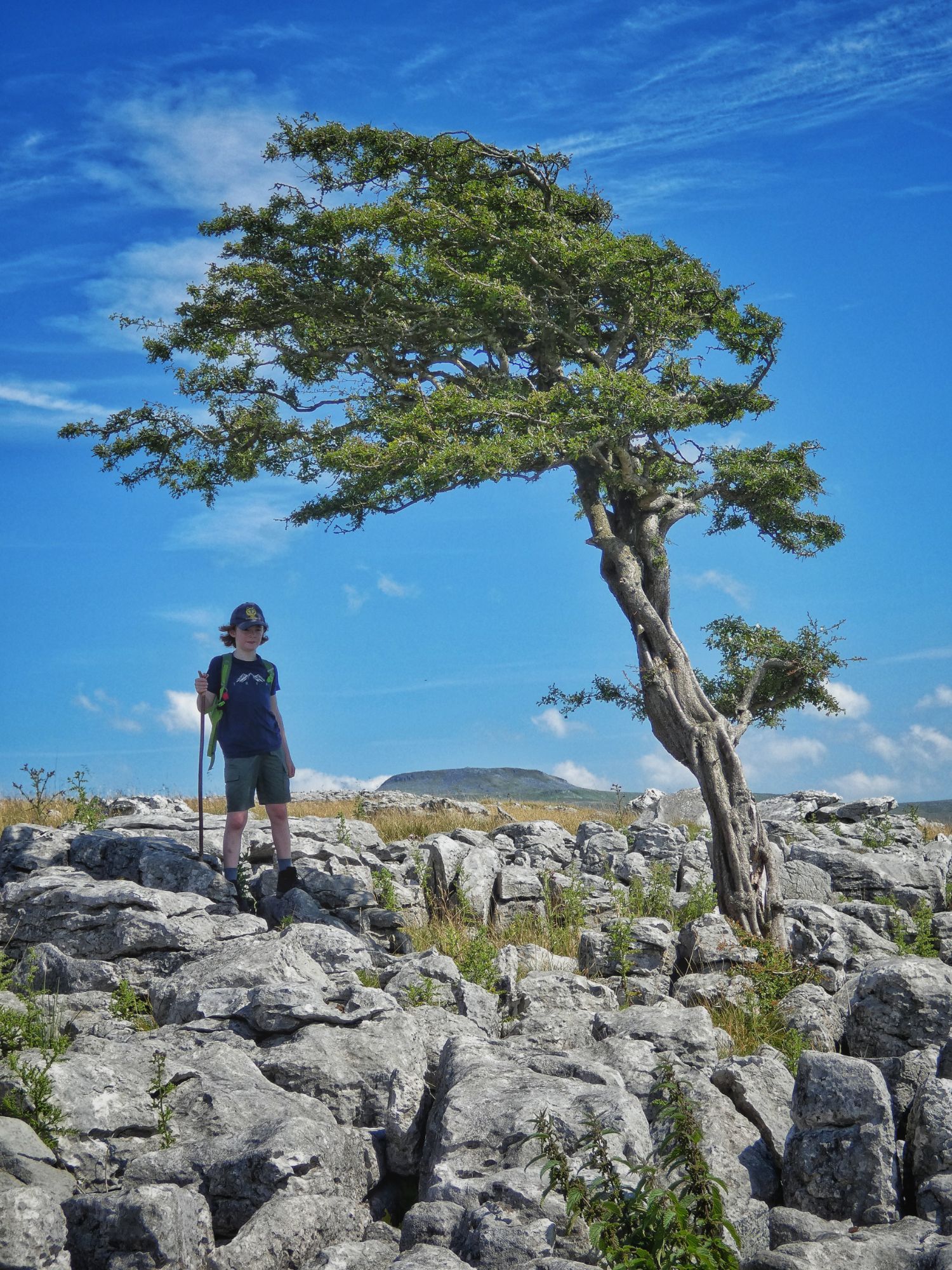
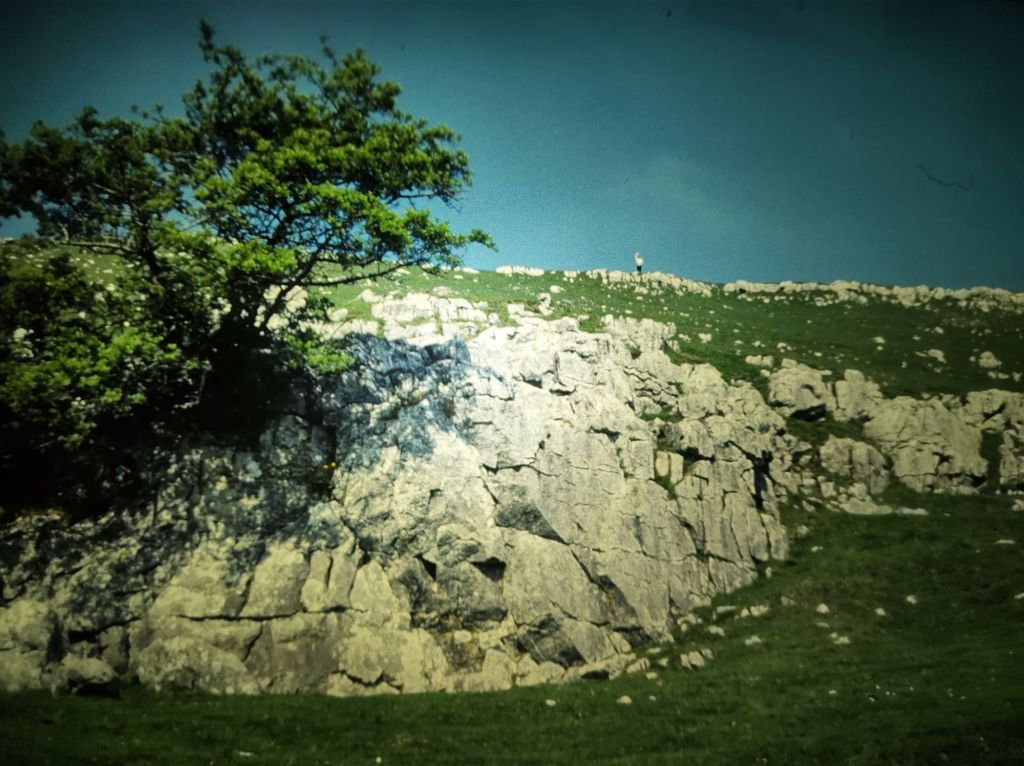
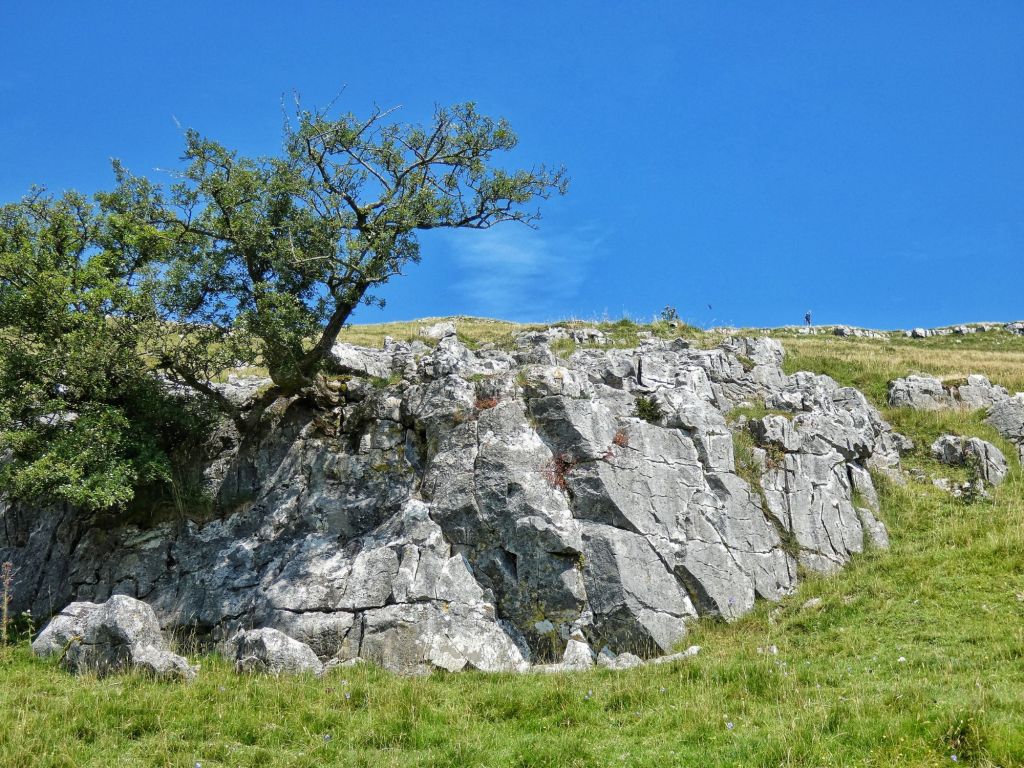
Thirty-four years ago, my dad took me camping in the Yorkshire Dales, and one of the first things we did was the famed Waterfalls Walk at Ingleton. I remember loving the deep gorge and the spectacular cascades of Pecca Falls and Thornton Force, but what has stayed with me the most, both in vivid memory and lasting influence, was ascending, on my own, the ramparts of Twistleton Scar End, the sharp prow of the good ship Whernside, carving its way into the lowlands with a bow wave of gleaming limestone foam. We had just had an ice cream from Joseph’s Ices van, who strategically positioned himself at the top of the ascent out of the valley, and my eyes turned upwards to the irresistible combination of the emerald green grass and bleached glint of limestone meeting a perfect blue sky, and I found myself drawn upwards as if pulled on a tether, desperate to discover what was at, and beyond, that horizon. After 200 feet of ascent I scrambled over the skyline crags to find an alien moonscape of limestone pavement; a fantastical arboretum of wind-sculpted hawthorns and yews emerging from the cracks in the pavement; the staggering sight of the gritstone monolith of Ingleborough set on its limestone plinth across the gulf of Chapel-le-Dale; and what was to this boy from the flatlands of Essex the perplexing but thrilling revelation that a high beckoning horizon could be gained, only to find it is immediately succeeded by another, higher and yet more enticing. That further meeting of white and blue again summoned, and the tether once more pulled me towards it, but I had now been out of sight of my dad for some minutes, so I resisted and turned back to the edge and waved down at him, before careering back down to the track. I could not tell at that distance, but he took a photograph of the moment that I waved, at which everything had changed for me; the Pennines were my landscape for life, and I would eventually move to them 20 years later. Bringing my son to this place had long been on my mind. After skimming stones down the gorge and enjoying the same waterfalls on a similarly glorious day, we found an ice cream van in exactly the same spot, and then I sent him up the slope to the same rib of limestone from which I had waved decades before to recreate the photograph my dad had taken of me, before joining him up there to explore the unchanged hawthorns and yews and limestone pavement, and to symbolically tread a little closer to that further horizon. One day, we will return and mount the succession of horizons that lie beyond it, five miles of them – Ewes Top, Rigg End, West Fell, High Pike – all the way to the summit of Whernside.
Our month rounded out with a halcyon week of haymaking. Scything instructor extraordinaire Steve Tomlin returned for the third year to hone the techniques of our merry band of High Hirst mowers, and after that first day we were away, faster and sharper than ever before, leaving short swaths and long windrows behind us. While my son was whittling spears at Forest School for three days of the week, I scythed and raked, and once he was finished we returned together to try out Steve Hindle’s ingenious new handmade, Heath Robinson baler. Essentially a cupboard with a lever-operated compressor on top, it proved faster and more efficient than our previous wheelie bin method, and although my son did miss being hoisted in to stamp and tamp the hay, his ever-lengthening legs have made this more difficult each year. The new baler’s only downside was that it had to remain stationary on the one terrace of level ground at the bottom of the meadow, so the hay had to be taken to it, which meant endless descents and re-ascents in the humid conditions. After some too-enthusiastic pitchforking in the glare of the sun in the middle of one day, he overheated, so for the rest of the week we moved to the late shift, arriving in the afternoon as the air cooled and the shadows lengthened. TJ and Liz came at the end of each day to fill their car with bales for their rescued menagerie, and we loved hearing of the personalities that were going to enjoy them. Some rain and thunderstorms were finally forecast on the last day of July, so we sculpted the hay that had been tedded out to dry into haycocks, which we came to call ‘tunnocks’ after Tunnocks Teacakes, since we gave each the overhanging lip at the base characteristic of this confection, but for our purposes for the rain to run clear off their dome. As we finished the last of them, he managed to burrow into and entirely disappear inside one and, without revealing himself, make this miniature haystack hop a little way across the field. Our laughter echoed into the storm-expectant evening air.

 Landscape Story