We took our chances among the incessant June showers to pay our first visit to Eagle Crag. We have long craned our necks up from the bus to wonder how we would ever reach this high looming outcrop, the upthrusting point of a stone blade that has impaled the impossibly steep hillside from behind. Once we had traversed above the terraces of Cornholme on an old track among the bilberry and reached the same height as the crag, it was no clearer how it was to be attained, still a third of a mile away along a scrub-swaddled crumple of close-packed contours. But we gamely plunged into the challenge, teetering along deer and sheep paths among the bracken, swinging on low beech boughs across plunging streams, reorienting ourselves as and when the crag’s sharp silhouette became visible ahead of us before diving back into the near-vertical maze. When we finally got there, we laid down on our bellies on the eagle’s back and crept to the overhanging edge at the front of its wings and soared with it over its territory, watching the traffic and the toy trains funnelled down within the narrow valley like sleds down a bobsleigh run. During the rest of the day we visited three standing stones, among Yorkshire’s tallest, impressive specimens even if there is doubt about their antiquity; and three ruined farmhouses, at Roundfield, where elder sprouted among its empty walls and tumbled roof beams, at Royd House, where we sat in the crook of a willow in its nettled stones, and at Gibbet, where we found a lichened sheep’s skull wedged in the branches of a snowy hawthorn.

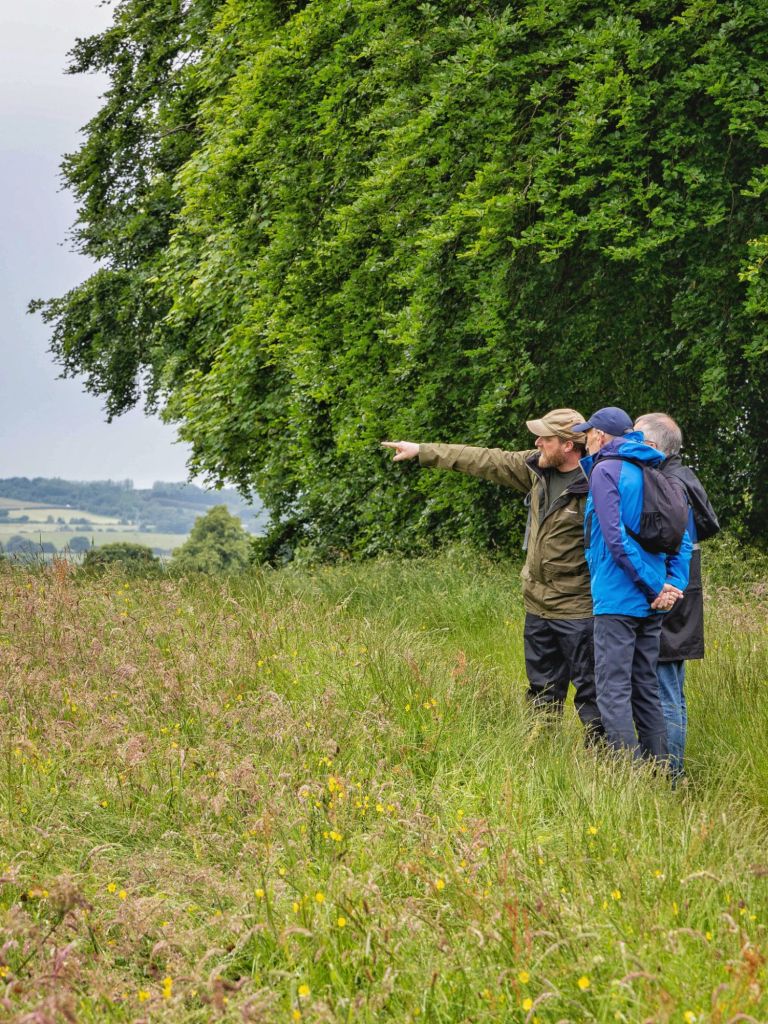
I enjoyed taking more groups out to explore the landscape for Hebden Bridge Arts’ The Man Who Planted Trees project. At Todmorden, we imagined the crowds waiting on the vanished station platform at Stansfield Hall for the Wakes Week Blackpool Special, visited the community orchard and allotment at Denis’ Field and spoke to some of the growers, and on the puckered hillside above Hollins we swept our eyes over the panorama and took in the works and legacy of the town’s most consequential family, the Fieldens, who dominated its industry and politics for a century. At Rastrick, we searched for the traces of the former farmed landscape overlain by a model post-war council estate, considered the tensions in the current battles to save the green spaces on the edge of town from further development in the context of the present-day housing crisis, and conjured the clamorous history of Strangstry Wood, its plummeting slope gouged and bitten by 19th-century quarries. In a change from guiding others, I myself was treated to a tour of the eponymous landscape of Richard Carter’s magnificent book, On the Moor, by the author himself, taking in Churn Milk Joan, Miller’s Grave and the very trig point he uses in one chapter to orient a fascinating discussion of the history of these iconic features in the mapping of the nation, and the science of how it was done. At Cromwell Bottom I joined the Calder Rivers Trust team for a river cleanup, clearing innumerable shreds of plastic and polystyrene among the hemlock on the banks, as well as endless bottles, two shoes (from different pairs), four kinds of sports balls – tennis, football, squash and rugby – and the obligatory shopping trolley. And at Dean Clough in Halifax, where peregrines lounge on the chimney of this behemoth of a former mill, the buzz of the year of CultureDale centred for an evening on the launch of the Artist Showcase at IOU’s Creation Centre. I had had a conversation about curlews with puppet-maker Sue Walpole and sound artist Jo Kennedy early in the planning of their exhibit, but I was nonetheless unprepared for how mesmerising their Curlew Sickle Moon installation was, with Sue’s softly-lit, gently moving woven curlews suspended in the dark space, accompanied by Jo’s enveloping soundscape of the moors and marshes of their habitat. And having helped a little with the felting process and understanding its purpose, it was marvellous and deeply moving to see Rachel Hawthorn’s hand-felted woollen funeral shroud for her friend Janet, set in a cradle woven from ivy, bramble, holly and willow foraged from the Luddenden landscape beloved by them both and where Janet lives and will one day rest in a natural burial ground close by her home.
The month finally, towards the end, mustered enough warmth for the neighbourhood children to dare a water fight with high-tech pistols and low-tech watering cans, although only enough warmth for it to be of limited duration, their screams eventually quietening into teeth-chattering once they were thoroughly saturated. In a calmer moment on another day, I looked out to find them transfixed by something at roof height, which I was pleased to find was a pair of blue tits flitting in and out of a nesting hole. They all came together again to serve cakes at our community’s little open gardens event, where we hosted a steady stream of visitors through the afternoon.

Dull days made a habit of giving way to golden evenings. After some friends’ joint birthday party in Heptonstall, we wandered west down the hill towards home, threading our way between white foxgloves and yellow broom glowing in the gloaming. At Cruttonstall, the meadows were in a state of perfection. After dinner up at the gate, we basked in a low strong sun and watched the shadows of the topmost oaks at the crest of Burnt Acres Wood fold themselves over into the pastures and stretch down the hill, the terraces of Hebden Bridge gleam in the late light, and as the sun finally slipped behind the hill he climbed his favourite oak to stay in the radiance for a few seconds longer. A week after this, we laid among the sorrel on the ledge at Turret Brink and watched the forage harvester at work cutting the Horsehold meadows, three weeks later than it would have liked but pleased to finally be getting started. After school one day, we put in our own first shift at High Hirst Woodmeadow, raking the mowings of a power scythe that was necessary to open up the ranker sward around the orchard trees before we bring out the hand scythes for the rest of the season.

We headed to London to the Restore Nature Now march. He sometimes comes home from school and says something like, ‘I heard a buzzard call, and I shouted and pointed up at it to everyone in the playground, but nobody seemed that bothered’, so it was heartening and galvanising to be among 60,000 fellow nature-lovers. The amazing costumes and puppets and banners were something to behold. We are not terribly crafty, but I had taken the opportunity of getting some advice from Michael Powell who had a protest placard making workshop at the Rastrick community creative day from which I led walks, and we were pleased with our simple efforts, and our slogans invoking two of our favourite birds – ‘We must act swiftly’, and ‘No time to lose for lapwings’. Despite pounding the tarmac along Park Lane, Piccadilly and Whitehall, it was far from a wildlife-free day. He was excited to see his first rose-ringed parakeets, and even found a tropical green feather in Green Park to take home as a souvenir; we watched a fledgling blackbird being fed by its parents in Victoria Embankment Gardens; and to the utter delight of the crowd gathered in Parliament Square, as Chris Packham and Megan McCubbin and Steve Backshall and other passionate speakers gave voice to our fierce love for nature, a pair of peregrine falcons circled over us, which we took as a sign and which drew the loudest cheer of the day.

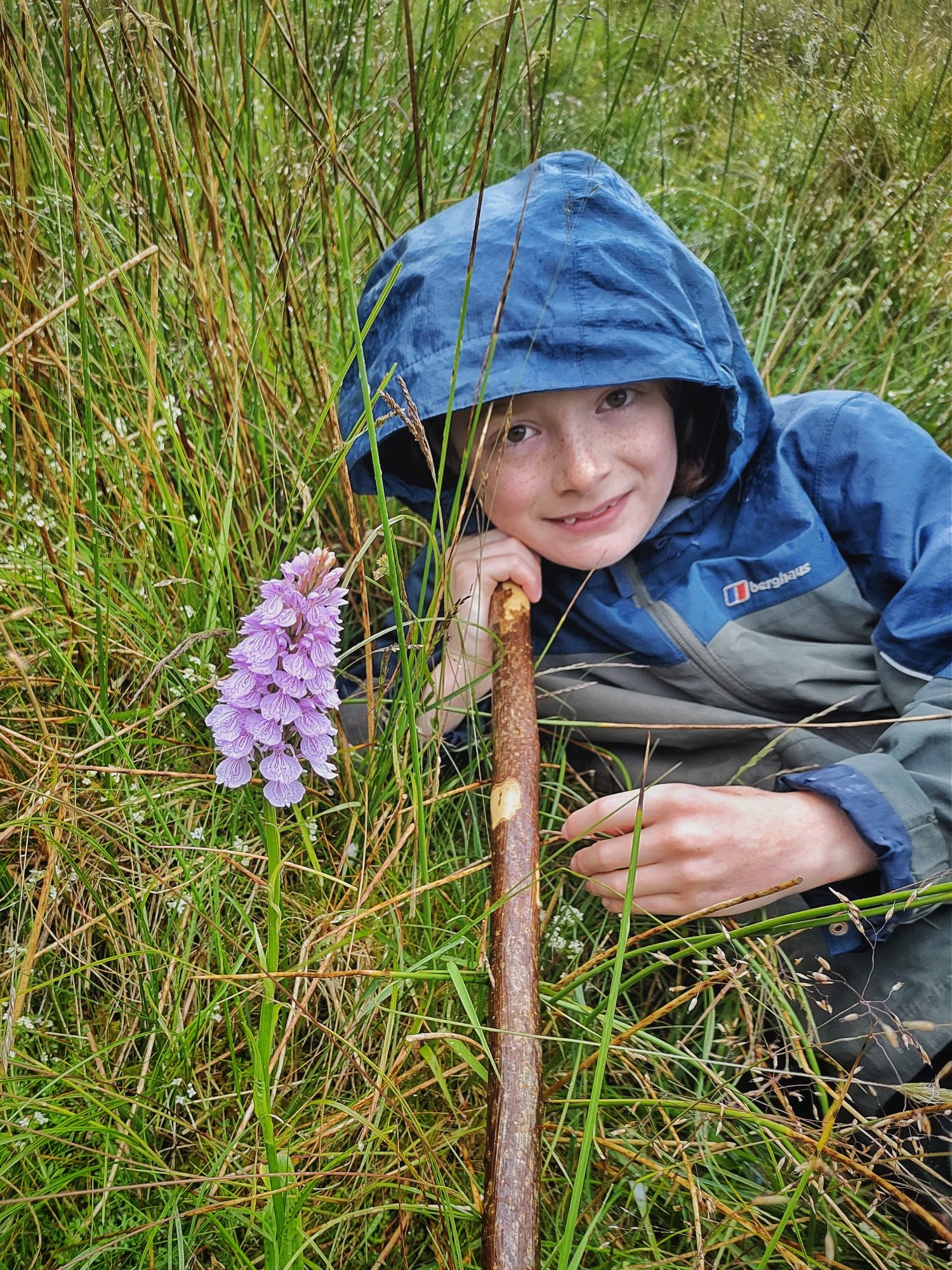
We finished the month with a wet walk in Strines Clough. We were led back to this favourite spot by having bumped into our friend Matt at the march, a 60,000-to-one chance, and he had told us about the orchids to be found above his wood. On the way there along Brown Hill Lane, we talked with Gary about his memories of the valley through the decades he has lived here, and of his pioneering wind turbine, installed with help from an RAF Puma helicopter in 1982. We left the track, its deep sides smothered in more tormentil than we had ever seen, and entered the boggy clough, sure enough soon spotting the pink patterned spire of a heath-spotted orchid, then another, then a swathe periscoping up among the deep rushes. We contorted ourselves, as we always do when we are here, into the magical copse of ancient goat willow that sits astride the stream, its otherworldly interior lit by little yellow lamps of northern hawk’s-beard. Up at the ruin that crouches under the moor and which has been shedding its stones back into the earth for the last 140 years, we sheltered from the rain against its last remaining wall, which echoed back into the white sky the melancholy calls of a pair curlews, the aching wail of a golden plover, and the eerie vibrato drumming of a snipe.
 Landscape Story