May is bluebell month; we waded through their torrents spilling down through the ancient woods on the way to school in the morning, and we deeply breathed in their scent rising on the warm air on the way home. When we judged they were at their peak, when there were barely any more buds to open and yet none had wilted, we meandered the same strange route across our hillside that we do every year to tour all the best bluebells scenes in the moment of their perfection. In an amphitheatre among young oaks, on an ash-crowned promontory above a roaring cascade, on the terrace of a long-forgotten cart track, under a wizened hawthorn in a dappled glade, we imbibed the azure abundance before it faded for another year.

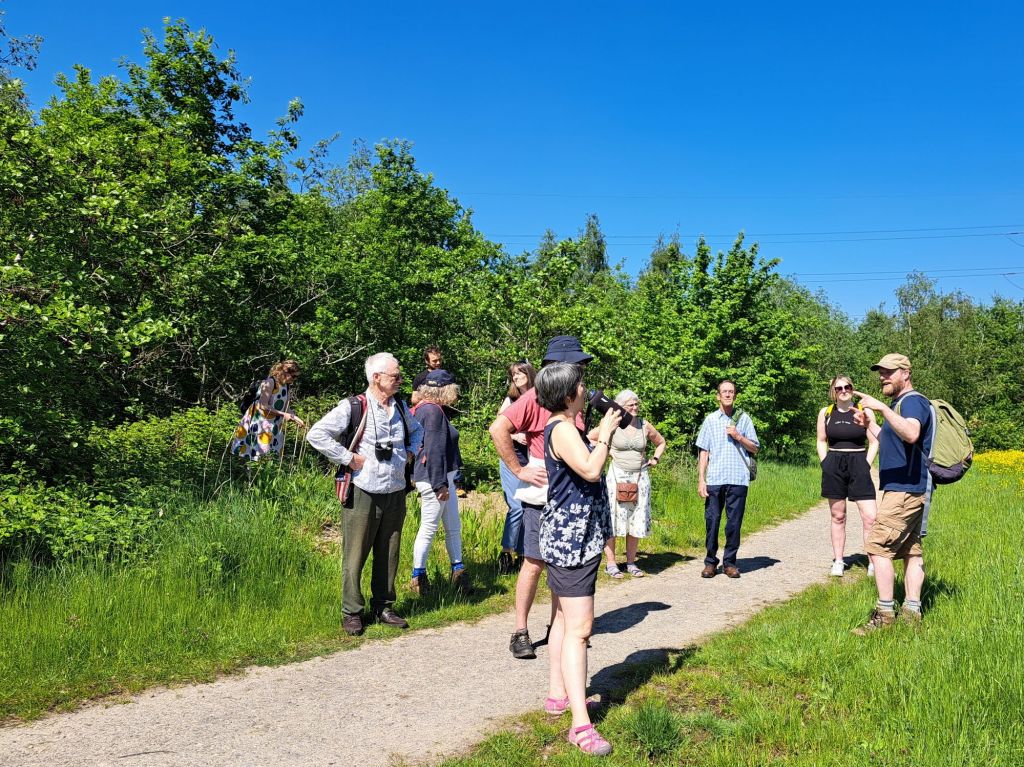
As the valley side woodlands have colonised the fields that were abandoned as too steep for tractors, so the bluebells have followed, thronging former pastures and meadows, hard-won from the hillsides, but easily lost. Contemplating change in the landscape, that which has already come to pass and that which is on its way, is what I spend much of my time doing. During this month, I got to do this in the company of some wonderful groups as part of Hebden Bridge Arts’ The Man Who Planted Trees programme of events, leading walks into Nutclough on the edge of Hebden Bridge and along the Calder and Hebble Navigation at Elland, both with the artist Sally Barker, where we foraged for natural materials among the remains of the industrial past with which to make artworks at Northlight Studios and Project Colt respectively; and at Cromwell Bottom, we excavated through the layers of history at this extraordinary site – quarries and gravel pits, lost canals and wilded osier beds, power station sludge lagoons and municipal waste tips – to tell the story of how it has emerged, phoenix-like, from this history of abuse into the wildlife jewel in the borough’s crown. I also began to explore the environs of Todmorden and Rastrick to design more walks for events the following month, and spent time at the West Yorkshire Archives poring over maps, deeds, planning applications, architect’s drawings, parish council correspondence and other documents, all another route into understanding the past of the place I inhabit. I am on an unending quest for understanding this landscape not as somehow fixed and timeless, but rather as the deeply historical and endlessly changing entity that it is.
The village green swarmed with the latest in the long line of generations of neighbourhood children, playing much the same games as their predecessors: digging holes in the embankments, making miniature fortified villages out of sticks and stones, getting gliders stuck in trees and hurling balls to dislodge them, and rightfully complaining when, even though the hillside opposite was still bathed in sun at the end of the lengthening days, it was time to come in. But one night, after enduring being torn from the green before he was ready and finally wrested to bed, we capriciously hoicked him out of the deep sleep he had immediately fallen into and carried him, in his pyjamas, back out to the now-dark green. But we had good reason, for having stepped outside just before bed, I was sufficiently convinced by the palest of glows over the trees to the north that this might be his first – and my wife and I’s second – opportunity to see an aurora display. It turned out to be a possibly once-in-a-lifetime spectacle at this latitude. What began with us having to point out to him faint, almost colourless shimmers above the chimneys of our terrace, culminated after an hour with the sky ablaze from horizon to horizon in waves of marine green, curtains of neon pink and shafts of unearthly purple radiating from a rare central corona. We gasped at each new imperceptible evolution of the splendid pageantry, grinned at each other in the darkness at the luck that had kept the skies clear of cloud, and eventually went to bed content that, even if we never experience the like of this cosmic majesty again, we witnessed it once, and did so together.

We made a pilgrimage to Selborne in Hampshire, to the home of Gilbert White, the 18th-century clergyman-naturalist who has become known as the ‘father of ecology’. His masterpiece is The Natural History of Selborne, a work that is, as his biographer Richard Mabey put it, a ‘deceptively simple and unpretentious account of natural comings and goings in an eighteenth-century Hampshire parish [that] has come to be regarded as one of the most perfectly realised celebrations of nature in the English language’. It has never been out of print in the 235 years since its publication, and the wonderful museum that has been made of Gilbert’s house, The Wakes, in which we spent several happy and absorbed hours, contains the hundreds of editions in which it has appeared, looking down from their shelves onto the museum’s greatest treasure, the original manuscript. His work’s mixture of affection for and close scientific observation of the more-than-human inhabitants of his garden, village and wider parish was revolutionary, and its lasting significance is testament to how the universal can be, and is perhaps best, found in the parochial. We wandered his marvellously recreated gardens and up through the steep beech woods of The Hangar onto Selborne Common, in that pleasant state of enjoying a wholly unfamiliar landscape, all the while imagining Gilbert on these same paths and how well this remarkable man would have intimately known and deeply understood everything he encountered.

We continued, as Gilbert called it, ‘watching narrowly’, back in our own beloved, familiar landscape. We kept track of the different greens unfurling in the woods opposite the gate after school, the muted pastel of birch next to the unripe lime of beech against the deceptively sickly pallor of new oak leaves. We clambered up from the charcoal burning platforms in Horsehold Wood to an unnamed outcrop that thrusts its chiselled face out from the trees, peering into the gaps in the gritstone blocks on which it rests its chin, scaling its right cheek by clinging on to its birch stubble, and scrambling onto the dome of its heathery head for a startling new view of the valley it surveys. We squeezed in three walks on weekend mornings: on the Dale Clough hillside we visited the special spots where the white and blue carpets of ransoms and bluebells abut each other in a hard, unyeilding line, counted the 200 steps arrowing up from Underbank House, and turned over stones to find dragonfly nymphs beneath its waterfall; we made a dash through early mist and puffs of pollen from the lodgepole pine at the junction of Kilnshaw Lane and Whittaker Road, up into a flawless blue morning at Stoodley Pike; and up past the blooms of Helen and Billie’s spectacular clematis at Lower Rawtonstall, and the blossoming crab apple and the scattered shining coins of the marsh marigolds beside the path to Pry, into David’s meadows, where his cattle, released from their winter quarters and running with the joys of spring in their pasture, seemingly felt the same as us.

 Landscape Story