As the April days lengthened, we stretched our legs with a 10-mile yomp across the moors; after stocking up on cakes and sweets at May’s Shop, we followed faint paths among the tawny grasses, from the bony finger of Reaps Cross to the hulking ruin of Raistrick Greave. Abandoned by the young Mitchell and Stansfield families in the 1880s, it lies marooned in a moorland sea that encroaches further every year to claim back the island of green it once raised from the desolate waves. We found glossy hart’s-tongue ferns stocking its cellar and, from a hole in its collapsing walls, the staring empty eyes of a sheep’s skull. The ghosts of that place harried us to the Boggart Stones, past the 1920s dam of Gorple Upper Reservoir and up the interminable, trackless slopes of Hameldon Holes, springy with deep cushions of bilberry. We crested the horizon and then rode on its swells to Hoof Stones Height, dropping down to pay our respects at the remains of the USAAF B-24 bomber which crashed here in February 1945, killing eight of its 11 American crew. More miles of bog brought us to Redmires Dam, where our puzzlement at how the deep cleft which breached it was created was immediately answered by the man responsible, who fortuitously popped up from where he had been tending the little hut of his gun club, which occupies the 19th-century reservoir’s empty acres. Fifty years ago, he told us, he packed the outflow with explosives and blew the dam wall apart, and he still remembers the shattering of the windows of the Sportsman’s Arms, 300 yards away. With this vision in our minds, we came across another curious scene; at Earnshaw Hole, among the highest farms in the district, a man was fruitlessly trying to coax his falcon, who he had followed to this remote spot with the help of a GPS tracker, down from a high perch on a pole. From time to time his wayward bird soared and stooped towards the dead chick he twirled enticingly on the end of a rope, but it was all in vain, and we left him in the last of the lowering sun, ruefully but fondly cursing its stubbornness.
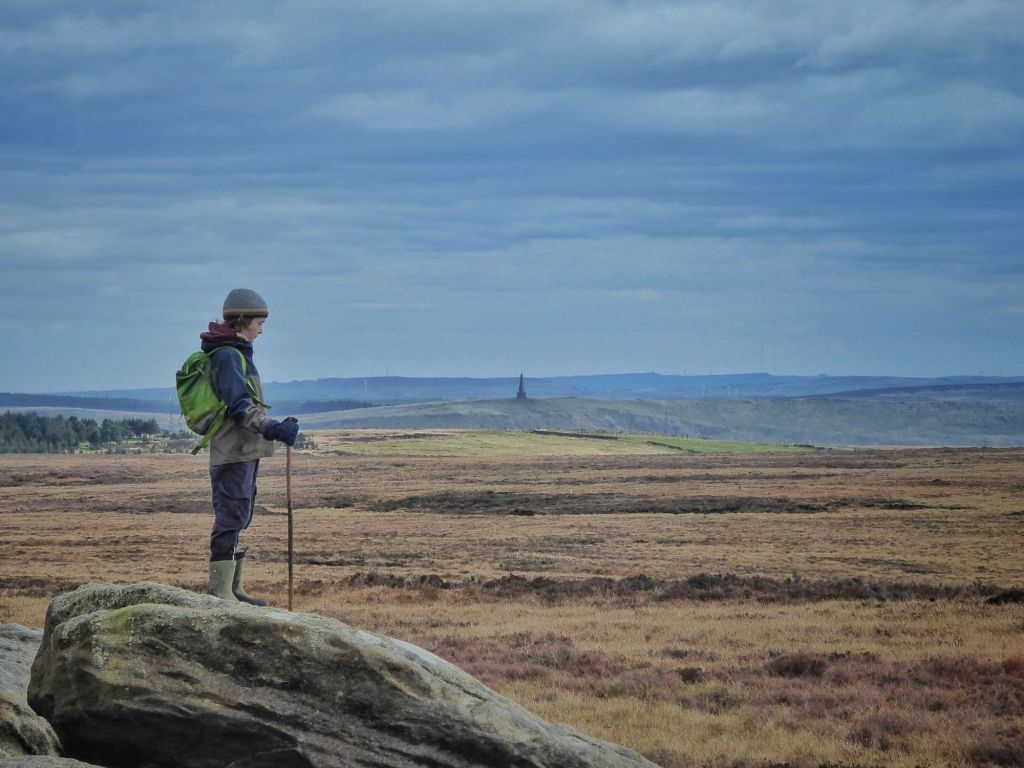
After the dark of a Hebden Bridge Picture House matinée we hoisted ourselves into the light along the lanes of Erringden, patting the horses in Crow Nest Wood on the way. Over the moor at the bottom of the Worth Valley, before a matinée at Keighley’s own Picture House, eight years older than Hebden’s but both now centenarians, we toured the treasures at Cliffe Castle Museum. We peered at the industrious bees in their glass hive beside the display of their original wicker hives, called skeps. The museum did a good job of displaying the landscape’s geological past with multicoloured gems and crystals under strong lights, and if we are not collectively careful, we will all need to visit here to understand its ornithological past, too, feathers faded, frozen in flight behind glass. We delved into Jumble Hole Clough for a visit to Beverley End, trying to imagine its remarkable, bluebell-and-wild-garlic-thronged terraces covered in wool-slung tenter frames and the recesses within its walls loud with bee-filled skeps. We spotted our first bluebell flower in the school run woods, and he blew his first dandelion clock on the way home from karate.

We had the honour of reporting the first swallow in Calderdale on the Calderbirds-SIGHTINGS WhatsApp group, in which we generally keep our heads down and just observe the records coming in from the proper birders. We were on Elland Bridge beside the noisy traffic, looking directly down on a mute swan settling on its eggs. He tuned into the ‘chissik’ call, unheard for long winter months, before I did, calling out to look up, and there it was, the unmistakable silhouette of tail streamers against the white cloud, followed immediately by another. We searched for ‘swallow’ in the 98-member-strong WhatsApp group, but the last record was 11th October, so we dared to stake our claim. Five hours later, the second sighting came in, and then they poured in over the subsequent days. It was 4th April, fully a week after the previous year’s first sighting, and five days later than our own. We were in Elland to reconnoitre routes for a series of guided walks I had been commissioned to lead, and we enjoyed getting to know a new area of the valley, especially Cromwell Bottom Nature Reserve, where the primroses and blackthorn were out in flower. He was also put to work on International Peening Day, where we joined our fellow High Hirst haymakers at the Fox and Goose pub to hammer (peen) our scythe blades back into shape for the coming mowing season.

After the Easter holidays, I returned to the Elland area during school hours for a second recce and to meet with Simon, the Chair of the Cromwell Bottom Wildlife Group, who manage the reserve. I also took myself on the train up to the Dales Countryside Museum in Hawes to see Rob and Harriet Fraser at the opening of their marvellous new exhibition, ‘Labour of Love’, about the farmers and other land managers who look after the commons in the Dales, the Lakes, Shropshire and Dartmoor. I had met Rob and Harriet years ago at a singular conference called ‘Artists, Farmers and Philosophers’ (I was presenting there in the capacity of the latter), and we had stayed in touch, and it was superb to see them and learn from them again. A week later, I was back in Hawes with all the family, for a re-run of a holiday that was cut brutally short by a bout of Covid last October. This one more than made up for it; we watched red squirrels feeding in the woods of Snaizeholme, swallows swooping under the bridge in Gayle, and lambs gambolling (there is no other word for what they were doing) at twilight at the end of the lion’s paw of Dodd Fell. As it does every year, our little Hawes holiday ended at Garsdale Station, where there is a statue of Ruswarp (pronounced ‘Russup’), the famous border collie companion of Graham Nuttall, a central campaigner for saving the celebrated – and very nearly closed – Settle–Carlisle Line. Not long after the line was technically reprieved in 1989, Graham went missing in the Welsh mountains, and Ruswarp stayed with his master’s body for the 11 days it took the search to find him, and lived just long enough to howl at his funeral. The response to this story brought the line back into the public’s, and therefore politicians’, minds, and the massive investment that was needed to ensure it not only survived but thrived was secured. Every year, we give dear, faithful Ruswarp a pat as our train home approaches.
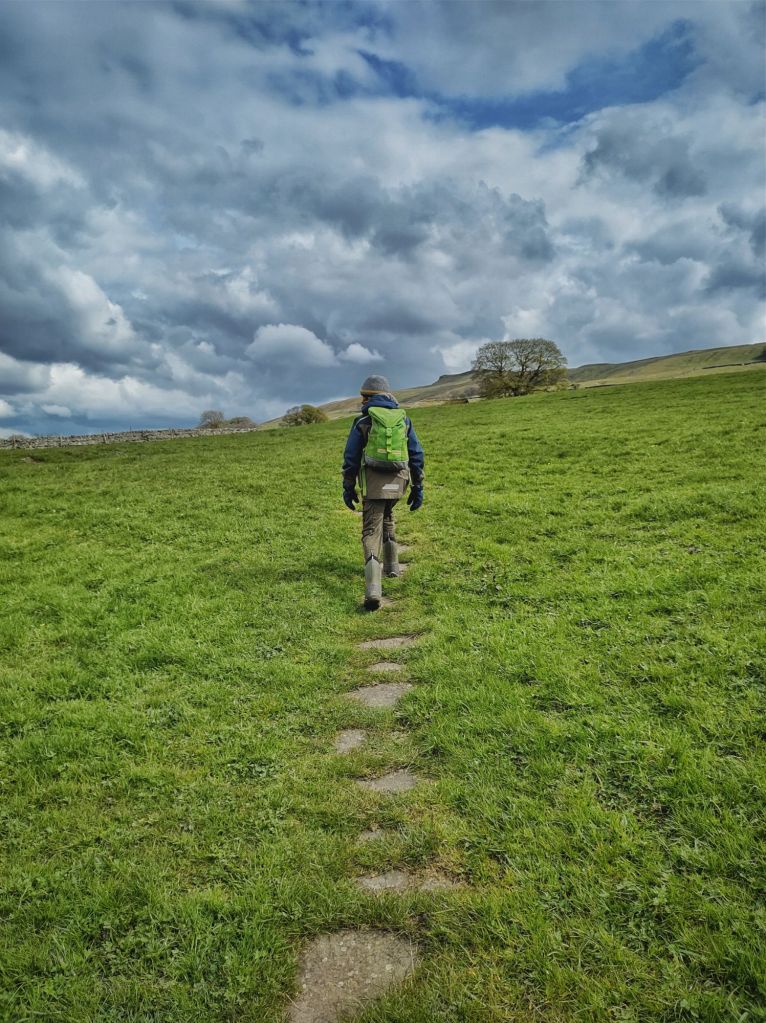
Our customary after-school walks were a succession of ascents, as every walk in this valley must be if it is to ever stray from the canal towpath. We clambered up a waterfall that we have only ever seen from above, spouting from an outcrop traversed over by our usual path, and discovered that it is an outflow from an ancient, man-made field drain. We climbed to a bench high on the Whins above the old corpseway up to Heptonstall and watched the first heat haze of the year rise off the baking hillside among the greening birch saplings. We used the deer paths to navigate our way upwards through the budding bluebells to our favourite sit spot for a snack and a story. And we threaded our way up between the coltsfoot-studded banks of the deep, steep Rake to hunt along the edge of Erringden Moor for the Mandike Stones, lost markers of an Anglo-Saxon boundary whose importance to our distant predecessors was fathomless under skylarks suspended in a wide singing sky.

 Landscape Story
wow!! 86A High Beckoning Horizon
LikeLike