We squelched and slid through the February mud in the Worth Valley, where we uncharacteristically followed signposts and clutched a walk leaflet to guide ourselves round the Railway Children Walk, a tour of the shooting locations of one of our favourite films. As we passed Three Chimneys we could just imagine Bobbie, Phyllis and Peter sitting there among the long summer grass in the garden; we waved to the passing steam trains just as they waved to the Old Gentleman who came to help them. When we reached Mytholmes Tunnel we wondered how the crew made it look so endless for the paperchase boy to be swallowed in the dark, and we fancied we could see the scars on the cutting where they ingeniously staged the landslide. We sat on a bench at Oakworth Station and watched the present-day Perks close and re-open the level crossing gates, and even though he did so in a considerably less entertainingly frantic manner than Bernard Cribbins, we could not help but hear Johnny Douglas’s hilarious honky-tonk theme for the scene. Just like Perks (despite his claim to the contrary), he had plenty of time for ‘conversationalising with the junior public’, inviting us into his ticket office, which had hardly changed since the 1905 setting of the book, let alone the 1970 recording of the film. The winter landscape may not have been as lush as that long ago summer, forever suspended in Technicolour celluloid, but we enjoyed following the swift swollen river, watching a treecreeper’s sharp silhouette against the low sun as it twirled its way up a moss-thirled sycamore, and the puffs of hopeful pollen released into the frigid air by the male yew trees. At sunset, to the bafflement of the Brontë Bus driver, we dinged the bell and got off at a lonely stop high on the moors. After the bemused bus carried on down to the lights winking on in the snug shadowed valley, we clambered up the rocks of Naze End and found a small snowfield not long for this world, and he spent a happy hour balling it up and hurling it into the amber twilight.
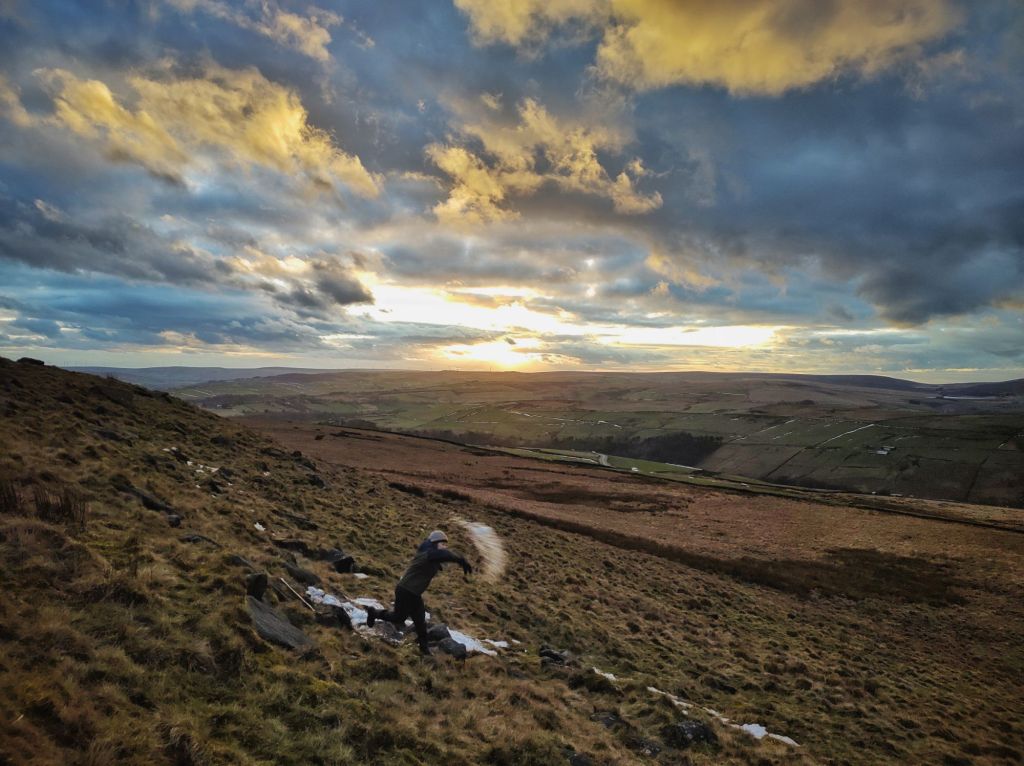
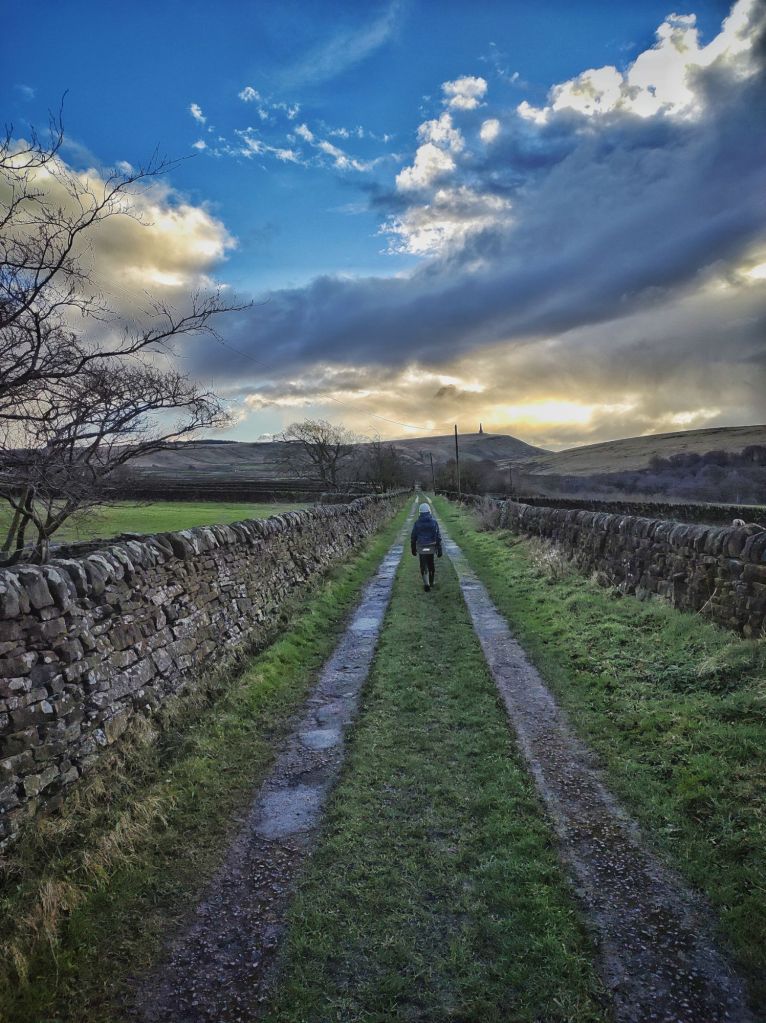
The snowfield was the last remnant of the single snowfall of the month four days previous. It had had the temerity to arrive during rather than before the school day, but the most was made of the one evening that it stayed in the valley, with sledging and snowballing galore on the village green. We set to work as well as play, digging and filling a wildlife pond in the school yard; helping plant an oak sapling with the neighbourhood children; and I got out for a bit of tree planting during the school day with the Calder Rivers Trust in Crimsworth Dean. On our after school walks, we searched out a squat standing stone among the rushes in Dick’s pasture above Dill’s Scout Wood, and were stalked by showers and rainbows into the strong glare of sunset along Pinnacle Lane.
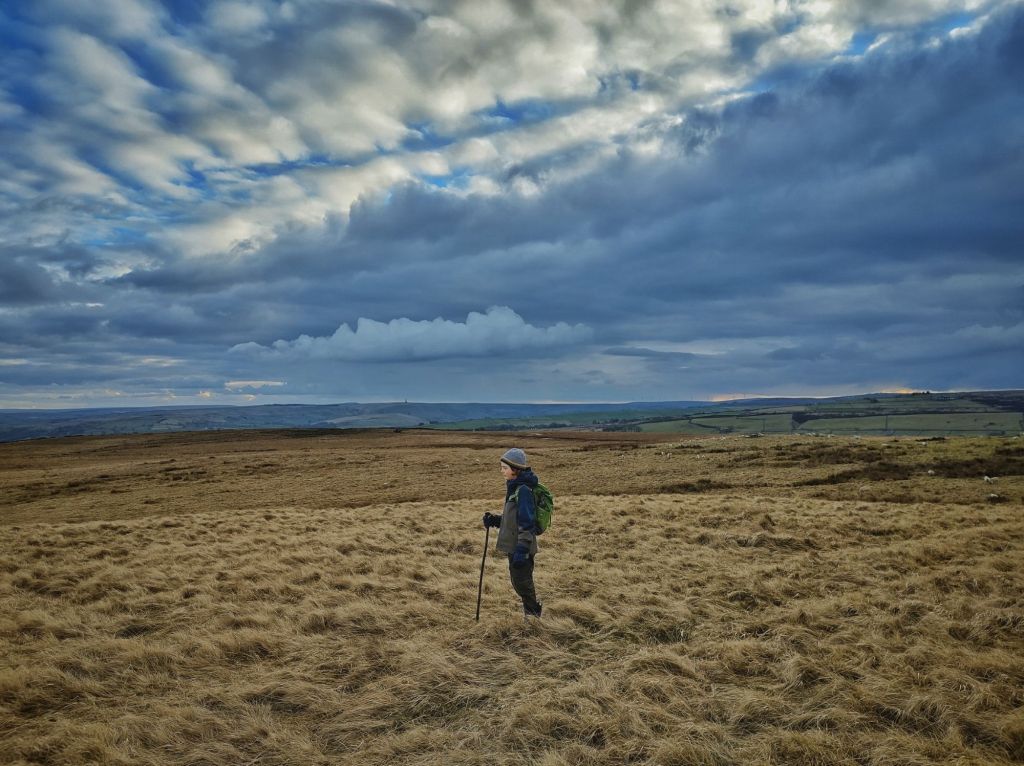
We joined naturalist Steve Blacksmith of the Halifax Scientific Society to survey the variety of conifers in Hardcastle Crags. He taught us how to distinguish Scots pines from Austrian black pines, pointed out Norway spruce and European larch, and showed us magnificent specimens of the much more unusual Weymouth pine and Douglas fir. After we left the group, we spent the rest of the day exploring Rowshaw Clough, climbing past the hidden Horseshoe Cascade and the Lund’s smart farm at Walshaw, past remarkable walls perched on boulders deep in the leafless bilberry and a mysterious ruin beside its wild stream, and on and up past the tumbled stones of Moor Cock to look down at Jack’s Allotment, a vast baize intake draped over the final rise to the moorland edge. Rippling away southwards, every contour of the Pennine spine’s vertebrae was picked out in a vivid winter light, but dark clouds soon chased us over the jutting hill of Hamlet, where we watched Adrian in his tractor bringing two silage bales up for his gratefully bellowing cattle. At the fading of the day, down we plunged into the woods at Midgehole, then instead of skirting round the base of the Heptonstall headland which stood between us and home, we made a beeline for it with one final 450-foot heave back up into the last of the light, through St Thomas a Becket’s ancient churchyard and down again through the darkling oaks of Granny Wood.
 Landscape Story