How can philosophy help deepen and enrich our understanding and appreciation of landscape? By way of an answer, I will offer reflection on three philosophical questions we can ask of any place or landscape: What is the narrative of this place? What is this landscape’s moral character? How is this place faring? I hope to show that the academic discipline I worked in for 17 years, 11 of them researching, writing and teaching at the University of Manchester, has much to offer our deliberations on the human relationship with our environment.

What is the narrative of this landscape? Reflecting on this question, having an understanding of a place’s history and how it has conditioned the landscape as it is today, deepens and enriches our appreciation of it. Of course, you can always enjoy the landscape – the views, the sights and sounds and smells, the light and shadow on the fields – without any knowledge of its history. And it is certainly not the case that a person cannot be connected to or belong to a place if they do not know about or have no personal or familial connection to its history. Rather, what I want to say is that having an understanding of a place’s history adds an extra dimension of appreciation. How deep you want to go with this will be different for different people: we can just have an awareness of the rough outline of the broad story of a place, a table of contents, as it were, but every one of these chapters in its history is of course made up of endless tomes of works themselves, which proper historians dedicate themselves to researching and writing.
First of all, then, what even is it for a place to have a narrative? It is an account of its history, certainly, but it is more than just a dry and dusty list of dates and events. Rather, it is more like a great novel which chronicles – in a way that novels usually do with human characters – its fortunes, its ups and downs, triumphs and tragedies.
For example, any account of the narrative of the landscape I inhabit, the upper reaches of West Yorkshire’s Calder Valley, would have to cover the laying down of the gritstones and the heaving of them into the Pennine chain; the savage cutting of its valley-within-a-valley by glacial meltwater, its reforestation after the last Ice Age, the clearance of these forests by the first settlers and subsequent tides of invasion and settlement by the Romans, the Angles, the Danes and the Norse; then the Normans and their establishment of hunting forests, which were eventually opened up to settlement and the enclosure of common land and moorland wastes; the rise of the dual economy of handloom weaving and subsistence farming, the coming of the canal and the railway and the industrial mills and the explosion of the town from a quiet river crossing on a packhorse track to a centre of textile production; and the collapse of that industry and the demise of the town and the abandonment of the mills and also hundreds of farms, and the saving of both by a renaissance brought about by a combination of local and newcomer campaigning and innovation.
This very quick and rough account of its history is not, as such, philosophical. The philosophical claim is subtler, and it happens when we move from history to narrative. Recall that in my rough outline of this landscape’s history, as well as factually listing periods and events, I also used words like collapse and demise, recovery and restoration. These are evaluative terms, value-laden judgements of how the subject of the narrative is faring. Narratives cannot help but involve such judgements.
They do this not only by explicitly containing such assessments, but also by the choices that the narrator makes as to what events to foreground and which to gloss over, and which characters are included and which left out from the story. A landscape’s story will be made up of many sub-plots, as it were; sub-narratives of both human and more-than-human characters that have participated in the overarching history of the place. Each of these may be given a bit-part or excluded altogether, and those included may be presented as a villain or a saviour, a victim or a hero. Much will depend, therefore, on who the narrator is, and how they choose to tell the story to their chosen audience.
So beyond simply learning about the history of a place, there is also reflecting on the nature and purpose and origin of the many narratives that can be told of any one place, each differing in the events and characters it includes and excludes, how it portrays them, and the judgements it makes of how the main subject of the narrative – the landscape itself – is faring. A dogmatic belief that there is only one narrative to be told of a place, only one judgement that can be justified concerning how it is faring, cannot survive reflection, and the resulting awareness that there is a multiplicity of narratives that can legitimately be told of a landscape cannot help but enrich and deepen one’s understanding of it. This extra step beyond the historical is one way in which a more philosophical turn of mind can add an extra dimension to our experience of a place.
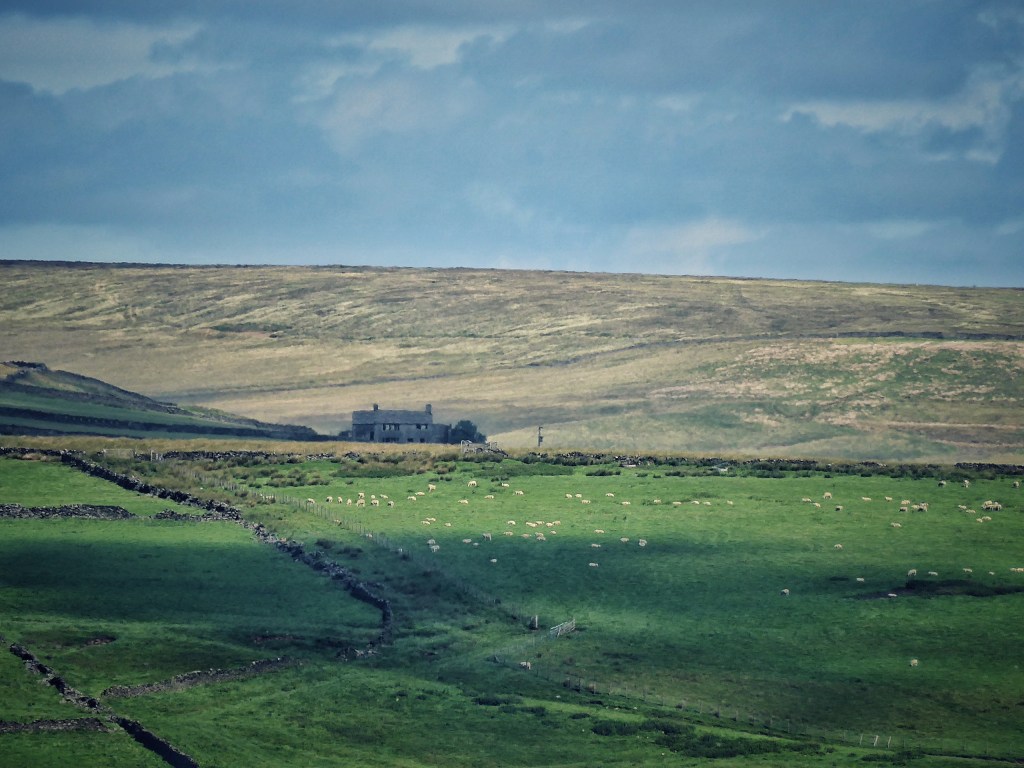
Let’s take the second question we can ask of a place: what is the moral character of this landscape? Again, my suggestion is that reflection on and concern for the moral qualities of a place can enrich and deepen our connection to and understanding of it, not that we cannot be attached to a place if we do not reflect.
But what do I mean by the moral character or qualities of a landscape? Now, what I am not suggesting here is that landscapes have moral qualities or moral characters in the same way that humans do. In a way, talking about the moral qualities of the landscape is just a way of talking about the moral qualities of the individuals and communities, and the systems and institutions, which shape landscapes. But I nonetheless think it is instructive to talk about the moral qualities that the landscape expresses. So, what aspects of a landscape’s history have a bearing on how we should perceive its moral character?
Firstly, the circumstances and process of a landscape’s creation surely has a significant bearing on its moral character. This is related back to the history point; to appropriately understand a thing’s moral properties, it is often important to know something of its history. Again to take my Pennine valley as an example, there is the fact that the creation of this landscape involved the large-scale clearance of forest and the significant impacts on wildlife, including extinctions, that that entailed. Further, this archetypal picturesque landscape of small fields bounded by dry stone walls is itself the creation of a process of enclosure, whereby communities were shut out of common land and their rights to use it – pasturage, pannage, estovers, turbary, piscary, rights in the soil, animals ferae naturae – were extinguished for the sake of private use and profit.
Then there is the relationship of the textile industry to the slave trade. This is something that the National Trust is reckoning with at the moment with the stately homes and estates under their care, many of which would not have been built without the proceeds from the slave trade. At the very least, due recognition in their accompanying interpretation is needed, and for some things, there perhaps needs to be a reevaluation of their worthiness for preservation. The West Yorkshire landscape’s industrial heritage is bound up with textiles, much of which was wool but much also was cotton, so it too is bound up with the slave trade. There may not be the large estates that were created directly from the proceeds as in other parts of the country here, but the wealth and growth of the towns was not unconnected to it, nor to the appalling conditions for the workers, many of whom were children.
Of further relevance here is the Industrial Revolution, in which this town and region played a fulsome role and which is now routinely identified as the beginning of the acceleration towards the climate catastrophe that is now unfolding. There is an inevitable tension between celebrating that heritage from this era and lamenting its terrible environmental cost, both local in terms of the continuing effects on the ecology of the air pollution it was responsible for, and global in terms of the legacy of emissions we will be affected by for generations to come.
Now thinking about the present, what features of this landscape might influence its moral character. For some, there is the fact that it is to a significant extent oriented around the production of meat, around which there is debate concerning the associated welfare and environmental impacts. Then there is the management of the moorlands for driven grouse shooting, and the associated issues of increased flood risk from managed moors, predator control and the ethics of sport shooting. There are debates around energy generation, in particular the local environmental impact of wind power, and whether there are ways for local communities to benefit from the imposition of wind farms that are often owned by corporations harvesting renewable subsidies. And there is also the wider moral failure in the catastrophic decline of the more-than-human species we share this landscape with, due to the changes we have driven in agricultural practices, the destruction of habitat, air and water pollution, and our incessant need to tidy every scruffy corner of field and garden and verge.
Everywhere we look, then, there are moral conflicts being played out across the landscape, and these feed also into our aesthetic perceptions, which is a separate fascinating philosophical question: the extent to which our moral and aesthetic judgements are, and should or should not be, connected. Even if it is right to find morally good objects, including landscapes, more aesthetically pleasing, it again depends on having the awareness of the issues at play.
And this brings us to a final point here: that underneath genuine ignorance and beyond misunderstandings, there is a range of admissible values, a plurality of legitimate moral claims, a spectrum of justifiable ethical positions on many if not all of the issues I have raised. There is no single objective moral truth to be discovered here, and so no one way that the landscape ought to be in an ideal moral world. There therefore should be nuance, and compromise, and a shared consensus built on understanding, mutual respect across different communities and interests, and practical judgement as to the most acceptable, all-things-considered options. And being alive to not only the issues at play across a landscape, but also that there are no optimal solutions but only a range of often rather tragic choices to make, is another way in which we can enrich and deepen our appreciation and understanding of a place.

The third and last question builds on the previous two, and the question is: how is this place faring? As with the moral character point, I’m not claiming that landscapes can fare well or poorly in the same way that humans and other sentient creatures can. Rather, as before, it is really a way of talking about how the landscape’s inhabitants – its human and more-than-human individuals, communities and populations – are faring.
Sadly, of course, it is clear that, along with the rest of the country and much of the world, apart from a few local success stories of flourishing wildlife, its more-than-human inhabitants are not faring well at all. Its insects and its birds in particular are in a terrible decline, one that climate breakdown will only accelerate and worsen, albeit with a few compensatory additions as species move north.
But how are its human communities doing? Well, back again to the point I made about narrative and about ethics: it depends on who is telling the story, and what their values are. To a member of an older generation who remembers the deprivations and degradations of the post-war, post-industrial slump in this valley, the material comforts and convenience and the restoration of the town after so much of it was derelict by the 1960s might be seen as a triumph, while equally there might be aspects of the community as it was then that they miss. To a resident in their teens or 20s, these comforts might be insufficient compensation for climate anxiety, the cost of living crisis, the poor prospect of ever owning their own home, the failure of the promise that each successive generation would enjoy more prosperity and opportunity. There is a plurality of perspectives and no single answer, but the purpose of philosophical reflection has always been to reveal complexity rather than provide answers.
But I contend that there is wonder to be found in complexity, and humility to cultivate in recognising and accepting it, and both can inform a more considered appreciation of the places we love. And of course if we love them, then we should certainly be concerned about their welfare, and motivated to do something to improve it, even while acknowledging that our own sense of what counts as improvement might not be another’s. Clearly many people are so motivated, as evidenced by all the volunteering and vocational work that is done to serve our human and more-than-human neighbours.
We might draw an analogy here with friendship that ties all three questions together. To be a proper friend to another, we should be curious about their past and how it has shaped them, we should be concerned with their moral character, and we should be interested in and concerned for their welfare. We can be a certain kind of friend without these, but I think we are a better friend with them, and the friendship is richer and deeper for it.
It has been my wish to show that philosophy reveals the complexity of the narratives, moral characters and states of welfare of places and landscapes. Narratives, moral characters and states of welfare are the kinds of things that are too complex for there not to be a multiplicity of arguable accounts, each embodying a plurality of perspectives and depending on a set of incommensurable values. But in revealing complexity, philosophy fosters wonder, humility, wisdom and pragmatism. There is wonder in properly comprehending, or even just glimpsing, the complexity of an entity. There is humility to be cultivated in accepting that an entity is too complex for there to be a single answer as to what its narrative, its moral character or its state of welfare is. And there is wisdom in recognising that the values expressed in different accounts of the narrative, moral character and state of a place’s welfare are incommensurable and cannot be traded off against one another or compared against some objective measure of truth. Decisions almost always involve tragic choices about what to forsake in order to gain something else of value. To make pragmatic progress, therefore, involves leaving behind polarised debates in which each side dogmatically declaims their own view while refusing to acknowledge the alternatives and attempting to recognise and respect the plurality of ways that people can care for places and love things as complex as landscapes.
 Landscape Story