In the first dun light of morning, a wren sings its usual trill, but it is tentative, muffled, truncated, evidently subdued by the night-long deluge. Another, atop the mound of Hannah’s lemon-and-cream honeysuckle, has a different attitude, celebrating getting through the night with its usual full-throated cacophony. Nearby, the Colden thunders headlong into the Calder, both at their highest since January. The flood alert issued by the Environment Agency is on the mark, the levels reaching the top of their normal range, reminding residents and business owners, just in case they were becoming complacent, that these waters remain an ever-present and growing danger to the town. It has been seven and a half years since the devastation of Boxing Day 2015. Ten months after those waters receded, the Calderdale Flood Action Plan was published, much later than promised, and it committed to delivering a flood alleviation scheme for the town that would be started by 2018 and completed by 2020. In the fourth and latest draft of the plan from 2019, it revised the completion to March 2023, but barring some minor tinkering at the edges and an awful lot of surveying, the scheme has yet to be started. If so-called one-in-a-century weather events could be relied upon to stick to their schedule, this delay need not be of concern, but with records tumbling with greater and greater frequency – the hottest day on record globally, extreme marine heatwaves in the North Atlantic and record low Antarctic sea ice have featured in the last month alone – it seems that a repeat of 2015 before too long cannot be ruled out. Downstream, where the Hebden Water empties its 23-square-mile catchment into the Calder in a frothing swirl of dark water, a stone head on the parapet of the Rochdale Canal aqueduct gazes out on the whirlpool, unnoticed by almost everyone who walks by on the towpath. The town may soon again need the protection against misfortune that talismans like this were intended for.
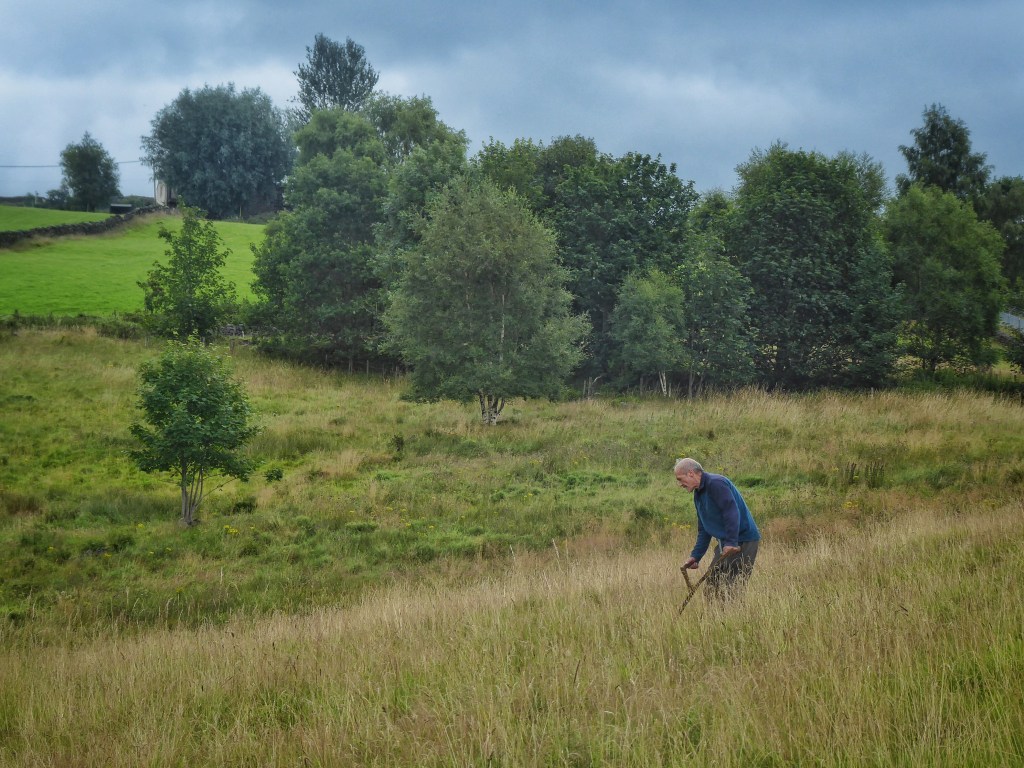
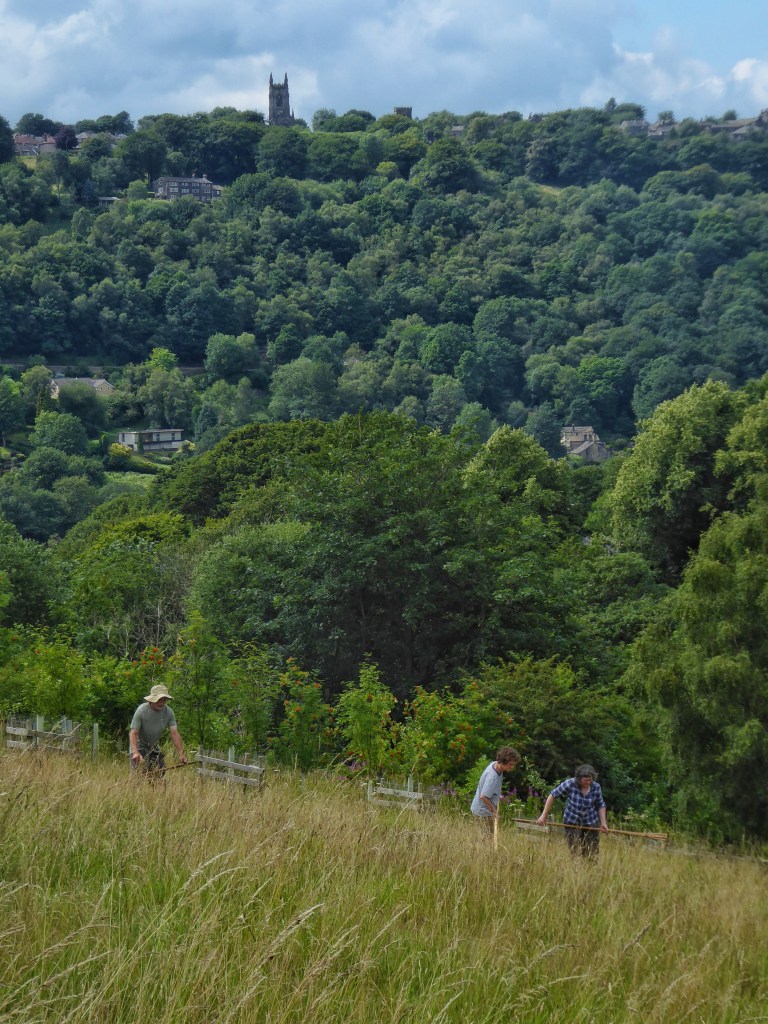
The rain falls on grass that was cut yesterday by a team of scythers at High Hirst Woodmeadow. It is a sight that, before a July weekend of 30-degree heat 12 months ago, cannot have been seen in the Calder Valley for 70 years or more, when Steve Tomlin came to teach a dozen novices committed to mowing this community-run meadow. Steve first taught them how to assemble their new scythes, each adjusted to their own proportions and posture, attaching the two handgrips to the shaft to make the snath, and then the 65cm curved blade to the snath by its tang and lug. Next, they were guided through making three fine but essential adjustments to the orientation of the blade – to its lift, its lay and its haft – which together ensure the most efficient slicing angle along the arc of the cut. Hours were then spent on the techniques for honing the blade with a whetstone always carried in a sheath at one’s side, and the annual task of peening, hammering the blade to reshape the bevel after the season’s wear.
Finally, 12 scythe blades sliced through the sward, combing the meadow into stripes of windrows and short-cropped swaths. It is a moment of fulfilment of a vision to revive the traditional management that created and sustained the sward’s incredible diversity, for the sheep’s fescue and sweet vernal grass, meadow vetchling and pignut and dozens more delicate wildflowers depend on the summer growth being removed after they have set seed, keeping the nutrient levels low and the more vigorous grasses in check.
This year, Steve returns to refresh the scythers’ techniques – how it is best to bend the right knee as the blade is at the 4 o’clock position, then bend the left knee as the blade curves round to 12 o’clock; how bending the right wrist over as the cut arcs keeps the blade’s sweet spot in contact with the ground; when in the motion it is optimum to take the tiny steps forward for the next cut; and most importantly of all, how it is always worthwhile to stop and hone the blade at least twice as often as it seems to be needed.
Last year, as the day’s heat eased, the rhythmic ringing of sharp steel through sun-baked grass grew a little more confident, and the windrows of already-drying hay stretched with the afternoon’s shadows down the hill. This year, the grass is wet but the scythers’ skills are a little more honed and the sward thicker and easier to cut thanks to July’s rain, and the grass falls as house martins swirl overhead and deer stalk through the neighbouring pasture.
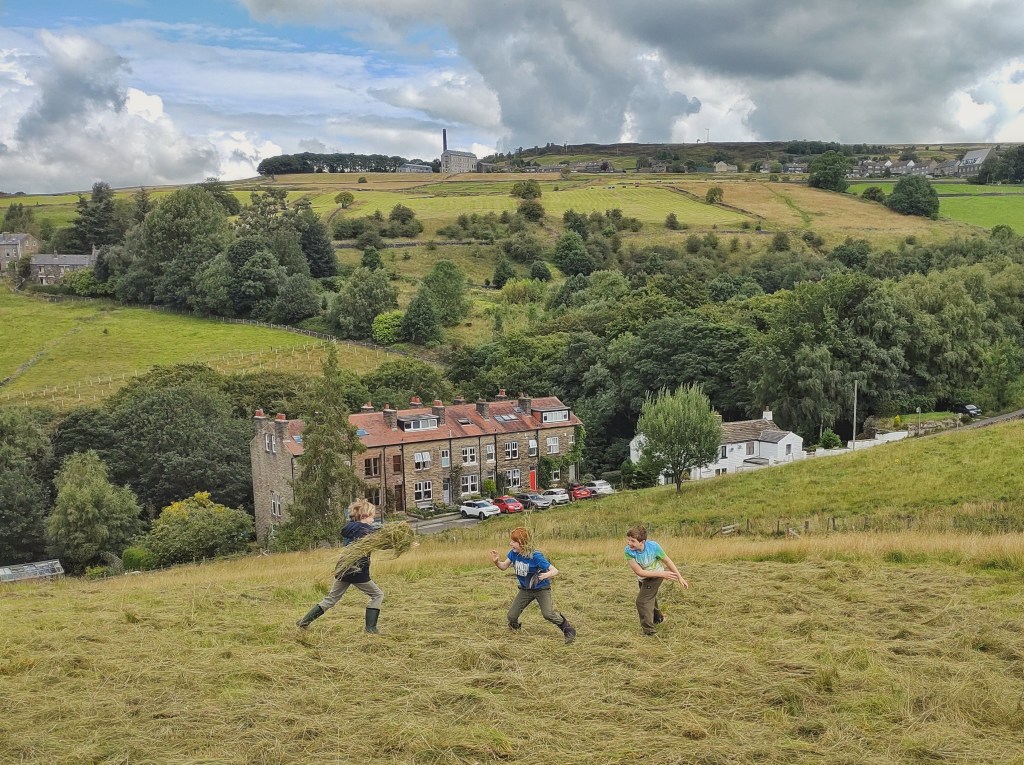
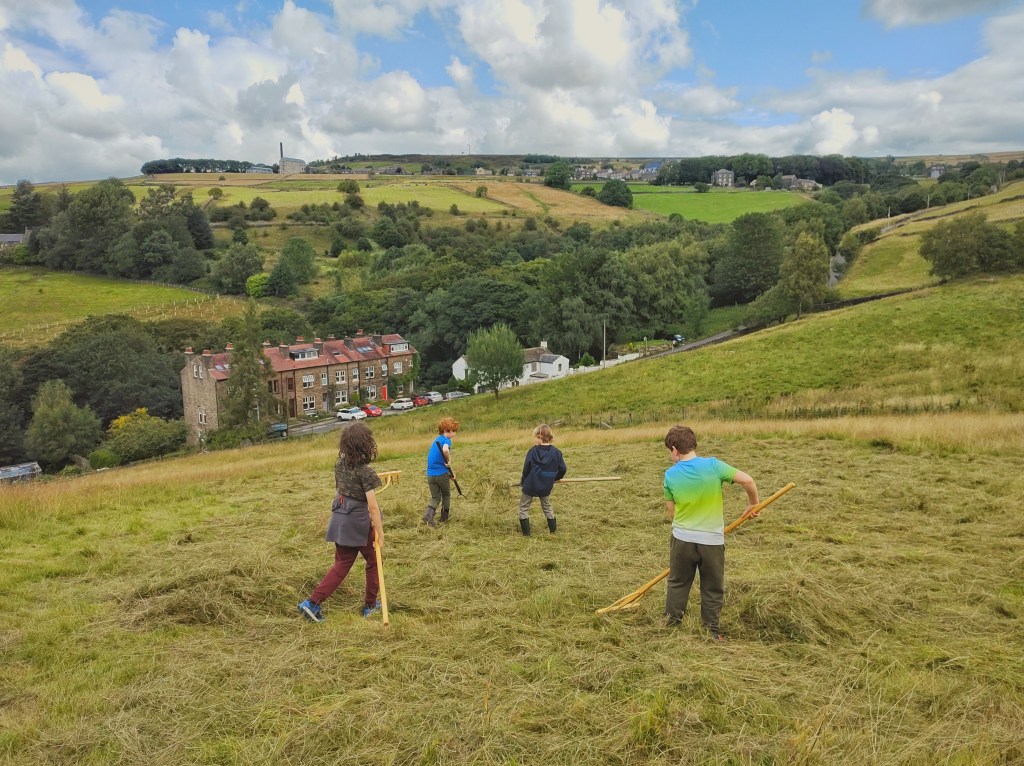
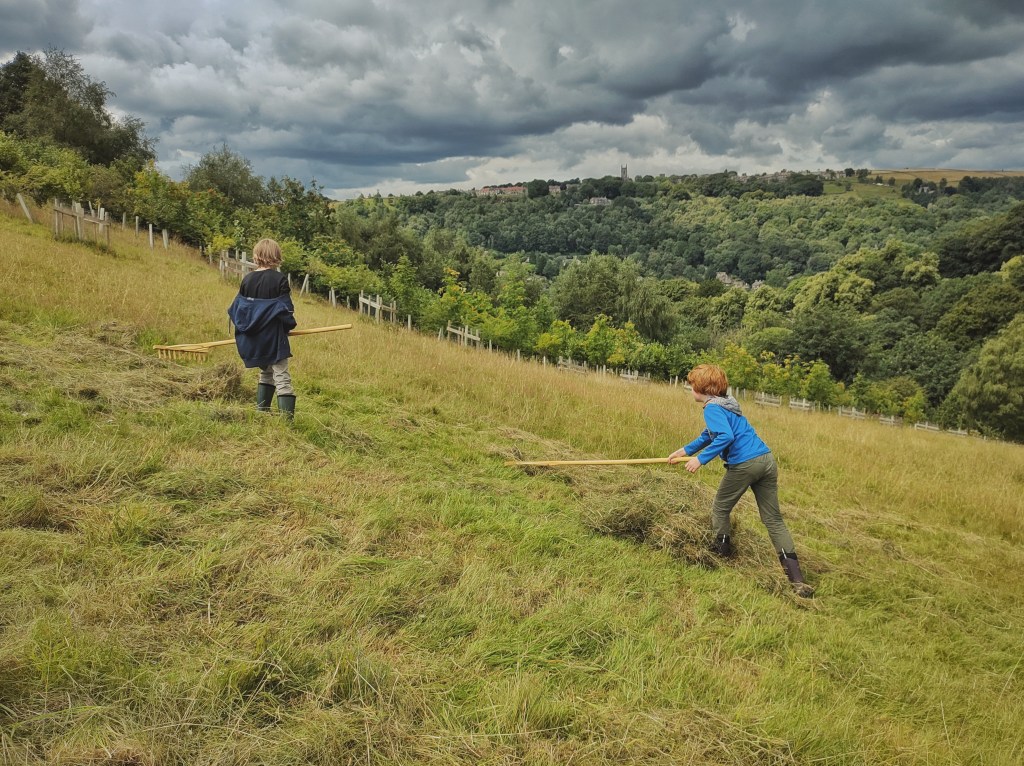
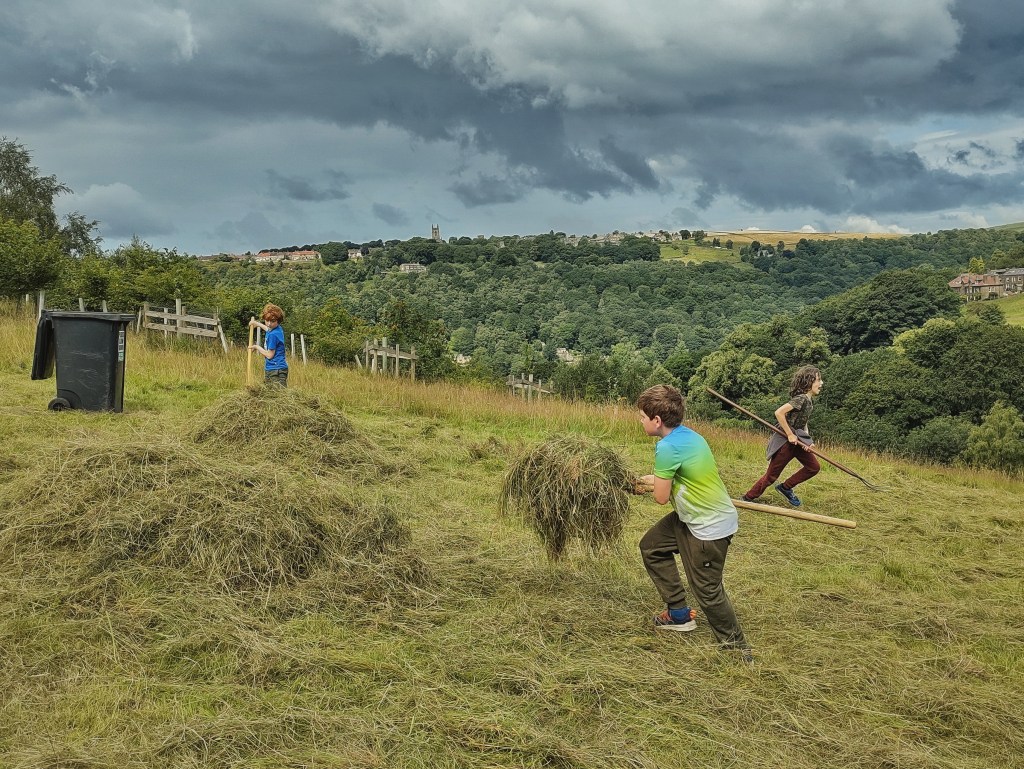
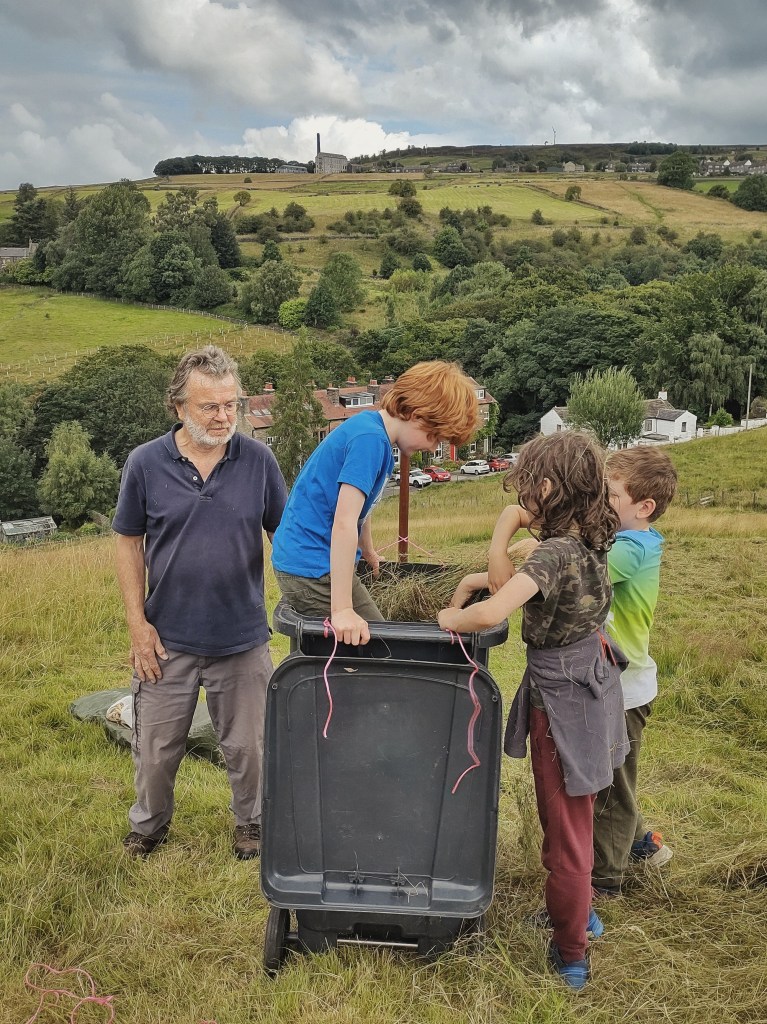
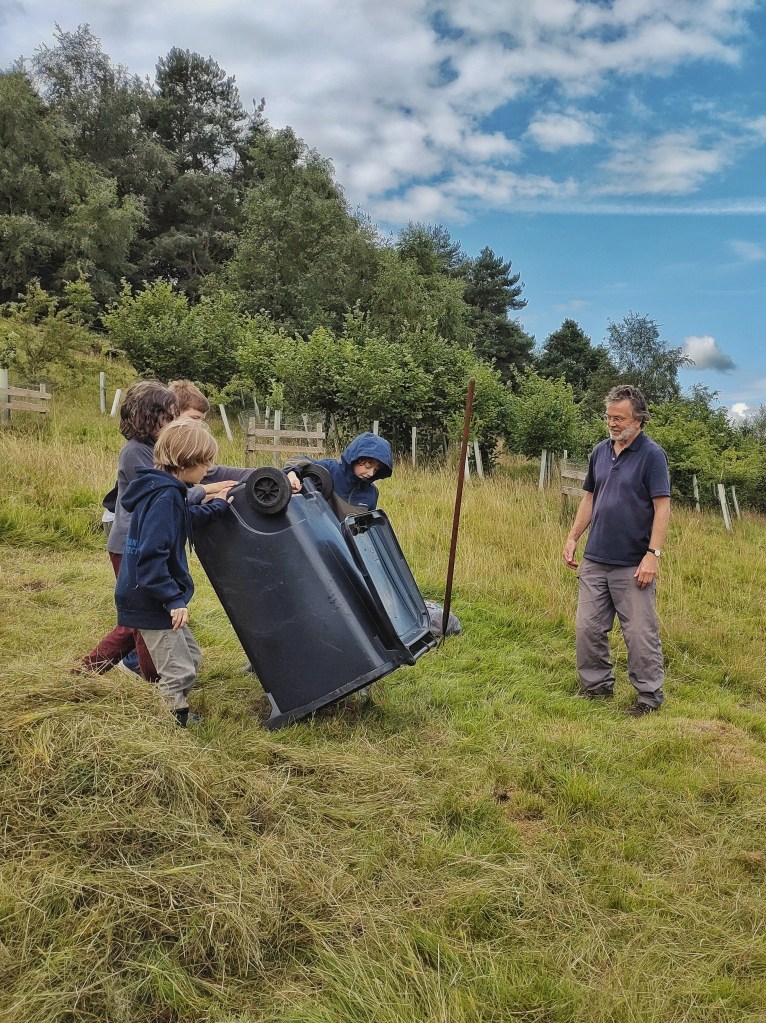
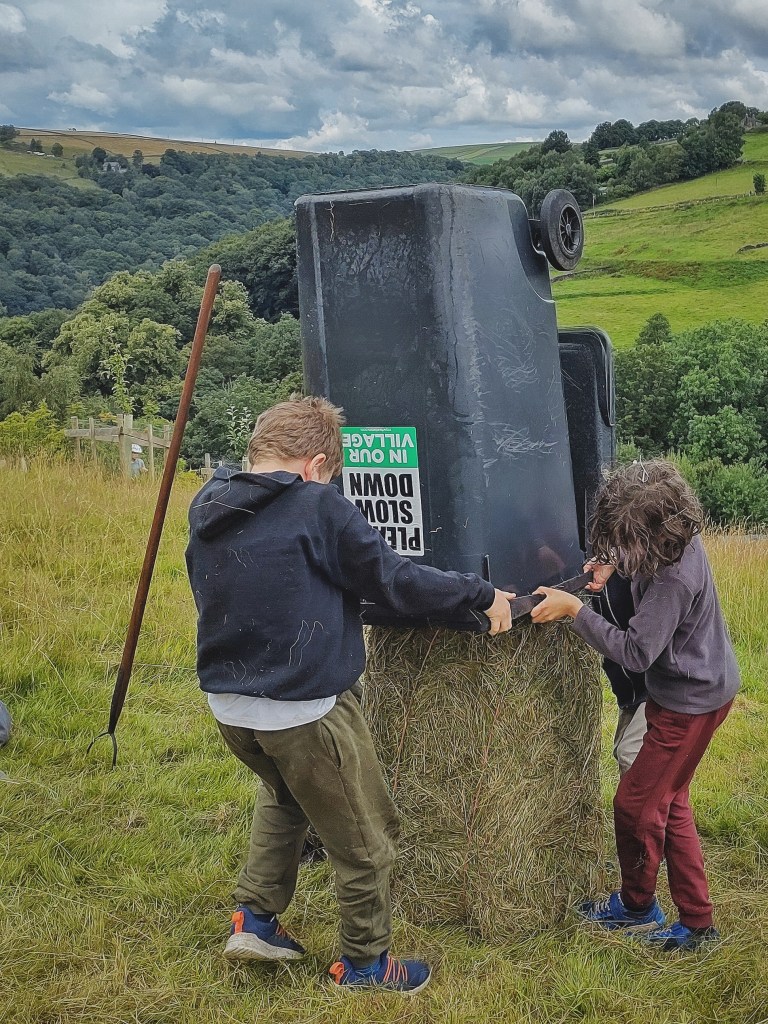
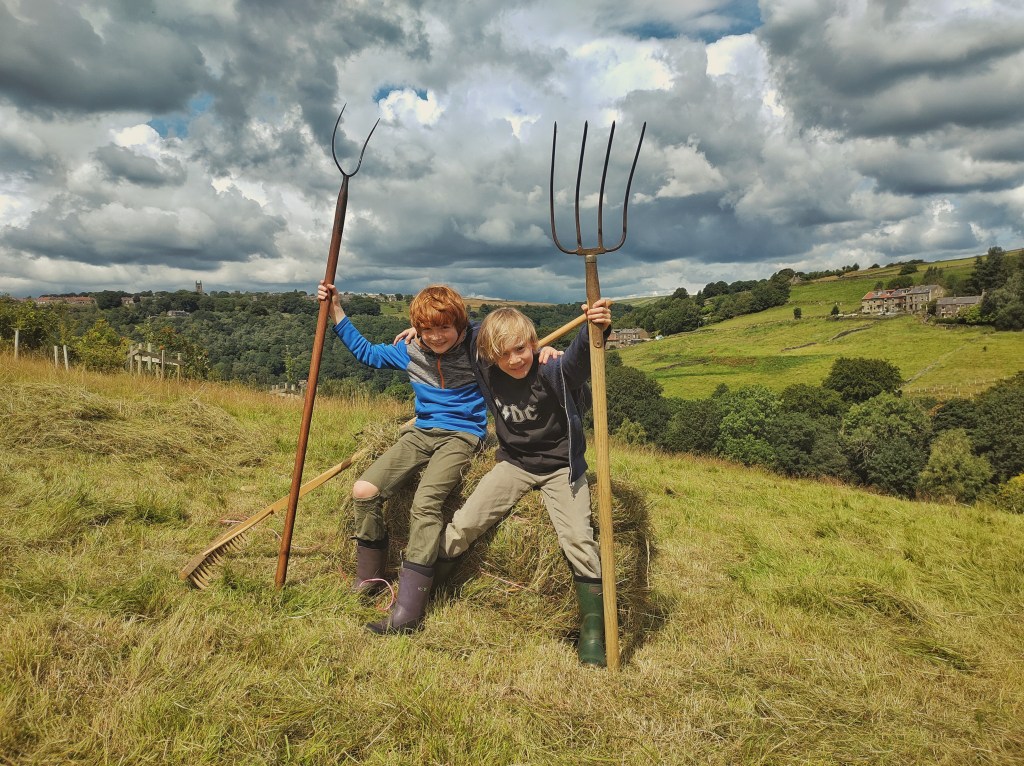
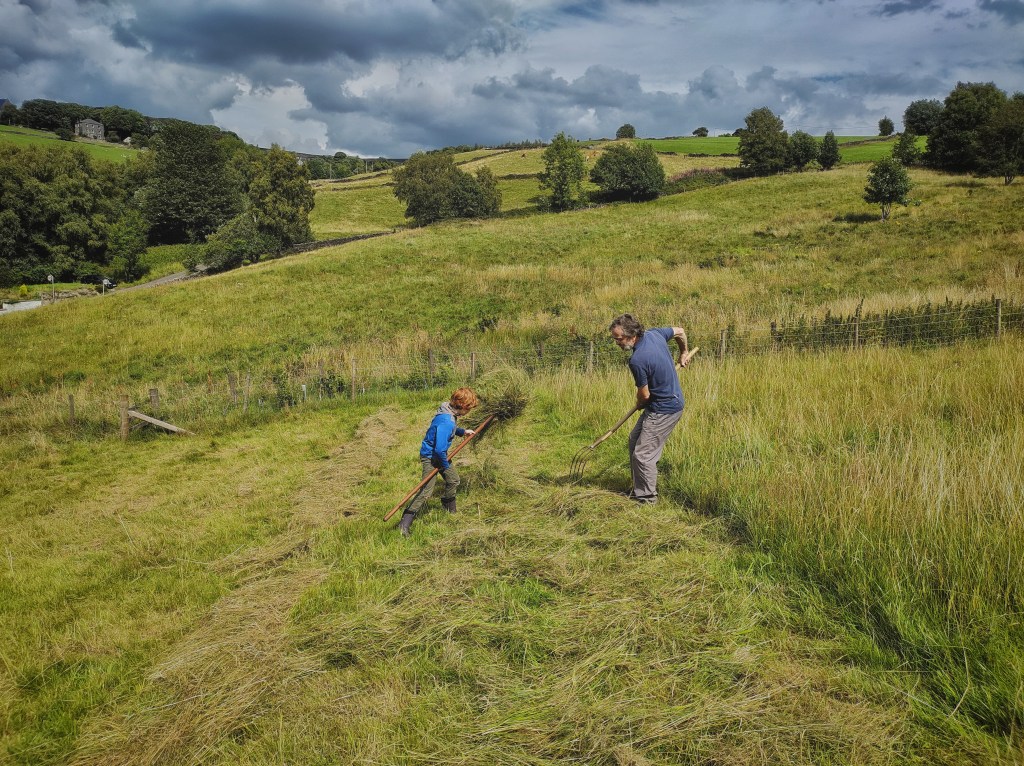
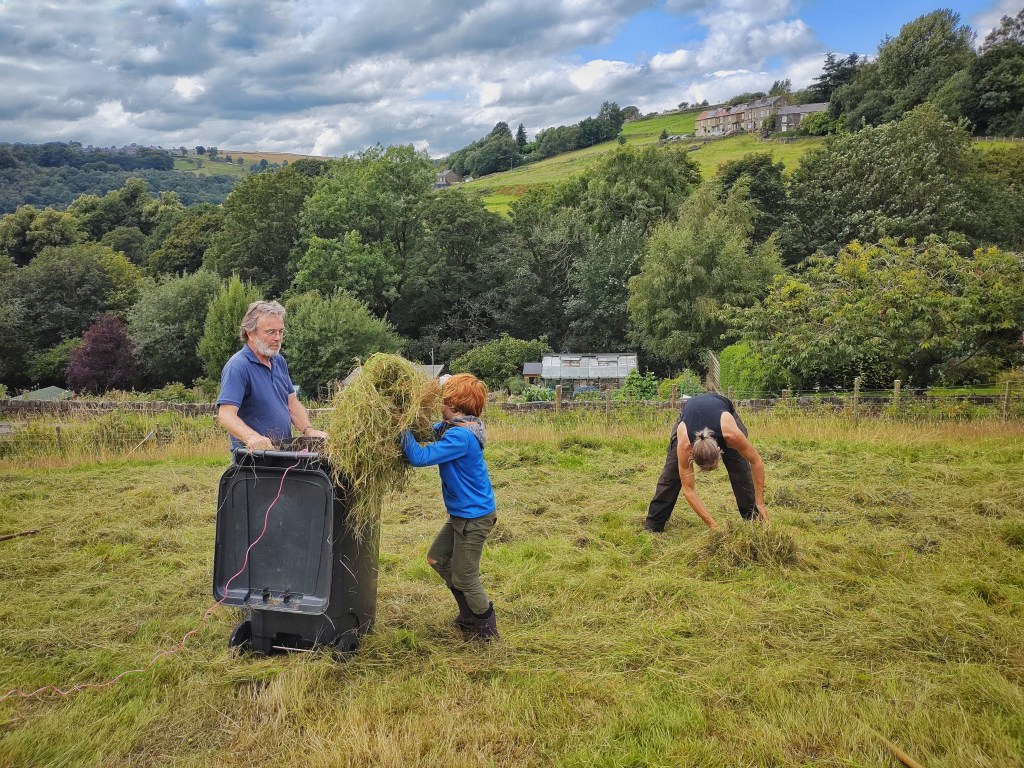
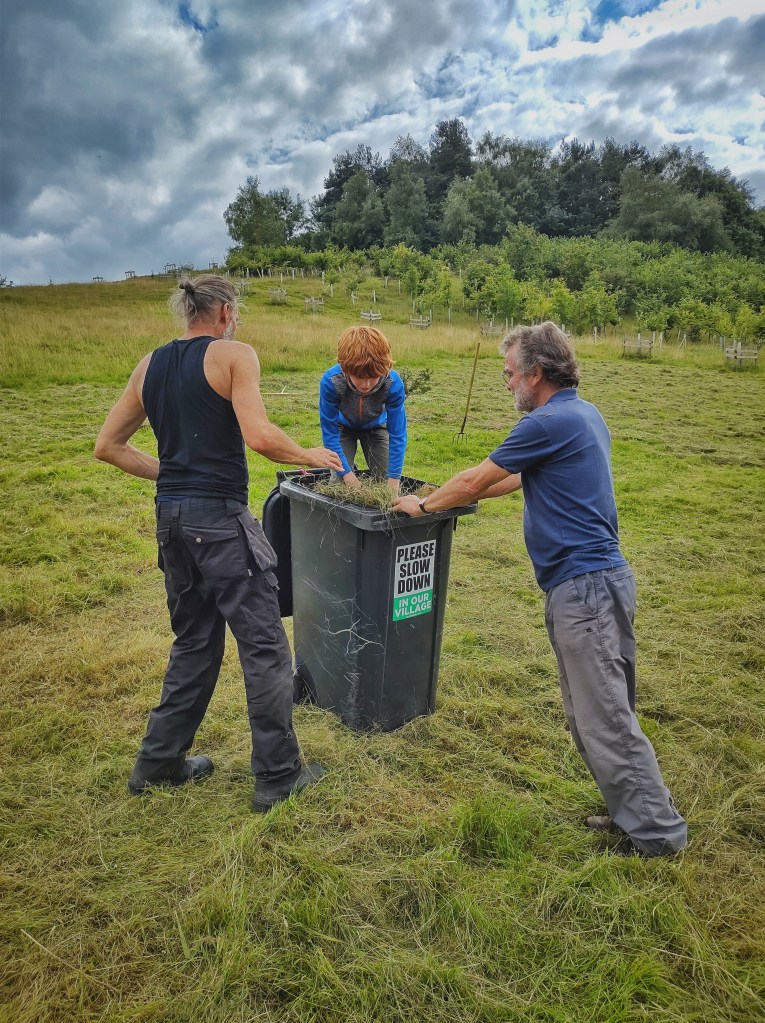
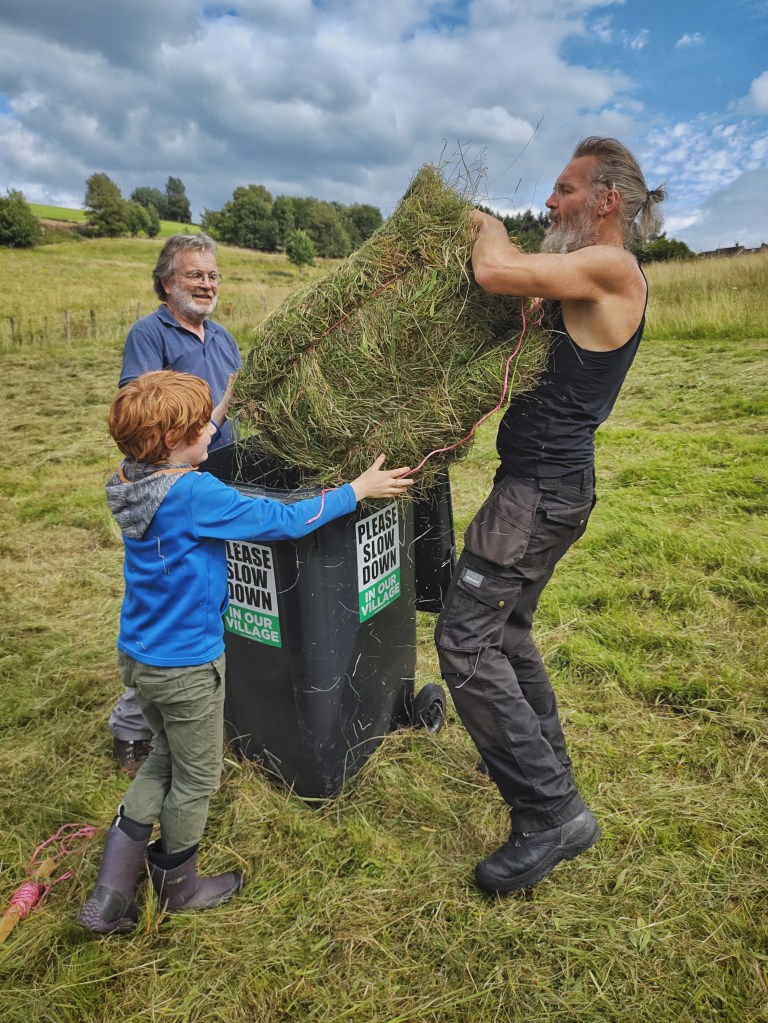
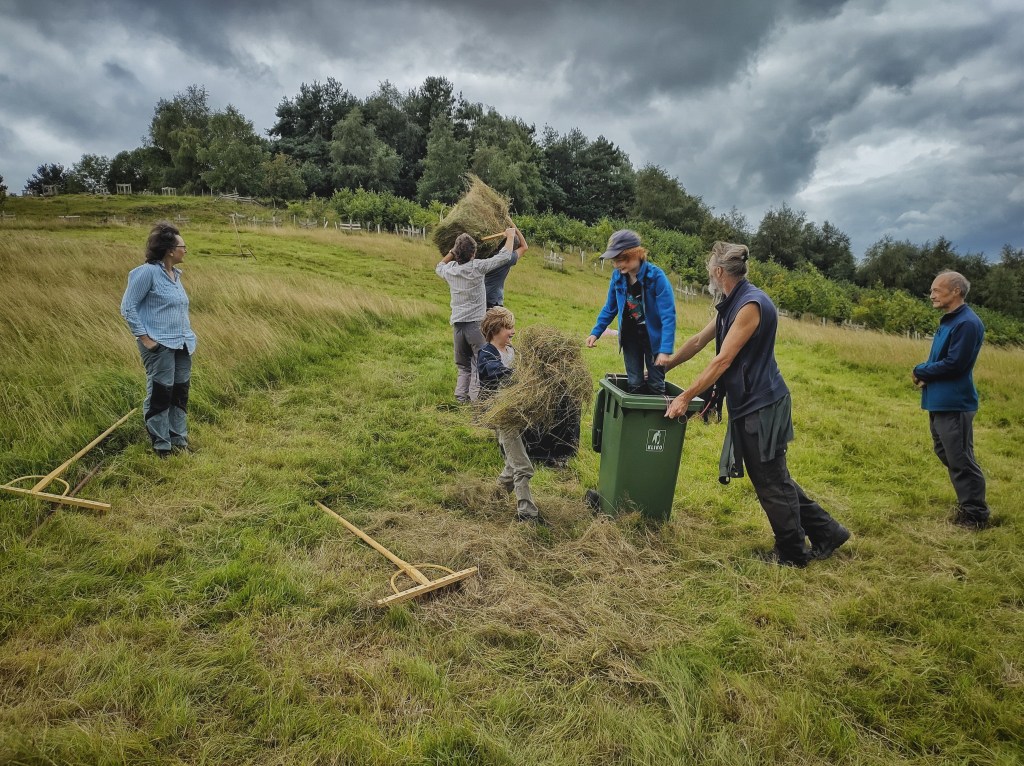
In the days that follow, best efforts are made to dry the cut grass, but the gaps in the showers are short, the air humid, and the sun and the breeze not quite strong enough. Nonetheless, with the help of a gaggle of children, bales are made for the immediate consumption of some local cattle. The grass is first tedded, that is, turned and fluffed out to dry. Tedding was once carried out with hay forks and hay rakes before they were replaced with the spinning tines of mechanical tedders behind tractors, but in this instance the unorthodox method of a vigorous grass fight serves very well. As the first shower of the day looms over Heptonstall, the helpers rake the grass into huge piles and then fork them into the project’s low-fi baler, a wheelie bin. The children then take it in turns being hauled into the bin and jumping, stamping and kneeling on the hay to tamp it down, compacting it until the bin is full. The pink baler twine that had been strung down from the bin’s hinges and up out again at the front is then tied, the bin is upturned and the bale tipped out. Not as traditional as the scythe, perhaps, but an innovative manual method for this small, steeply-sloping site.
By the end of the week, with the help of a succession of volunteers overseen by Neil’s tireless and ever-cheerful co-ordination, a substantial portion of the meadow is mown and baled, and the eight days of effort culminate in upholding the tradition of a haytime picnic to celebrate the bringing in of the harvest. Cider is poured and homemade cakes passed round, the younger haymakers, released from their labour, career down the slope with abandon, and this year’s swift fledglings wheel and scream overhead.





 Landscape Story
Whenever I see people looking over the bridge across Black Pit I point out the stone head.
LikeLike