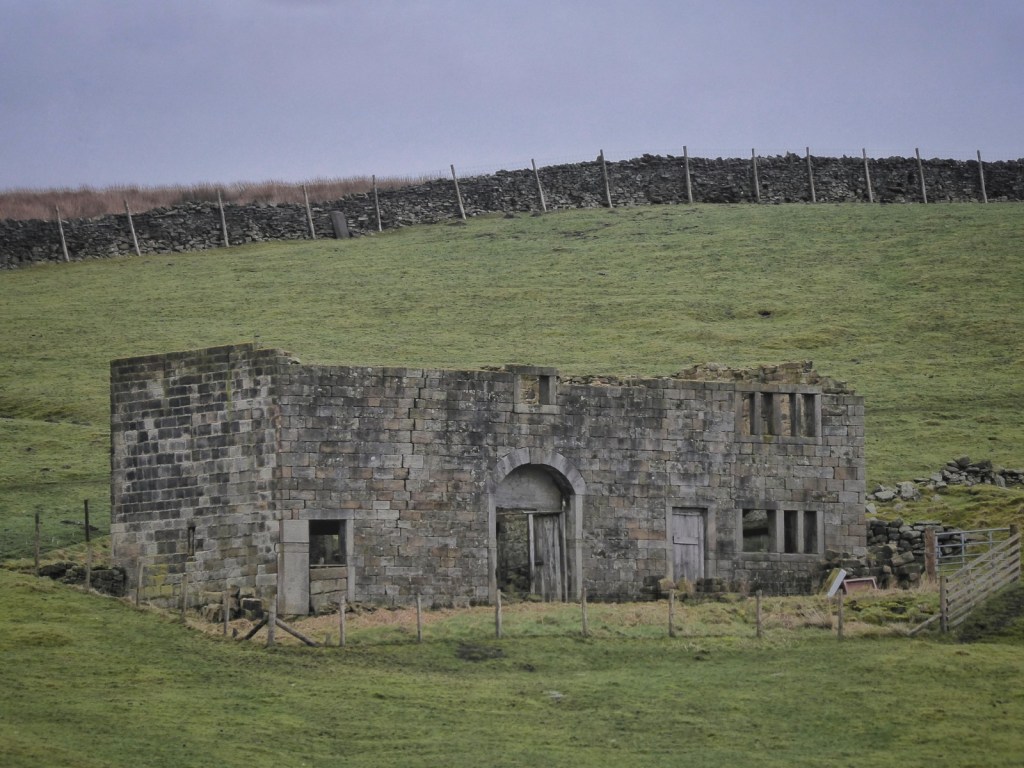
The head of Crimsworth Dean, cradled on all sides by the moor, is utterly quiet. No one is venturing out in the bone-cold morning under the grey skies. But this silence and stillness has not always prevailed. One hundred and seventy years ago, 22 farms occupied the 600 or so acres of enclosed land upstream of Lumb Falls at the head of this tributary valley. But then this community started quietening as the farms were abandoned, a casualty of the collapse of domestic handloom weaving that supplemented the meagre income from the sale of bull calves and butter. Today, only three working farms remain, with five more now dwellings only, while fourteen farms have gone – six vanished more or less entirely, eight lingering on as ruined reminders of a thriving past. It is still a beautiful place, with good people tending their ancestors’ acres, but a hush such as this has not been heard for long centuries.
It is the birds that break the silence and stir the stillness. At Roms Greave, the rasp of a lapwing echoes strangely off its gable end. Across the clough from White Hole, where sheep have been brought in to the sheds for lambing, the first curlews pipe to signal the blessing of their return, a golden plover shrills its rhythmic little song and a pair of goosanders’ wings whistle over. A kestrel hunts down by the stream and a pheasant bolts out of the barn at Lane Head.
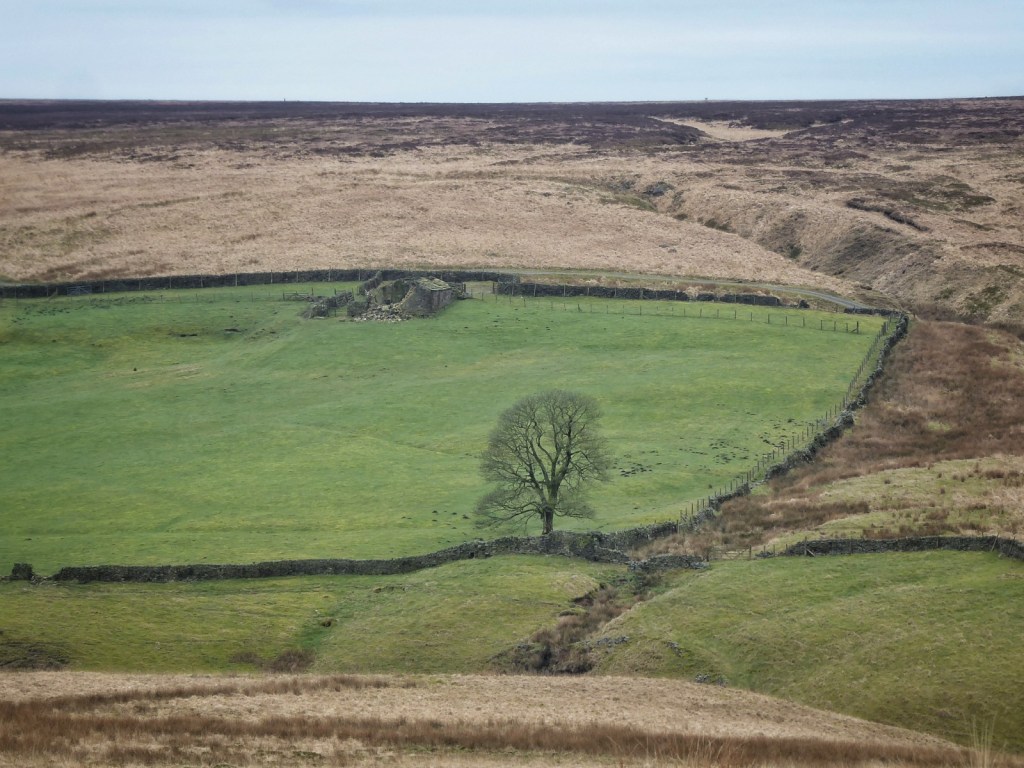
Mare Greave was among the first of the farms to go. Inhabited at the time of the 1851 census, it is marked as empty in the following four and is absent altogether from those carried out in 1901 and 1911. The Ordnance Survey maps tally with this timeline of abandonment and suggest irreversible collapse or substantial demolition between 1891 and 1893; after appearing on the first edition of the six-inch OS map (sheet 215) surveyed between 1847 and 1849, the site is marked by a field tree between a couple of remaining walls in the first edition of the 25-inch map surveyed in 1893 (CCXV.1) and has disappeared entirely by 1905.
At least four generations of Greenwoods made this their home; Thomas was living here in 1726, his son Jonas died here in 1802, his son Charles in turn handed it on to his son Jonas. Jonas Greenwood was married by Patrick Brontë to Mary Moore of Middle Withins, a mile and a half away over the brow of the moor above Haworth. Jonas and Mary farmed their 19 acres and raised seven children before leaving Mare Greave some time after 1851 to live out their days at neighbouring Thurrish. But their son William moved just downhill to White Hole, where the family continued farming for 128 years across two more generations – Jonas and William Stanley – only leaving in the 1980s. A related family farm there still.
A sycamore marks the site of Mare Greave, very plausibly the same one noted on the 1893 survey. Fingerprint patterns, distinctive of the species, are revealed in the pale patches where its outer layer of moss-covered bark has sloughed away, and the base of its trunk has spread to encompass and absorb the remaining few stones of the farm’s foundations, gripping them in its roots as momento mori. The house once had three fields above it as a buffer against the moor, though it crept down to re-claim these long ago. But the rest of its fields are still grazed and green, though its barn, unusually situated a couple of hundred yards away and somehow having survived a century and a half longer, now seems to be succumbing to the elements, with a fresh roof collapse in the last few years. A pair of hen harriers quarter the moor above it, the white rump of the female flaring over the line of grouse butts ascending Round Hill.
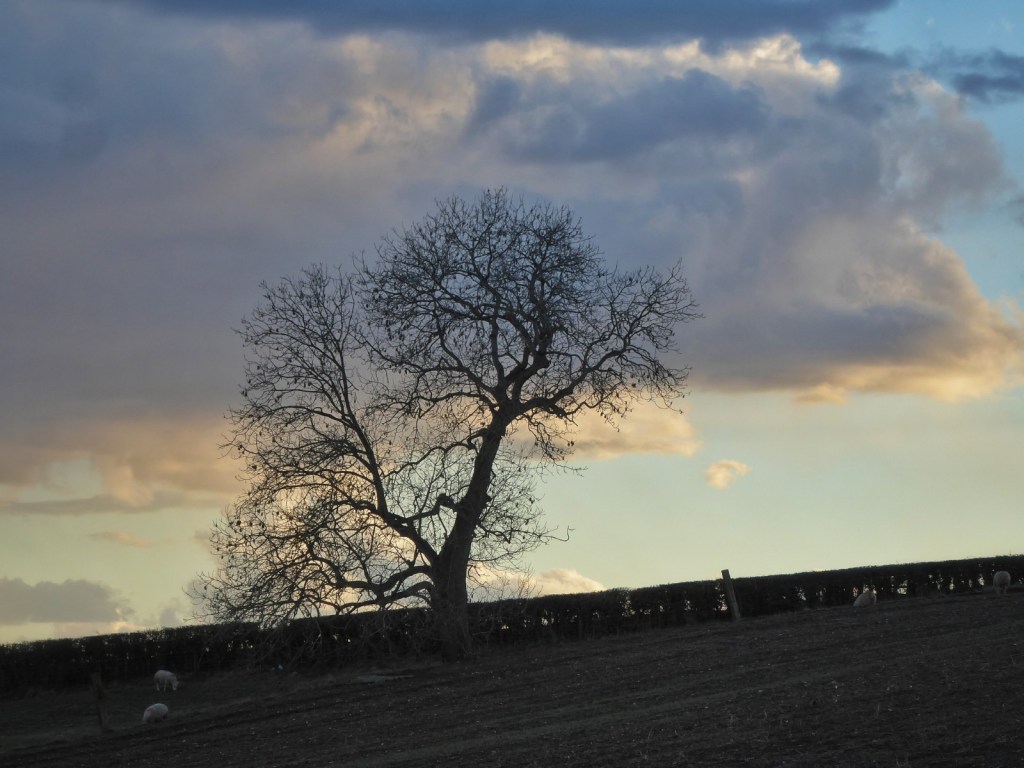
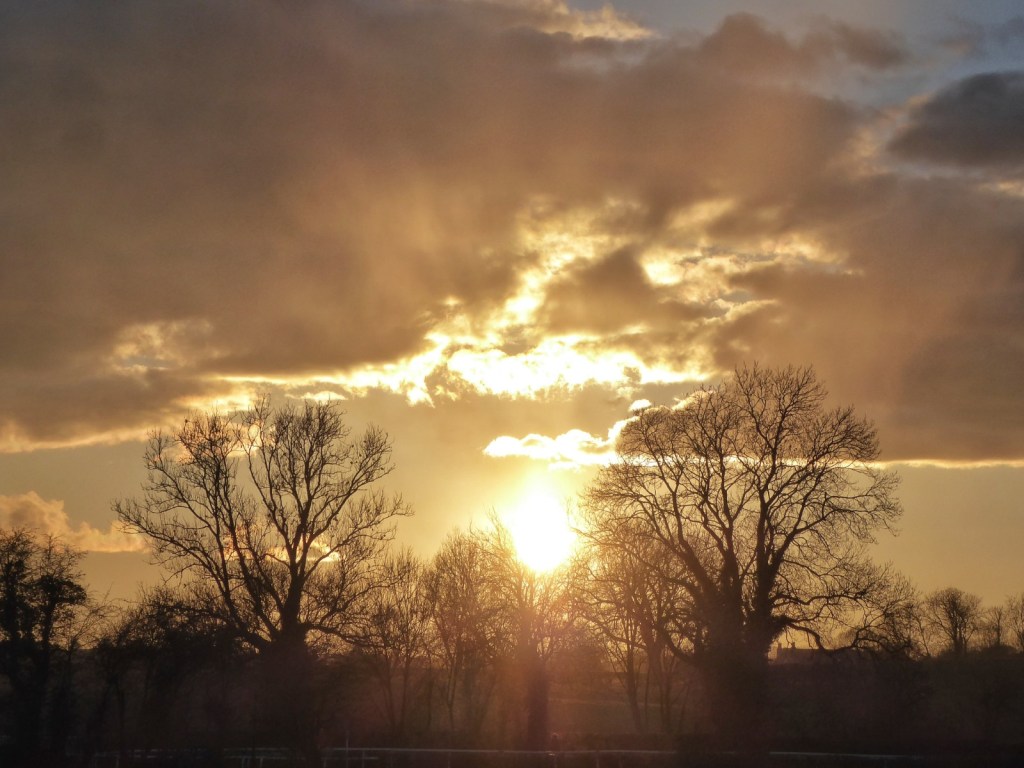
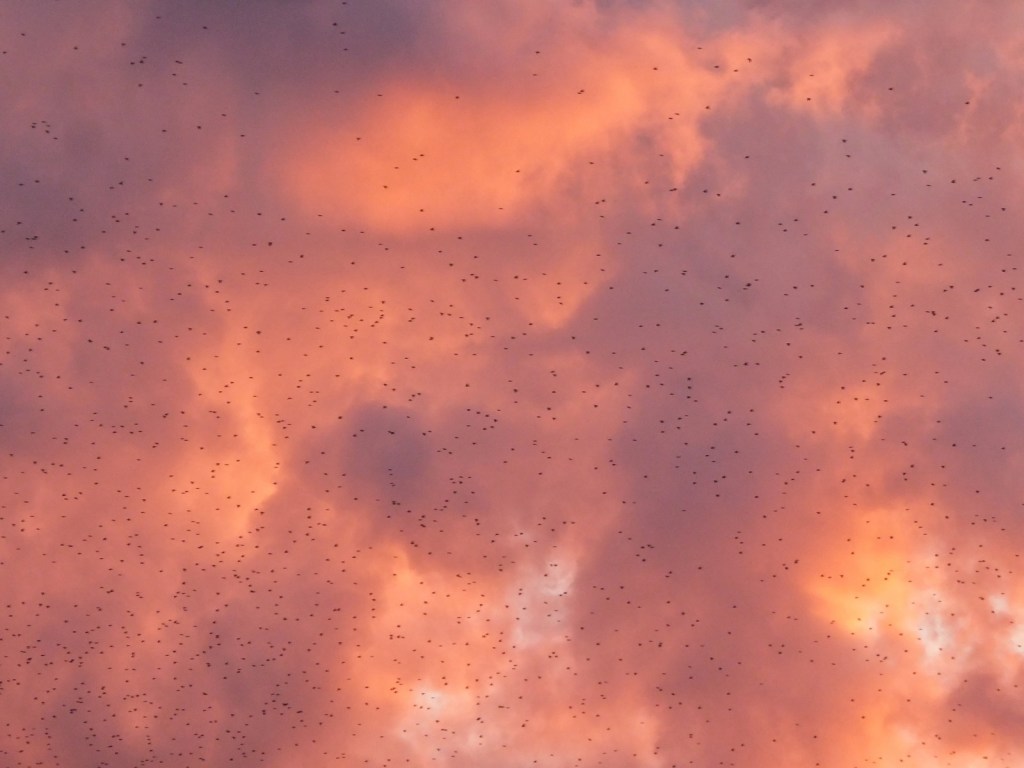
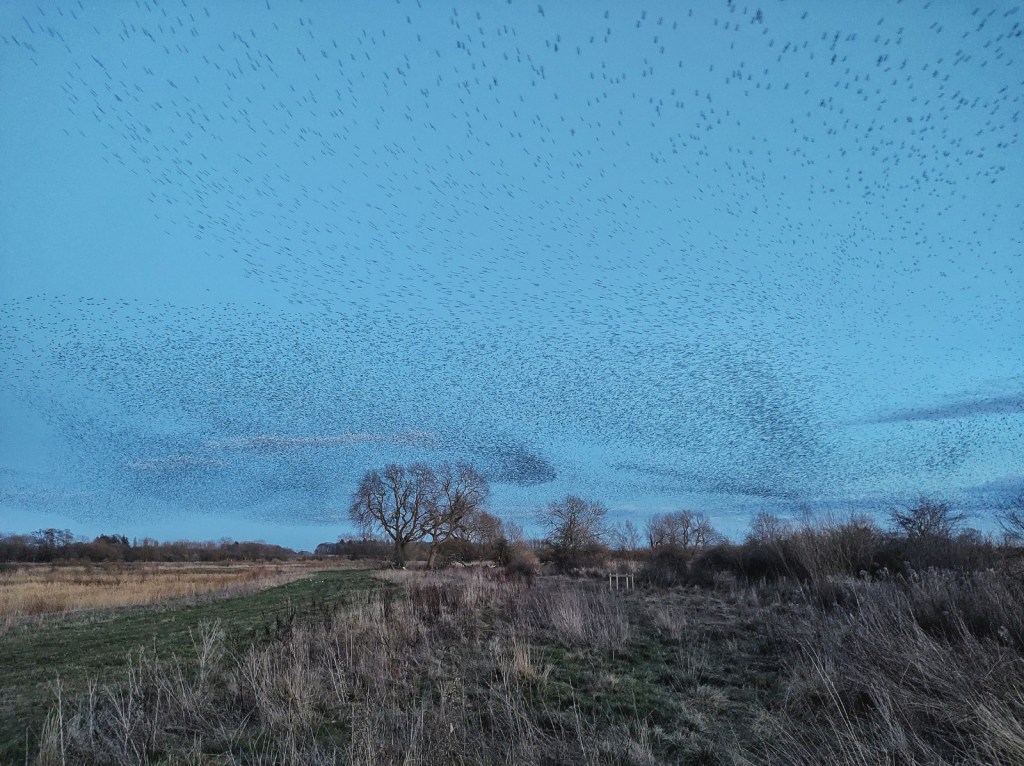
March continues making up for February’s mildness. In a frigid dusk at the Yorkshire Wildlife Trust’s Ripon City Wetlands reserve, a great gathering has been marshalling for the best part of an hour over the sharp silhouettes of the ash trees in the neighbouring farmland, swelling as flock after immense flock of starlings traverses the space between the rose sunset clouds and the newly-convivial pairing of Jupiter and Venus. A barn owl, cormorants, a soaring red kite and a Chinook helicopter’s ponderous flypast has been keeping the watchers entertained while they wait, but anticipation for the main event is quietly feverish. And when it arrives, they can do nothing but stand in rapt, reverential silence as a murmuration of a quarter of a million starlings pulses and morphs and writhes over the reeds.
For half an hour the display intensifies, now coiling and twisting away from the watchers over the open water of the lagoon, now wheeling and dancing overhead so that the rushing water sound of thousands of pairs of wings gives the sense of being submerged and engulfed. A greylag goose launches away from the water and plunges into its midst, only for it to be granted miraculous passage as a tunnel opens before it and closes immediately after. Just as the evening ritual is reaching its culminating pitch, the full moon heaves itself over the stark trees fringing the River Ure, and the murmuration seems drawn towards it, flickering across its glowing face in a last flourish before the collective decision is made to begin the descent to their nocturnal refuge.
But they do not do anything as undramatic as land, or descend, or even fall into the reeds. They are sucked. A vortex has opened at their chosen site and in a dizzying, funnelling spiral they are drawn, pulled, inhaled within. There cannot be room for more in those few square metres, yet still the whirlpool drains thousands more downwards. But now a competing site has been proposed in a neighbouring reedbed. Suddenly the supply of starlings to the first roost is starved as momentum to the new site grows. There is indecision as fence sitters turn the line of scrubby willow and hawthorn that separate the two possibilities into soot-black, spiky sculptures of trees. And then the deliberation is over and the decision is made, and the trees are revealed again with the suddenness and showmanship of a stage magician whipping a cloak away to reveal an apparated rabbit; the branches whip and sway as the weight of untold numbers of birds spring away to the newly-favoured site, and those thousands that had already found a good perch within the first now blast through the hedge in a corkscrewing, braided helix of whirling energy. It takes short minutes for the sky to empty, the reeds to blacken and the spectacle to end. The birds, until now silent but for the waterfall-surge sound of their wings, chatter in their language of static-and-whistle radio interference, and the watchers, sated with a display of nature’s abundance now all too rare, dazedly drift away into the twilight.









 Landscape Story