Malham | We have been to a number of agricultural shows – Todmorden, Halifax, Bingley, Kilnsey, Otley – since our son was born, making as they do an ideal family day out. But of them all, Malham is our firm favourite and a fixture in the calendar. It has everything you want from a traditional show: cattle parading around the main ring, lovingly-restored vintage tractors, the slow spectacle of a dry stone walling competition, solemn judges in smart tweed jackets scrutinising rows of Swaledale sheep, all soundtracked by announcements over the tannoy of the next sheep dog trial and burnished hymns from the Haworth Brass Band. My wife and son always arrive laden with arrangements of fresh-cut sweet peas and dahlias, baskets of vegetables, tins of cakes and scones, jars of jam, models and drawings to distribute on the crisp white tablecloths of the produce tent, and usually leave with a goodly number of rosettes.
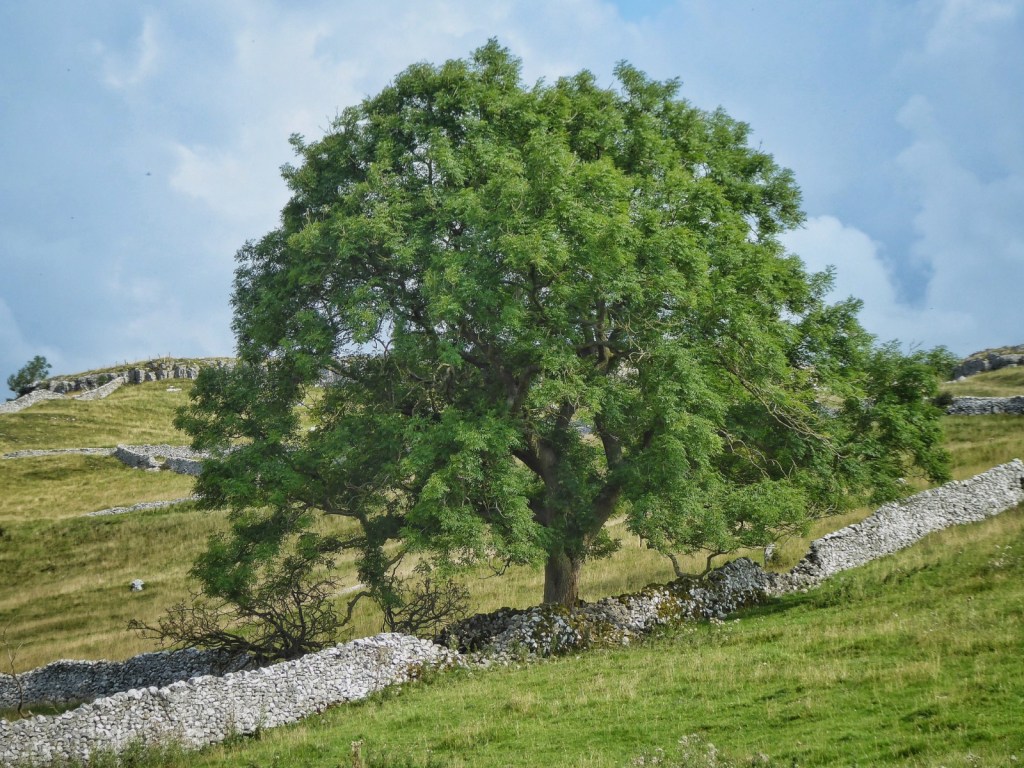
Sometimes, as this year, we stay in the village at the hostel and, the next day, walk through the spectacular limestone landscapes for which Malham is justly famous. Through pastures studded with scabious, eyebright and tormentil, under magnificent ash, some still billowing with health, others ailing with dieback, we come to the awesome amphitheatre of Malham Cove. From its base, where Malham Beck emerges, having disappeared high on Kirkby Fell over a mile away, we crane at the climbers struggling up its sheer, 230-foot face. Swirling around them are hundreds of pairs of house martins that have made it their summer home. So much for our attempt to domesticate and appropriate them with their name; here is a glorious abundance in their natural habitat, their nests not under gleaming white PVC bargeboards but overhanging ledges of limestone, many still occupied by late broods being fed by parents who must be feeling the pull of the journey ahead.
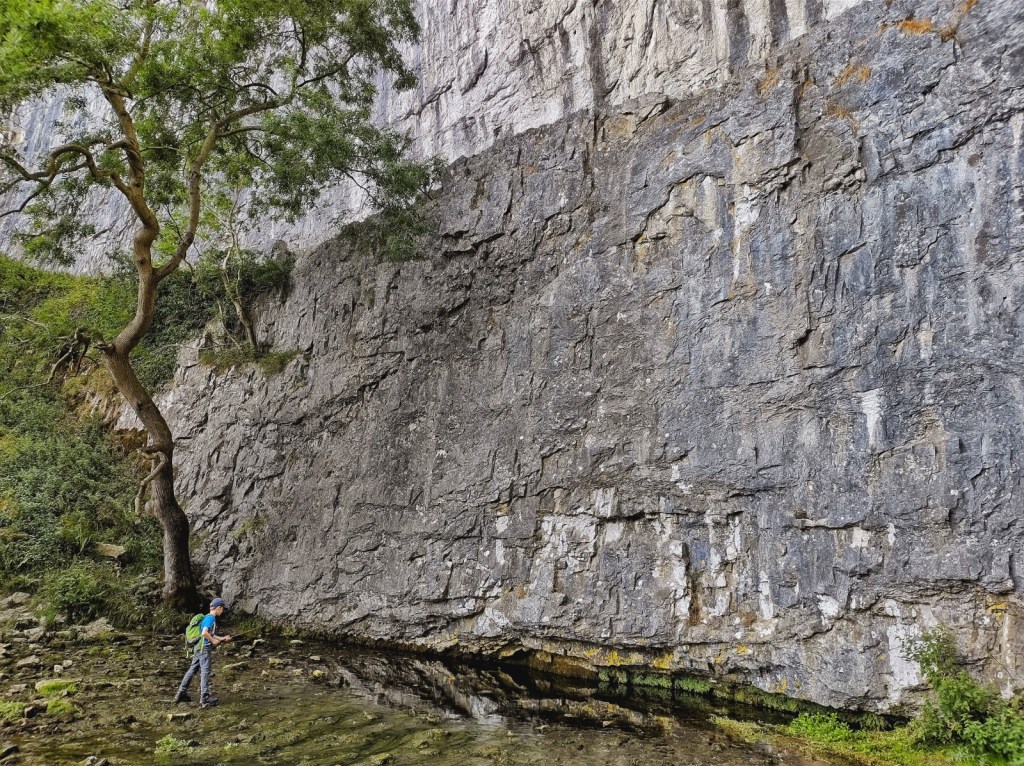


From the limestone pavement at the top we pick out the Nab Hill and Withins Height skylines of our home moors, 22 miles away, thunderclouds towering over them. In the dry valley behind the Cove we encounter three Muslim lads rolling out their prayer mats. A little later, they join us in exploring a cave and we chat to them about their prayers, how the one they have just performed was the third of five a day, and how they use a compass on their phone to orient themselves south-east towards Mecca. Later, we beckon them over to Water Sinks, where the stream that issues from Malham Tarn, one of the few lakes the leaky Yorkshire Dales’ geology tolerates, abruptly vanishes with a throaty gurgle among the stones to pass underneath the Cove and to resurface in bubbling springs south of the village and become the mighty River Aire flowing under Leeds Station.
After being detained at a fantastically remote but cunningly placed ice cream van, which has held its fertile feeding territory for over 30 years, we skirt the shores of the Tarn, its glassy surface marked by a single scratch, the mystery of its origin solved by the sudden breach of a great-crested grebe. It continues its progress half above and half below the water line, under the watching windows of the Georgian Water House. Home of a Field Studies Council centre since 1946, thousands of students have stayed and learnt about the natural world here, including many on field trips organised by my wife, but, tragically, it is now set to close.
We press on for Gordale Scar, where one does not look at the limestone scenery as at the Cove, but sinks within it, down into a ravine the proportions of which are difficult to take in, and to escape from which through its maw requires a tricky downclimb with a substantial audience.

The crowds keep coming upstream as we head down, back to the village. Mostly, they are large family groups of south Asians, some staggering with vats of curry and bags of naans for what looks set to be the picnic to end all picnics. A very rare sight even a few years ago, this is so heartening to see, and I think some credit must go to the Yorkshire Dales National Park and the recent transformation it has made in its marketing and communications, which now regularly portray a diversity of visitors enjoying the area, making sure all are made to feel welcome.
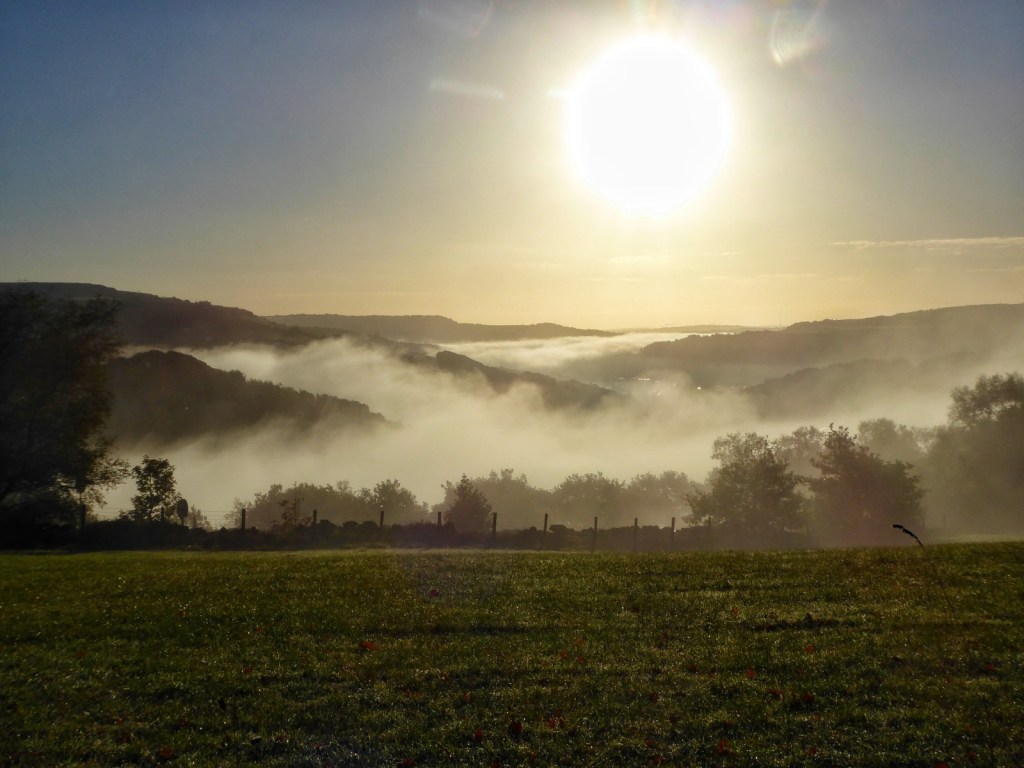
Inversion | Sometimes, when we open the curtains to a claggy mist squatting in the valley, we extend our morning school run yet further up the hill than normal in a bid to rise above it. Our route, directly up the steepest of slopes in this narrowest, steepest-sided part of the valley is punishing, but it soon answers the question as to whether our gamble is going to pay off. As we stride up the contours, the transformation on this particular October morning is breathtakingly swift, from a chilled, monotone murk to a clement, luminous clarity. The feathered spent seedheads of the common bent grass are radiant with droplets the mist has hung upon them as it sunk into the valley. We wonder at the scene, his school and our town somewhere under this slowly-scudding swaddle of fleece, back into which we must now dive if we’re not going to be late.




Acorns | We join Slow the Flow, not to build leaky woody dams as we have in the past, but to help gather acorns, which will be passed to White Rose Forest, the community forest for North and West Yorkshire, grown on and returned to the Calder Valley for local groups to plant. Together with The Mersey Forest, Greater Manchester’s City of Trees and Humber Forest, the aim is to plant 50 million trees to create The Northern Forest from coast to coast.
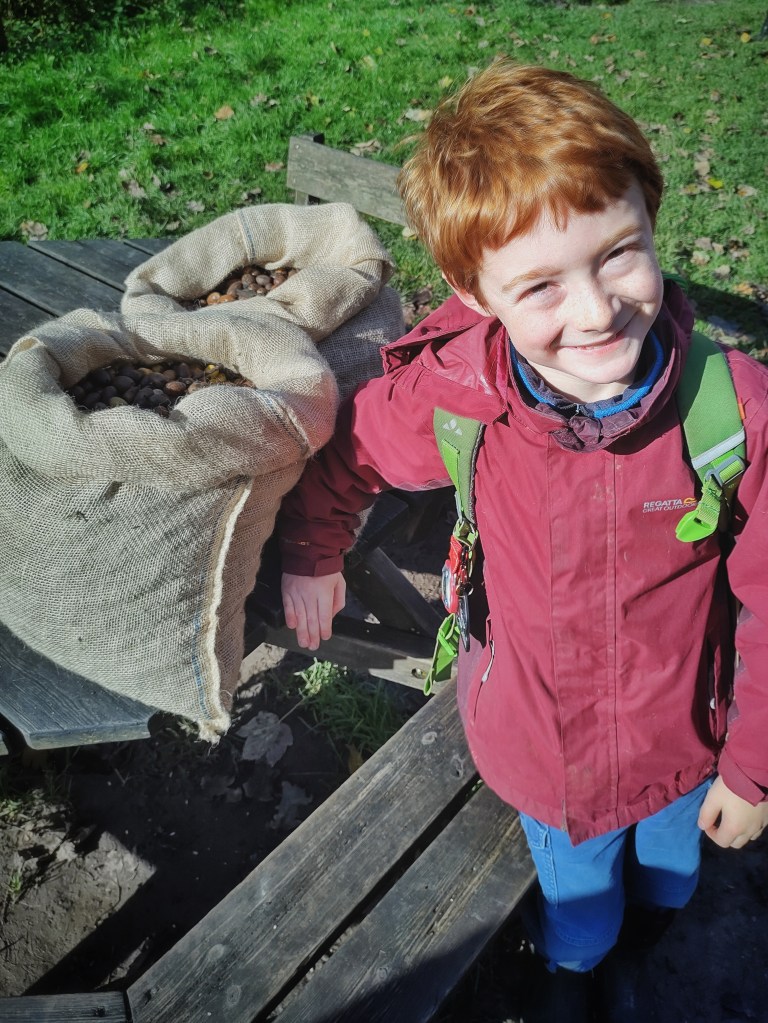
It’s exciting, visionary stuff, and we fan out into Hardcastle Crags in little groups. My son, wife and I take the high path along the top edge of the woods, but the pickings are surprisingly slim, especially given, in this mast year, we could have filled the three bags we have been given from our lawn in 10 minutes flat. But we persevere and, eventually, beside the track above Gibson Mill we hit the motherlode. Meeting with the others at the mill we pool our plunder into two respectfully burgeoning sacks, before walking back to our bikes at the car park, stopping to admire a bustling nest of northern hairy wood ants along the way.
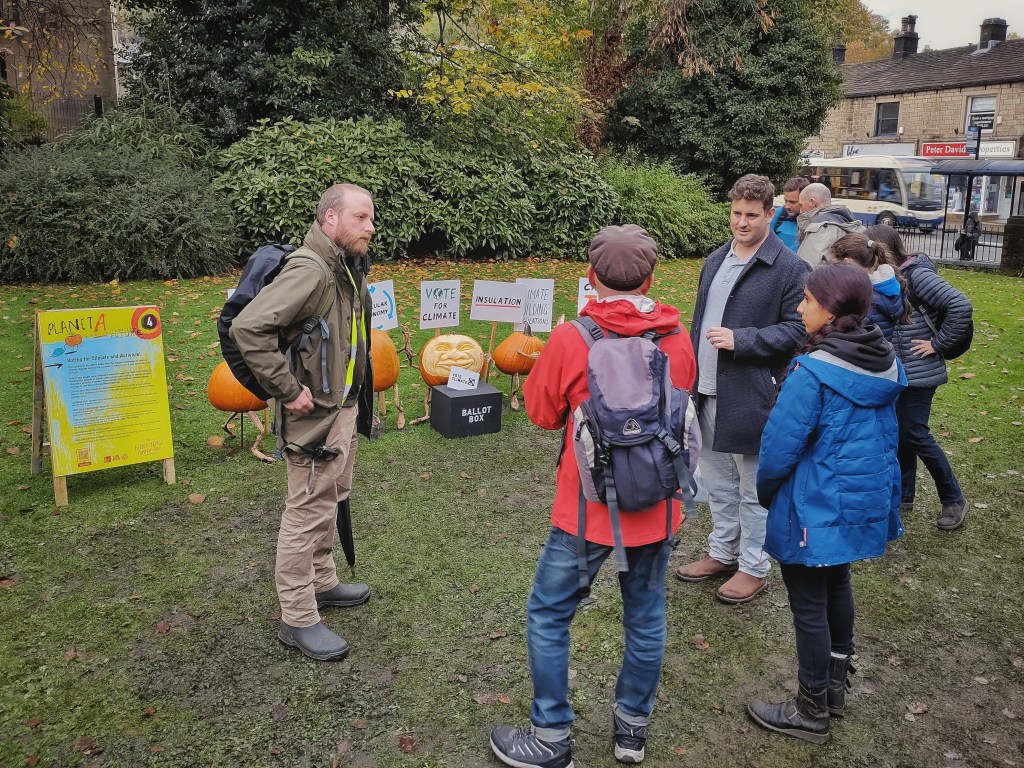
Climate Conversations | For a weekend every year the most extraordinary carved pumpkins appear around Hebden Bridge – in the park, on the steps of the cinema, beside the canal, in the town square. Commissioned by the Town Council, the Pumpkin Festival and its marvellous creations are the work of Sand In Your Eye, a local arts organisation. This year, the festival was themed around the action we need to take to maintain a habitable climate. I was engaged by the Town Council this year to facilitate deeper conversations with visitors, of which there were thousands streaming in off the trains, about the issues raised by the exhibits, which depicted the technologies we must immediately deploy at scale and the means by which we can ensure that action is taken in time. To that end, I was stationed by the carving of a queue of diminutive, determined, orange citizens voting for climate action at the ballot box. Among hundreds of conversations across the two days I cannot recount all the many different angles we came at the subject from, but recurring themes were the tension between maintaining hope alongside realism concerning the predicament we are in and our chances of extricating ourselves from it in time, and of the need to find some way of processing grief for what is already lost and for a dreamed-of future that may not come to pass. But despite the heavy subject matter, there was always a lightness and a touch of humour (admittedly sometimes gallows humour) that I can think was due in no small part to the presence of the pumpkins. From these conversations and also overhearing visitors talking – especially when explaining things to their children – I have only had my conviction that the public are not the barrier to urgent and radical climate action strengthened.
Recommendations |
‘Moss Garden’ by David Bowie and Brian Eno, from Bowie’s 1977 album Heroes, always evokes for me a vision of being above the clouds.
‘The Oak Tree Planters’, a 2004 episode of BBC Radio 4’s Living World on jays.
Millstone Grit by Glyn Hughes poetically captures the essence of this patch of the Pennines in the mid-70s, and has recently been re-issued by Little Toller with an introduction by Benjamin Myers.
 Landscape Story