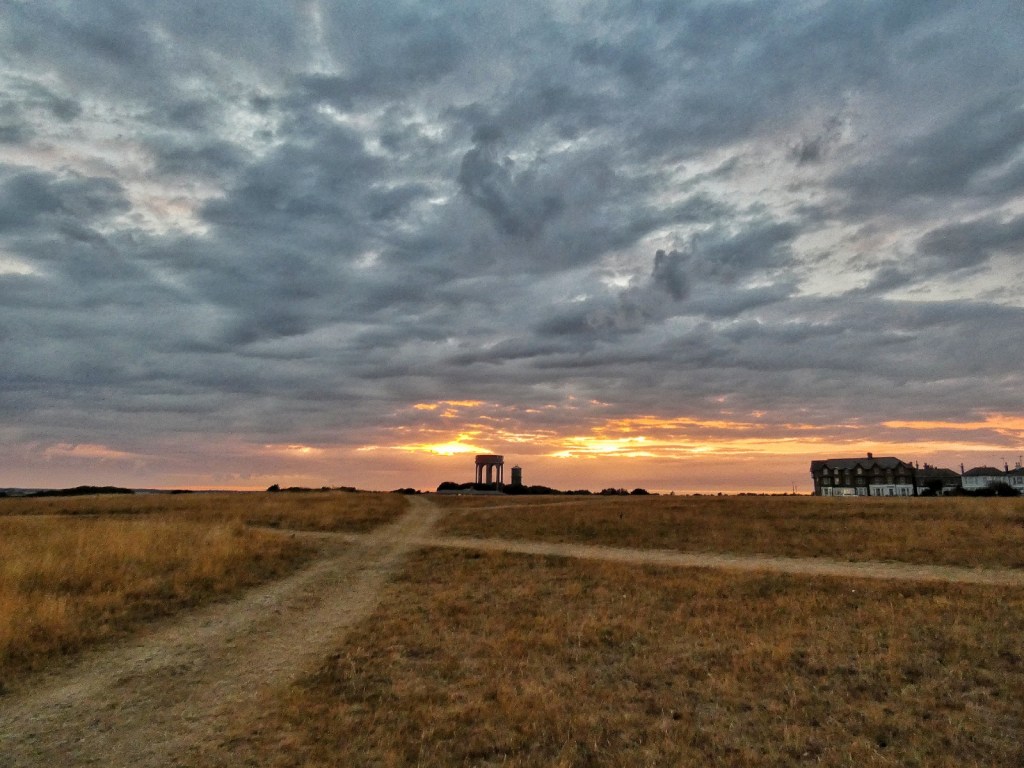
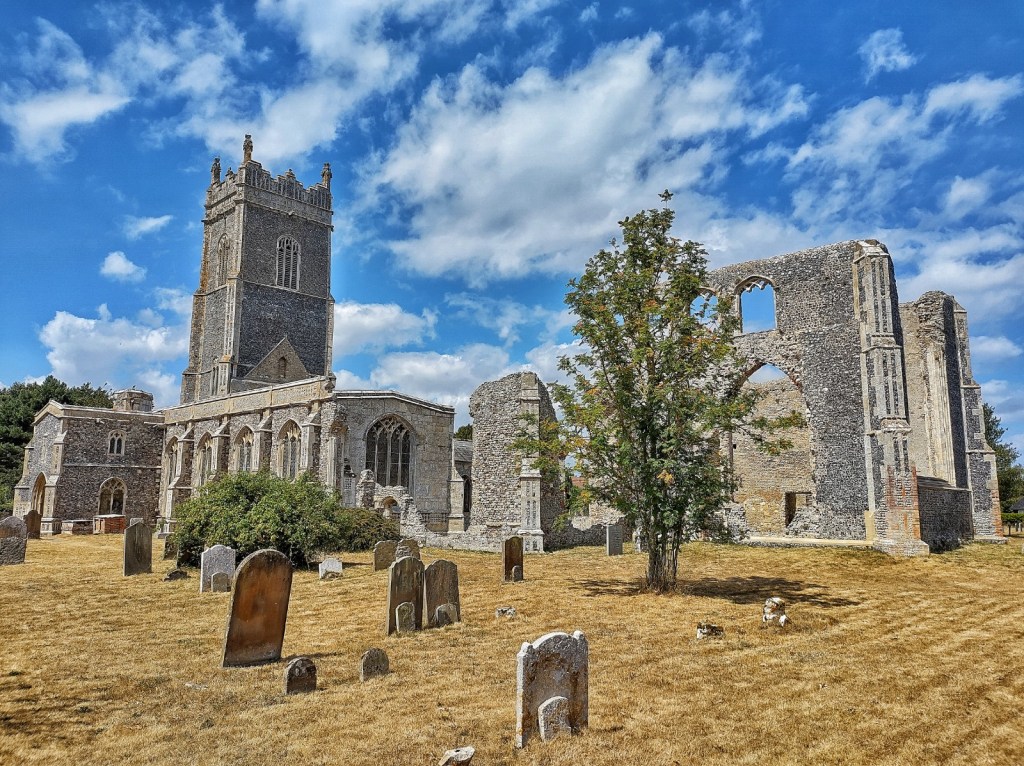
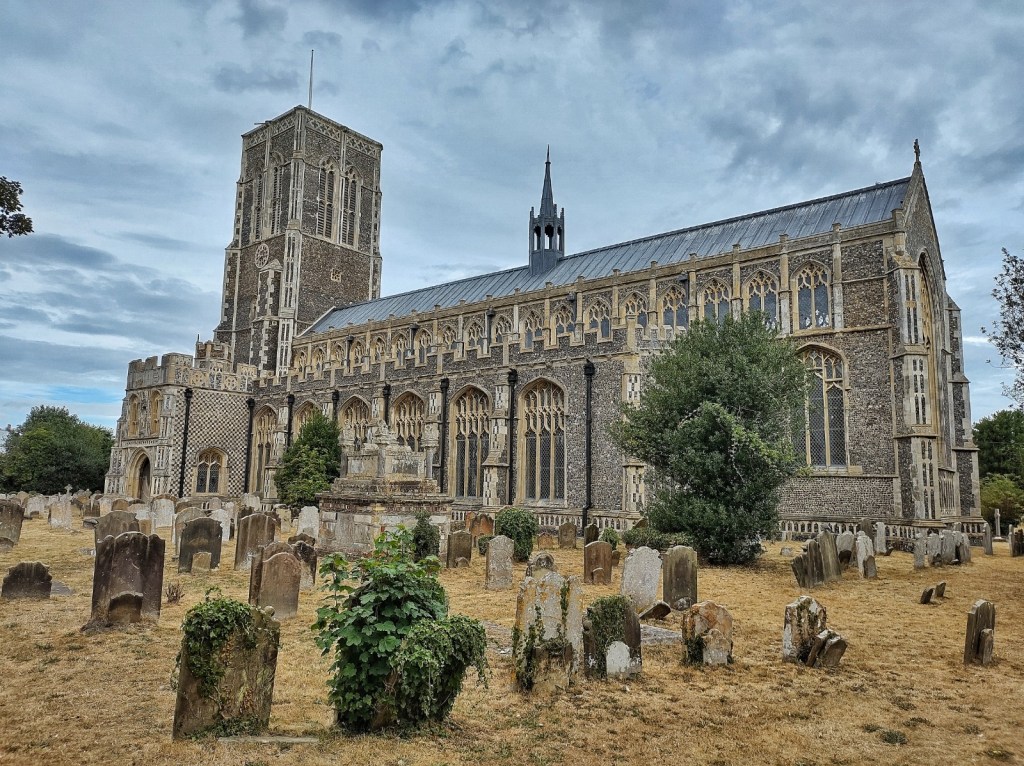
Suffolk | The sixth of our annual weeks in the wholly different landscape of the East Anglian coast. The grass of Southwold’s spacious commons are brown, but in as stark a symbol of the need for us to re-think our relationship with ‘weeds’ as I can think of, are flecked with the resilient green of deep-rooted yarrow, sorrel and ragwort. Otherwise, it’s easy to take a holiday from despair at the extremity of this summer, much of our time being spent digging on the perfect beach and splashing in the sea, with the afternoon’s sea breezes to mask the ongoing heat. Hollyhocks tower in every garden, self-seeded like our foxgloves at home, springing from any crack or cleft where they may. The swifts are here to hail us, but their exuberant screams on the first evening turn out to be not a greeting but a farewell, and the skies are silent by the time we leave. Apart, that is, from a curiously repetitive call heard on the last day, which we trace to a small speaker mounted above a terrace of swift nest boxes on the Adnam’s brewery – a technique to attract them to these new nesting opportunities when they arrive, but one which can now be turned off, if the absence of their joyous sounds can be borne. The RSPB’s Minsmere reserve is the wonder it was last year, with egrets and marsh harriers sailing over the swaying reeds, pantaloon bees and bee-wolves tunnelling in the sandy soil, and the tantalising but unfulfilled promise of adders in the dunes and bitterns in the mire. As every year, Dani Church – the fifth generation of her family to ply the River Blyth – rows us over to Walberswick for a visit to its strangely shrunken church, one of a trio of fine flint churches we see during the week, and a crossing of its baking heath hinterlands, gorse seed pods popping in the heat and rowan berries already scarlet and shining. The pier and its quirky arcade is thronged, but there is a haven of hush in the Sailor’s Reading Room, a refuge since 1864 for fishermen when not at sea, open now for all to come and read the papers spread on the ancient tables, today beaming with England’s superlative win last night in the Women’s Euro final. Somehow, the sounds of the crowds passing on the front just outside its always-open doors, the merry squeals from the beach and the ever-present rush and suck of the waves only deepens the peace within its hallowed walls, its changeless years measured by the tick and chime of the clock above the fireplace while the fissured faces of long-gone mariners stare benignly out from fading photographs.
Wildings | The temperature has risen again. For the following four days, a Met Office amber warning of extreme heat will sprawl across the southern half of England and wedge us between two stag beetle mandibles, curling up either side of the marginally cooler Pennines. I drop our son off at the best place for him in these conditions: to spend the day in the shady woods at a Forest School with his friends. At the nearby bowling club, improbably carved out of this steep, boulder-strewn, wooded hillside a century ago, our friend Bob – one of the most knowledgeable wildlife enthusiasts I know – is out early mowing the dewy grass. Having managed a start with two circuits of the headlands before I wave him to a stop, to the backdrop of the excited hoots and howls of the marshalling little tree folk we stand and natter about newts and pine martens, mining bees and marsh harriers, wildcats and tawny owls. After the arboreal mayhem has moved off to its camp for the day, I leave Bob to his task, with ears peeled in response to his tip off that before we arrived and drowned it out he had been hearing a raptor-like call coming from somewhere above his immaculate green. Sure enough, the peace left in the wake of wildings reveals it just a few steps along the path home. As plaintive as a golden plover, but with an edge; whingeing like a juvenile buzzard, but not quite as pathetic; rhythmic like the nuthatch’s car alarm call, but with a downwards not upwards intonation. Aware that Bob’s got a job to do but also that he’d appreciate a second opinion on what he’s been hearing, I return as he’s in the very centre of the green on a long diagonal pass. I let the mower putter to halt before hollering ‘sparrowhawk, juvenile!’ across to him. He gives a thumbs up and a thanks, and I leave him so he can be finished before today’s match.

Balsam | Himalayan balsam is a significant problem in our valley. It forms dense stands that can spread quickly and outcompete other, native plants, such that when it dies back in the autumn only bare ground is left, prone to soil erosion and with none of the ‘hydraulic roughness’ created by vegetation that slows the flow of water into the river channels, mitigating flooding. Local groups such as Forus Tree organise ‘balsam bashing’ days, but a surprising amount of work is done by individuals. Clearing an invasive, non-native species that is swamping native flora seems to be something people like to get their teeth into. I took my son and a friend of his to do a session on our nearest patch – which has tripled in size to sweep across a bluebell wood in the last few years – earlier in the summer, but we could only make the most meagre dent in it. But on our school run through the woods we have several times encountered a man who, having read about the ecological benefits of removing balsam, made his way out here from town and put in a number of shifts, reducing the size of this patch. Over the early weeks of summer he made a deal of difference, but it still looked like it would take several years of determined effort to eliminate it. But on the first day we passed along this way after returning from Suffolk, we have found that he must have redoubled his efforts, for apart from one small tricky patch shielded by a massive fallen willow, the entire hillside is clear. The seedbed will ensure it comes back for a few years yet, but it’s an excellent start. I hope to see him again to thank him.
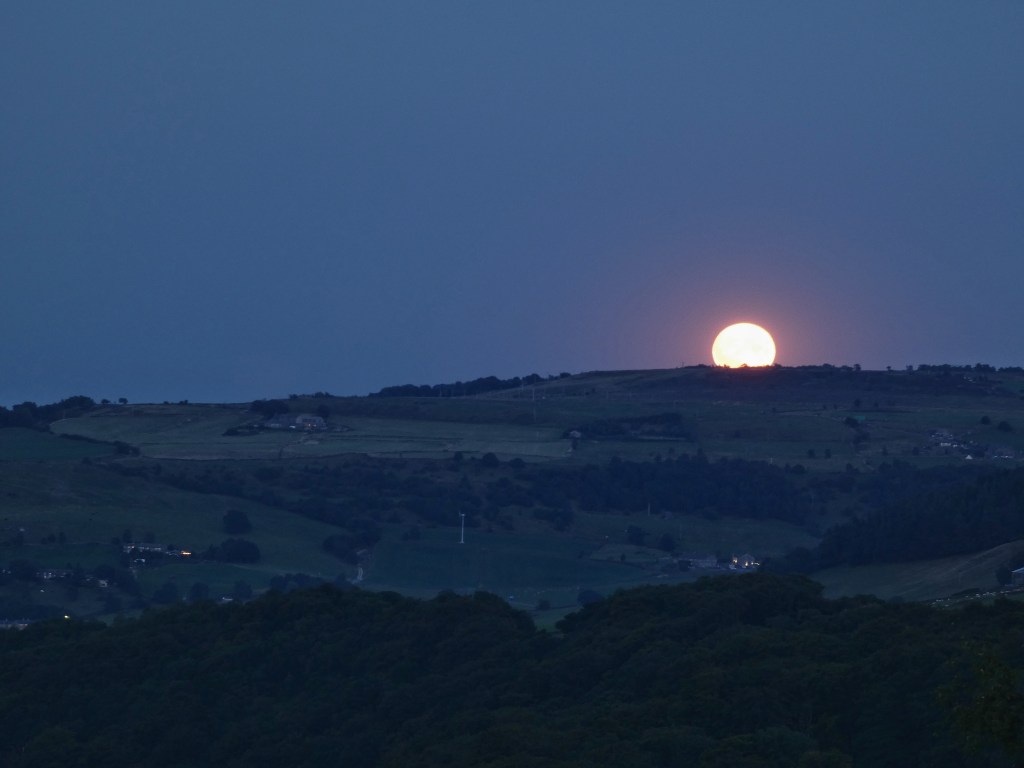
Moons | Despite the fading light there are still a good 25 of the 30 degrees the day accumulated to contend with, so I leave half an hour for a slow, measured climb up the hill before the Moon is due to rise at 9.13pm. At the gate, I settle to wait and drink in the stillness. I note that the Moor and Home fields across at Edge End have been mown and the headlands already baled, with the rest waiting for rowing up tomorrow. I’m enjoying the anticipation of the 99.7% full Moon making its appearance. Belatedly, it occurs to me I can work out more or less exactly where it will heave itself over the horizon, and take my compass out. Bother: at 127 degrees it will rise right over the mast above Hebden Bridge. Not an ideal view. I know where I’ve got to move to now, and fast. So much for the gentle pace. I hurtle up the lane, through the hamlet of Lower Rawtonstall and up to Badger Lane, scratching and stinging my legs on thistles and nettles that crowd the path I can barely make out in the gloom. But I’m just in time: a peach glow heralds its imminent cresting over the far side of Cragg Vale. Suddenly there is a glint among the fine furze of trees and here it comes. Unlike when it rises over our much nearer horizon from home, it takes its majestic time breaching this far one. A bat flickers past, its leathery flapping audible in the evening’s held breath. But I barely register it: the Moon is magnetic, holding all my attention…until…until I turn my head away from it at a pale flare to my left, and am confronted by the face of another moon. A barn owl is silently beating across the rough field across the other side of the lane. As it crosses the wall, it turns and bears down on me, the dark craters of its eyes seemingly unseeing, so squarely is it facing me, so undoubtedly will its course bring our faces into collision. But I do not turn away; ducking does not occur to me. I am not sure if this is due to confidence that it will register me in time or a refusal to be the one to blink from this encounter and miss a millisecond of it. Thankfully, it is the one that blinks, and banks, and traverses across the Moon six feet from my own face. I follow it all the way down along New Lane’s hedge of mixed conifers. My camera was in the middle of a four-second exposure as it passed, but if it did cross the zoomed-in lens, it left no trace of its passing.
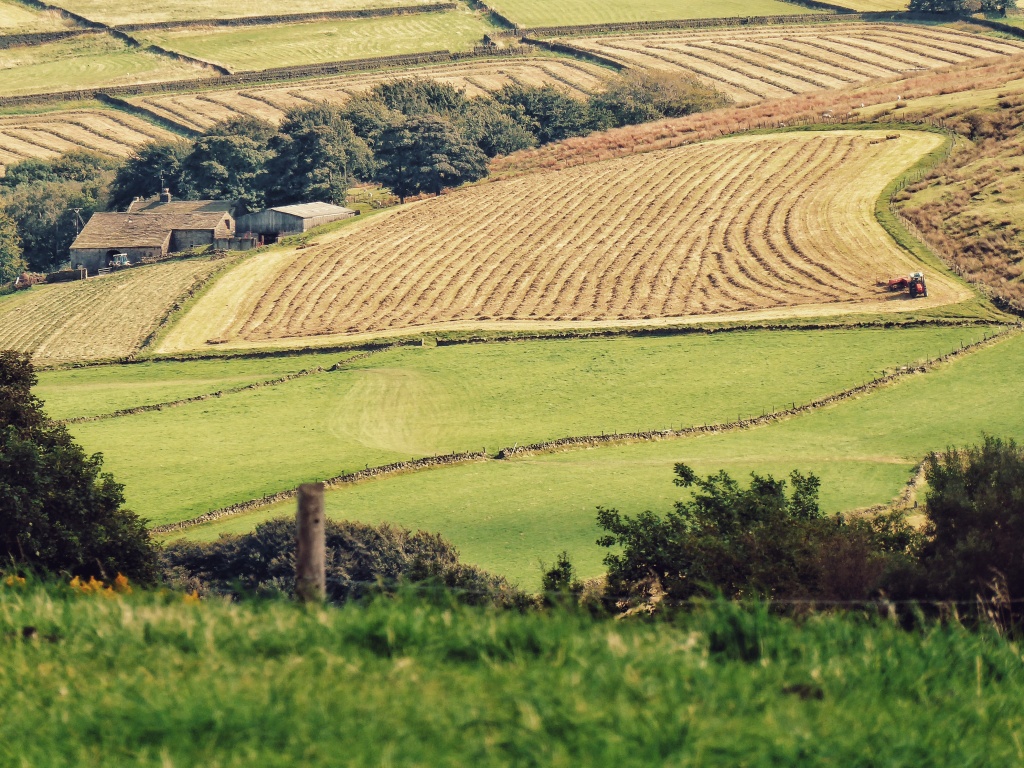
Hay Time | By midday the following day the Moor Field is being combed into windrows by the spinning haybob. This is a moment I try and see every year from the opposite side of the valley, for the rows of drying grass follow the graceful curve of the field’s boundary ditch so elegantly, with the ditch itself – possibly dating from the time that the vaccary of Cruttonstall was set within the Erringden Deer Park seven centuries ago – picking out the form of the moor’s shoulder: a harmonious conversation between today’s farmers, their predecessors and the landscape. Given the fine forecast, I guess that it will be the small hay baler rather than the large silage baler that will be coming out later today or tomorrow, but I will sadly miss the spectacle and its familiar accompanying hum, for all of the coming weekend I will be on a sycthing course in another ancient hay meadow on the other side of town.

Gallery |



Recommendations |
‘Moonlight’, the third of Benjamin Britten’s Four Sea Interludes from his opera Peter Grimes. Listen here.
The work of Harry Becker (1865–1928), who painted and drew Suffolk agricultural landscapes and labour. You can get a flavour of his work here. He illustrated Adrian Bell’s Suffolk trilogy of novels, for sale on my Rural Reads Bookshop page.
The Dig (2021), starring Carey Mulligan and Ralph Feinnes, which dramatises the 1939 dig of Sutton Hoo.
To receive dispatches of Field Studies from the heart of the Pennines, sign up by email (below for mobile, top right for desktop).
 Landscape Story